

ELECTROPHILIC ADDITION TO UNSATURATED CARBON
289
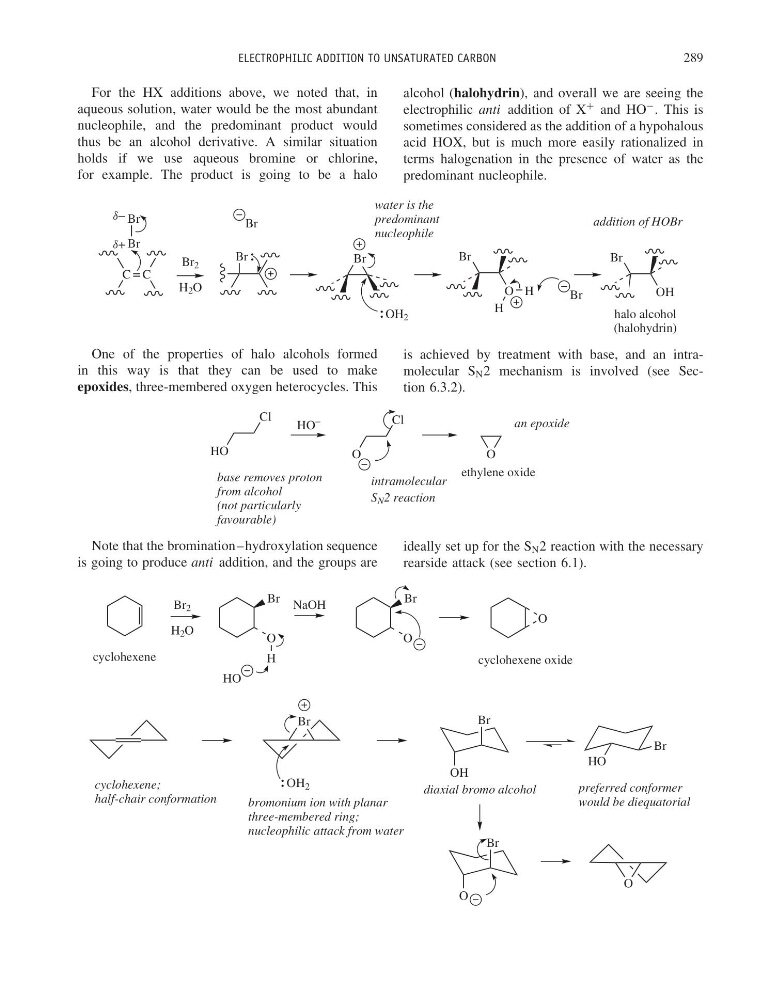
For the HX additions above, we noted that, in
aqueous solution, water would be the most abundant
nucleophile, and the predominant product would
thus be an alcohol derivative. A similar situation
holds if we use aqueous bromine or chlorine,
for example. The product is going to be a halo
alcohol (halohydrin), and overall we are seeing the
electrophilic anti addition of X
+ and HO
− . This is
sometimes considered as the addition of a hypohalous
acid HOX, but is much more easily rationalized in
terms halogenation in the presence of water as the
predominant nucleophile.
C C
Br
Br
O
Br
Br
Br
d+
d−
Br
OH 2
H
H
Br
Br
OH
water is the
predominant
nucleophile
Br 2
H 2 O
halo alcohol
(halohydrin)
addition of HOBr
One of the properties of halo alcohols formed
in this way is that they can be used to make
epoxides, three-membered oxygen heterocycles. This
is achieved by treatment with base, and an intramolecular S N 2 mechanism is involved (see Section 6.3.2).
Cl
HO
HO
−
Cl
O
O
ethylene oxide
base removes proton
from alcohol
(not particularly
favourable)
intramolecular
S N 2 reaction
an epoxide
Note that the bromination–hydroxylation sequence
is going to produce anti addition, and the groups are
ideally set up for the S N 2 reaction with the necessary
rearside attack (see section 6.1).
Br 2
H 2 O
O
Br
H
HO
O
Br
NaOH
O
cyclohexene oxide
cyclohexene
Br
HO
Br
OH 2
OH
Br
cyclohexene;
half-chair conformation
bromonium ion with planar
three-membered ring;
nucleophilic attack from water
diaxial bromo alcohol
preferred conformer
would be diequatorial
O
Br
O
289
For the HX additions above, we noted that, in
aqueous solution, water would be the most abundant
nucleophile, and the predominant product would
thus be an alcohol derivative. A similar situation
holds if we use aqueous bromine or chlorine,
for example. The product is going to be a halo
alcohol (halohydrin), and overall we are seeing the
electrophilic anti addition of X
+ and HO
− . This is
sometimes considered as the addition of a hypohalous
acid HOX, but is much more easily rationalized in
terms halogenation in the presence of water as the
predominant nucleophile.
C C
Br
Br
O
Br
Br
Br
d+
d−
Br
OH 2
H
H
Br
Br
OH
water is the
predominant
nucleophile
Br 2
H 2 O
halo alcohol
(halohydrin)
addition of HOBr
One of the properties of halo alcohols formed
in this way is that they can be used to make
epoxides, three-membered oxygen heterocycles. This
is achieved by treatment with base, and an intramolecular S N 2 mechanism is involved (see Section 6.3.2).
Cl
HO
HO
−
Cl
O
O
ethylene oxide
base removes proton
from alcohol
(not particularly
favourable)
intramolecular
S N 2 reaction
an epoxide
Note that the bromination–hydroxylation sequence
is going to produce anti addition, and the groups are
ideally set up for the S N 2 reaction with the necessary
rearside attack (see section 6.1).
Br 2
H 2 O
O
Br
H
HO
O
Br
NaOH
O
cyclohexene oxide
cyclohexene
Br
HO
Br
OH 2
OH
Br
cyclohexene;
half-chair conformation
bromonium ion with planar
three-membered ring;
nucleophilic attack from water
diaxial bromo alcohol
preferred conformer
would be diequatorial
O
Br
O