

288
ELECTROPHILIC REACTIONS
Br 2
Br
H
H
Br
H
H
Br
Br
H
H
Br
Br
H
H
Br
pair of
enantiomers
S
S
R
R
or
Br
H
H
Note
Br
H
H
≡
cyclohexene
Br
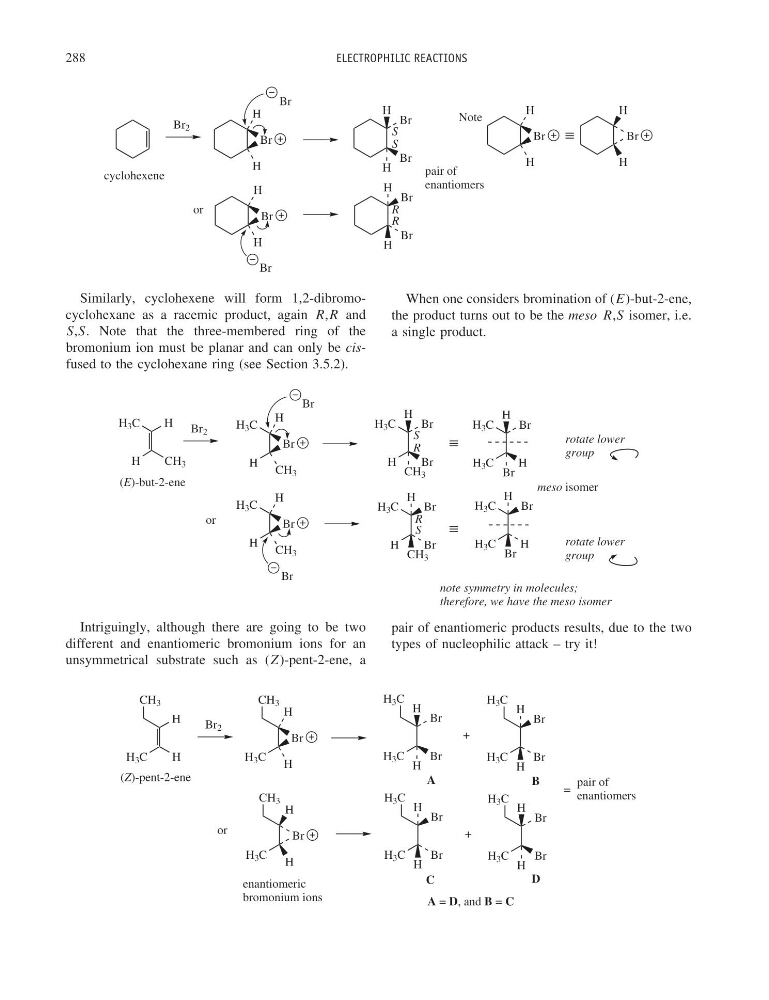
Similarly, cyclohexene will form 1,2-dibromocyclohexane as a racemic product, again R,R and
S,S. Note that the three-membered ring of the
bromonium ion must be planar and can only be cisfused to the cyclohexane ring (see Section 3.5.2).
When one considers bromination of (E)-but-2-ene,
the product turns out to be the meso R,S isomer, i.e.
a single product.
H
H 3 C
Br 2
H
H 3 C
Br
H
CH 3
H
H 3 C
Br
H
CH 3
Br
H
H 3 C
Br
H
CH 3
Br
H
H 3 C
Br
H
CH 3
Br
meso isomer
S
R
R
S
or
H
CH 3
≡
≡
H 3 C
H 3 C
H
H
Br
Br
H 3 C
H 3 C
H
H
Br
Br
(E)-but-2-ene
Br
rotate lower
group
rotate lower
group
note symmetry in molecules;
therefore, we have the meso isomer
Intriguingly, although there are going to be two
different and enantiomeric bromonium ions for an
unsymmetrical substrate such as (Z)-pent-2-ene, a
pair of enantiomeric products results, due to the two
types of nucleophilic attack – try it!
H 3 C
Br 2
H 3 C
Br
H
H
H 3 C
Br
H
H
Br
H 3 C
Br
H
H
H 3 C
Br
H
H
Br
pair of
enantiomers
or
H
H
CH 3
CH 3
CH 3
H 3 C
H 3 C
H 3 C
Br
H
H
Br
H 3 C
+
+
H 3 C
Br
H
H
Br
H 3 C
enantiomeric
bromonium ions
A
B
C
D
A = D, and B = C
(Z)-pent-2-ene
=
ELECTROPHILIC REACTIONS
Br 2
Br
H
H
Br
H
H
Br
Br
H
H
Br
Br
H
H
Br
pair of
enantiomers
S
S
R
R
or
Br
H
H
Note
Br
H
H
≡
cyclohexene
Br
Similarly, cyclohexene will form 1,2-dibromocyclohexane as a racemic product, again R,R and
S,S. Note that the three-membered ring of the
bromonium ion must be planar and can only be cisfused to the cyclohexane ring (see Section 3.5.2).
When one considers bromination of (E)-but-2-ene,
the product turns out to be the meso R,S isomer, i.e.
a single product.
H
H 3 C
Br 2
H
H 3 C
Br
H
CH 3
H
H 3 C
Br
H
CH 3
Br
H
H 3 C
Br
H
CH 3
Br
H
H 3 C
Br
H
CH 3
Br
meso isomer
S
R
R
S
or
H
CH 3
≡
≡
H 3 C
H 3 C
H
H
Br
Br
H 3 C
H 3 C
H
H
Br
Br
(E)-but-2-ene
Br
rotate lower
group
rotate lower
group
note symmetry in molecules;
therefore, we have the meso isomer
Intriguingly, although there are going to be two
different and enantiomeric bromonium ions for an
unsymmetrical substrate such as (Z)-pent-2-ene, a
pair of enantiomeric products results, due to the two
types of nucleophilic attack – try it!
H 3 C
Br 2
H 3 C
Br
H
H
H 3 C
Br
H
H
Br
H 3 C
Br
H
H
H 3 C
Br
H
H
Br
pair of
enantiomers
or
H
H
CH 3
CH 3
CH 3
H 3 C
H 3 C
H 3 C
Br
H
H
Br
H 3 C
+
+
H 3 C
Br
H
H
Br
H 3 C
enantiomeric
bromonium ions
A
B
C
D
A = D, and B = C
(Z)-pent-2-ene
=