

ELECTROPHILIC ADDITION TO UNSATURATED CARBON
287
As the reactants get closer, there is a flow of
electrons from the π bond to the nearer halogen,
followed by departure of the further halogen as
halide. This results in formation of a carbocation.
In the next step, we see a significant difference
in mechanism when compared with the addition of
HX. Instead of the carbocation being quenched by
attack of nucleophile, there is formation of a cyclic
halonium ion. This is achieved by bonding of a
lone pair of electrons from the large halogen atom
to the carbocation, and it helps stabilize the cation by
transferring the charge to the halogen.
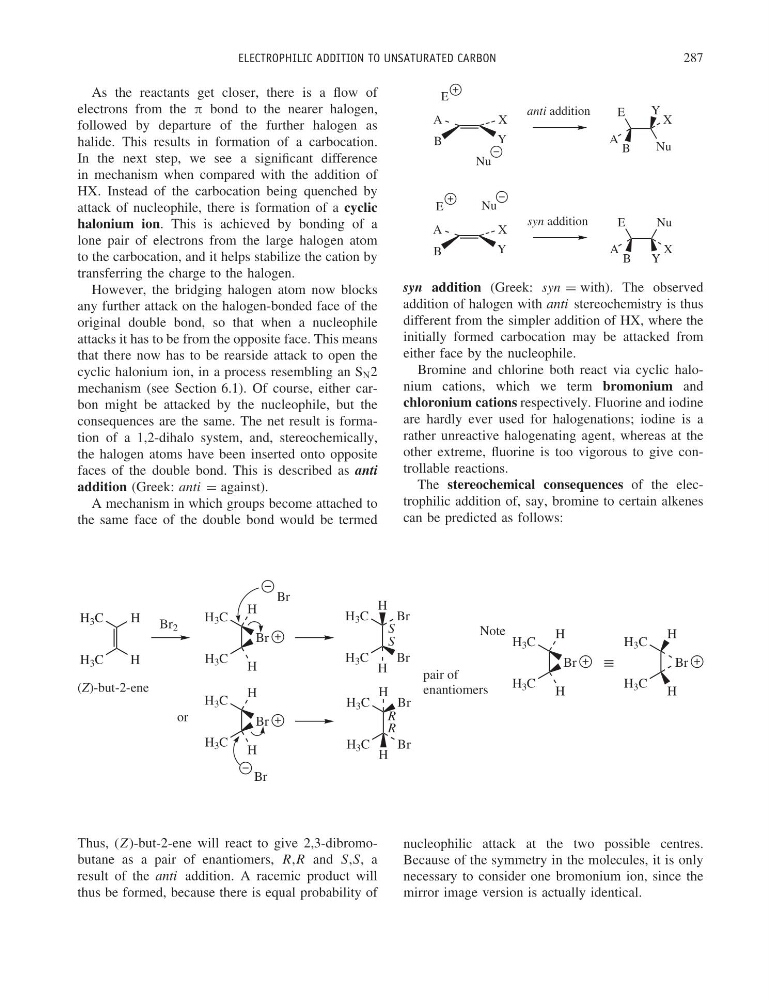
However, the bridging halogen atom now blocks
any further attack on the halogen-bonded face of the
original double bond, so that when a nucleophile
attacks it has to be from the opposite face. This means
that there now has to be rearside attack to open the
cyclic halonium ion, in a process resembling an S N 2
mechanism (see Section 6.1). Of course, either carbon might be attacked by the nucleophile, but the
consequences are the same. The net result is formation of a 1,2-dihalo system, and, stereochemically,
the halogen atoms have been inserted onto opposite
faces of the double bond. This is described as anti
addition (Greek: anti = against).
A mechanism in which groups become attached to
the same face of the double bond would be termed
E
Nu
syn addition
B
E
A
Nu
Y
X
B
E
A
Nu
Y
X
Y
X
B
A
E
Nu
anti addition
Y
X
B
A
syn addition (Greek: syn = with). The observed
addition of halogen with anti stereochemistry is thus
different from the simpler addition of HX, where the
initially formed carbocation may be attacked from
either face by the nucleophile.
Bromine and chlorine both react via cyclic halonium cations, which we term bromonium and
chloronium cations respectively. Fluorine and iodine
are hardly ever used for halogenations; iodine is a
rather unreactive halogenating agent, whereas at the
other extreme, fluorine is too vigorous to give controllable reactions.
The stereochemical consequences of the electrophilic addition of, say, bromine to certain alkenes
can be predicted as follows:
H 3 C
H 3 C
Br 2
H 3 C
H 3 C
Br
H
H
Br
H 3 C
H 3 C
Br
H
H
Br
H 3 C
H 3 C
Br
H
H
Br
H 3 C
H 3 C
Br
H
H
Br
pair of
enantiomers
S
S
R
R
or
H
H
H 3 C
H 3 C
Br
H
H
Note
≡
H 3 C
H 3 C
Br
H
H
(Z)-but-2-ene
Thus, (Z)-but-2-ene will react to give 2,3-dibromobutane as a pair of enantiomers, R,R and S,S, a
result of the anti addition. A racemic product will
thus be formed, because there is equal probability of
nucleophilic attack at the two possible centres.
Because of the symmetry in the molecules, it is only
necessary to consider one bromonium ion, since the
mirror image version is actually identical.
287
As the reactants get closer, there is a flow of
electrons from the π bond to the nearer halogen,
followed by departure of the further halogen as
halide. This results in formation of a carbocation.
In the next step, we see a significant difference
in mechanism when compared with the addition of
HX. Instead of the carbocation being quenched by
attack of nucleophile, there is formation of a cyclic
halonium ion. This is achieved by bonding of a
lone pair of electrons from the large halogen atom
to the carbocation, and it helps stabilize the cation by
transferring the charge to the halogen.
However, the bridging halogen atom now blocks
any further attack on the halogen-bonded face of the
original double bond, so that when a nucleophile
attacks it has to be from the opposite face. This means
that there now has to be rearside attack to open the
cyclic halonium ion, in a process resembling an S N 2
mechanism (see Section 6.1). Of course, either carbon might be attacked by the nucleophile, but the
consequences are the same. The net result is formation of a 1,2-dihalo system, and, stereochemically,
the halogen atoms have been inserted onto opposite
faces of the double bond. This is described as anti
addition (Greek: anti = against).
A mechanism in which groups become attached to
the same face of the double bond would be termed
E
Nu
syn addition
B
E
A
Nu
Y
X
B
E
A
Nu
Y
X
Y
X
B
A
E
Nu
anti addition
Y
X
B
A
syn addition (Greek: syn = with). The observed
addition of halogen with anti stereochemistry is thus
different from the simpler addition of HX, where the
initially formed carbocation may be attacked from
either face by the nucleophile.
Bromine and chlorine both react via cyclic halonium cations, which we term bromonium and
chloronium cations respectively. Fluorine and iodine
are hardly ever used for halogenations; iodine is a
rather unreactive halogenating agent, whereas at the
other extreme, fluorine is too vigorous to give controllable reactions.
The stereochemical consequences of the electrophilic addition of, say, bromine to certain alkenes
can be predicted as follows:
H 3 C
H 3 C
Br 2
H 3 C
H 3 C
Br
H
H
Br
H 3 C
H 3 C
Br
H
H
Br
H 3 C
H 3 C
Br
H
H
Br
H 3 C
H 3 C
Br
H
H
Br
pair of
enantiomers
S
S
R
R
or
H
H
H 3 C
H 3 C
Br
H
H
Note
≡
H 3 C
H 3 C
Br
H
H
(Z)-but-2-ene
Thus, (Z)-but-2-ene will react to give 2,3-dibromobutane as a pair of enantiomers, R,R and S,S, a
result of the anti addition. A racemic product will
thus be formed, because there is equal probability of
nucleophilic attack at the two possible centres.
Because of the symmetry in the molecules, it is only
necessary to consider one bromonium ion, since the
mirror image version is actually identical.