

286
ELECTROPHILIC REACTIONS
Naturally, if the protonation step could lead to
either a tertiary or a very unfavourable primary
carbocation, then we would expect the product to
be almost entirely the result of tertiary carbocation
involvement.
H
H
CH 3
CH 3
H
H
CH 3
CH 3
H
H
H
CH 3
Cl
H
CH 3
favourable tertiary
carbocation
essentially
sole product
H +
Cl
−
H
+
H
H
CH 3
H
H
Cl
CH 3
H
H
CH 3
highly unfavourable
primary carbocation
CH 3
Cl −
2-methylpropene
Long before any reaction mechanism had been
deduced, Markovnikov’s rule had been utilized
to predict the regiochemistry for addition of HX
to an unsymmetrical alkene. Markovnikov’s rule
states that addition of HX across a carbon–carbon
multiple bond proceeds in such a way that the
proton adds to the less-substituted carbon atom,
i.e. that already bearing the greater number of
hydrogen atoms. Since we now know that carbocation
stability controls the regiochemistry of electrophilic
addition, it is recommended that the more favoured
product be predicted simply from an inspection of
the possible carbocation intermediates. Alternatively,
Markovnikov’s rule should be restated in mechanistic
terms, in that the electrophile adds to the double
bond to form the more stable carbocation. In
some circumstances, this generalization has appeared
incorrect, and so-called anti-Markovnikov addition
has been observed. Careful analysis of the reagents
has shown that abnormal anti-Markovnikov addition
of HX is the result of a radical reaction brought about
by the presence of peroxides as radical initiators. This
will be discussed further in Section 9.4.
The relative ease with which hydrogen halides
react with alkenes is in the order HI > HBr > HCl >
HF. This is the same as their relative acidities
(see Section 4.3.2) and indicates that protonation of
the alkene is the rate-limiting step for the addition
reaction.
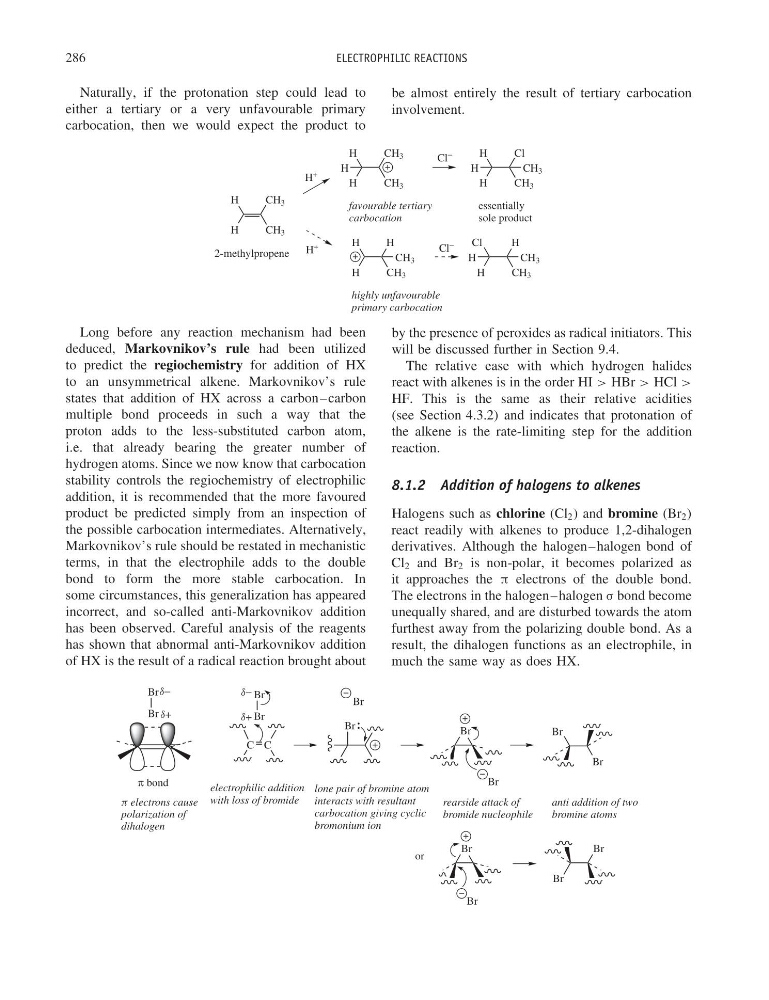
8.1.2 Addition of halogens to alkenes
Halogens such as chlorine (Cl 2 ) and bromine (Br 2 )
react readily with alkenes to produce 1,2-dihalogen
derivatives. Although the halogen–halogen bond of
Cl 2 and Br 2 is non-polar, it becomes polarized as
it approaches the π electrons of the double bond.
The electrons in the halogen–halogen σ bond become
unequally shared, and are disturbed towards the atom
furthest away from the polarizing double bond. As a
result, the dihalogen functions as an electrophile, in
much the same way as does HX.
C C
Br
Br
Br
p electrons cause
polarization of
dihalogen
lone pair of bromine atom
interacts with resultant
carbocation giving cyclic
bromonium ion
anti addition of two
bromine atoms
Br
Br d+
d−
Br
Br
Br
d+
d−
electrophilic addition
with loss of bromide
Br
Br
rearside attack of
bromide nucleophile
Br
Br
Br
Br
or
π bond
ELECTROPHILIC REACTIONS
Naturally, if the protonation step could lead to
either a tertiary or a very unfavourable primary
carbocation, then we would expect the product to
be almost entirely the result of tertiary carbocation
involvement.
H
H
CH 3
CH 3
H
H
CH 3
CH 3
H
H
H
CH 3
Cl
H
CH 3
favourable tertiary
carbocation
essentially
sole product
H +
Cl
−
H
+
H
H
CH 3
H
H
Cl
CH 3
H
H
CH 3
highly unfavourable
primary carbocation
CH 3
Cl −
2-methylpropene
Long before any reaction mechanism had been
deduced, Markovnikov’s rule had been utilized
to predict the regiochemistry for addition of HX
to an unsymmetrical alkene. Markovnikov’s rule
states that addition of HX across a carbon–carbon
multiple bond proceeds in such a way that the
proton adds to the less-substituted carbon atom,
i.e. that already bearing the greater number of
hydrogen atoms. Since we now know that carbocation
stability controls the regiochemistry of electrophilic
addition, it is recommended that the more favoured
product be predicted simply from an inspection of
the possible carbocation intermediates. Alternatively,
Markovnikov’s rule should be restated in mechanistic
terms, in that the electrophile adds to the double
bond to form the more stable carbocation. In
some circumstances, this generalization has appeared
incorrect, and so-called anti-Markovnikov addition
has been observed. Careful analysis of the reagents
has shown that abnormal anti-Markovnikov addition
of HX is the result of a radical reaction brought about
by the presence of peroxides as radical initiators. This
will be discussed further in Section 9.4.
The relative ease with which hydrogen halides
react with alkenes is in the order HI > HBr > HCl >
HF. This is the same as their relative acidities
(see Section 4.3.2) and indicates that protonation of
the alkene is the rate-limiting step for the addition
reaction.
8.1.2 Addition of halogens to alkenes
Halogens such as chlorine (Cl 2 ) and bromine (Br 2 )
react readily with alkenes to produce 1,2-dihalogen
derivatives. Although the halogen–halogen bond of
Cl 2 and Br 2 is non-polar, it becomes polarized as
it approaches the π electrons of the double bond.
The electrons in the halogen–halogen σ bond become
unequally shared, and are disturbed towards the atom
furthest away from the polarizing double bond. As a
result, the dihalogen functions as an electrophile, in
much the same way as does HX.
C C
Br
Br
Br
p electrons cause
polarization of
dihalogen
lone pair of bromine atom
interacts with resultant
carbocation giving cyclic
bromonium ion
anti addition of two
bromine atoms
Br
Br d+
d−
Br
Br
Br
d+
d−
electrophilic addition
with loss of bromide
Br
Br
rearside attack of
bromide nucleophile
Br
Br
Br
Br
or
π bond