

ELECTROPHILIC ADDITION TO UNSATURATED CARBON
285
Since HCl will be completely dissociated in water,
the electrophile in this case will be the hydronium ion,
although the same carbocation will be produced. The
reaction is completed by nucleophilic attack of water,
followed by loss of a proton, thus regenerating the
acid catalyst. The overall conversion thus becomes
hydration of the alkene. This is an important industrial process, typically employing sulfuric acid, but it
is seldom used in the laboratory because the yields are
very dependent upon the conditions used, and better
routes to alcohols are available.
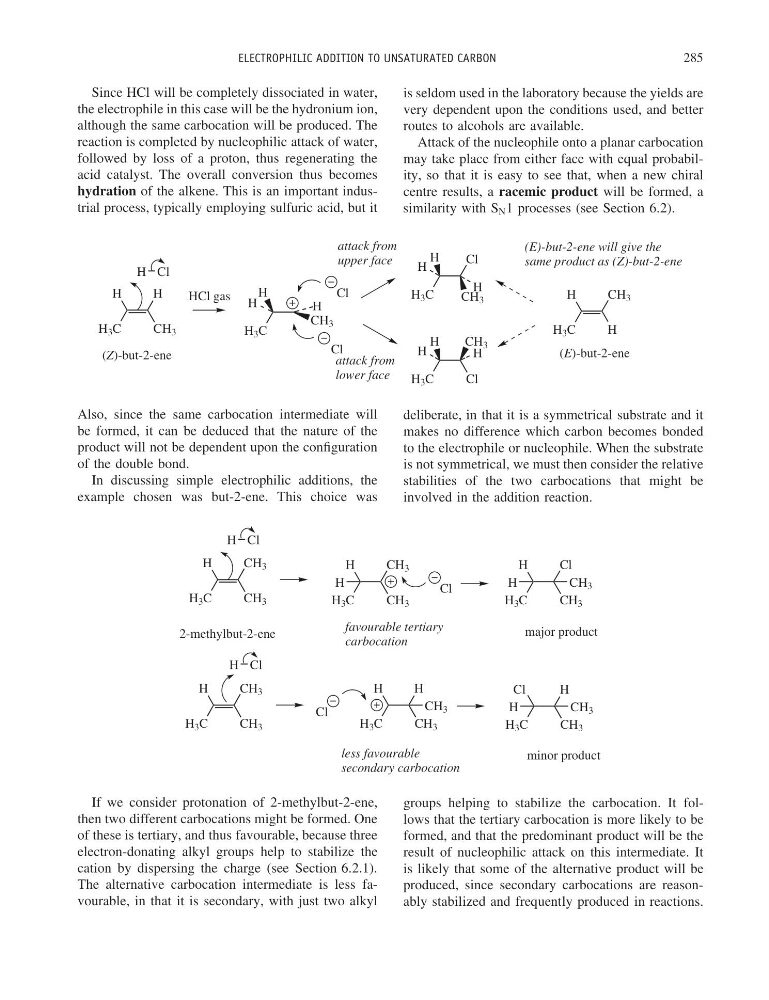
Attack of the nucleophile onto a planar carbocation
may take place from either face with equal probability, so that it is easy to see that, when a new chiral
centre results, a racemic product will be formed, a
similarity with S N 1 processes (see Section 6.2).
H 3 C
H
CH 3
H
H Cl
H 3 C
H
H
Cl
HCl gas
CH 3
H
Cl
H 3 C
Cl
CH 3
H
H
H
H 3 C
H
H
Cl
CH 3
H
attack from
upper face
attack from
lower face
H 3 C
H
H
CH 3
(E)-but-2-ene will give the
same product as (Z)-but-2-ene
(Z)-but-2-ene
(E)-but-2-ene
Also, since the same carbocation intermediate will
be formed, it can be deduced that the nature of the
product will not be dependent upon the configuration
of the double bond.
In discussing simple electrophilic additions, the
example chosen was but-2-ene. This choice was
deliberate, in that it is a symmetrical substrate and it
makes no difference which carbon becomes bonded
to the electrophile or nucleophile. When the substrate
is not symmetrical, we must then consider the relative
stabilities of the two carbocations that might be
involved in the addition reaction.
H 3 C
H
CH 3
CH 3
H Cl
H 3 C
H
CH 3
CH 3
H
Cl
H 3 C
H
CH 3
Cl
H
CH 3
H 3 C
H
CH 3
CH 3
H Cl
H 3 C
H
CH 3
H
Cl
H 3 C
Cl
CH 3
H
H
CH 3
CH 3
favourable tertiary
carbocation
less favourable
secondary carbocation
major product
minor product
2-methylbut-2-ene
If we consider protonation of 2-methylbut-2-ene,
then two different carbocations might be formed. One
of these is tertiary, and thus favourable, because three
electron-donating alkyl groups help to stabilize the
cation by dispersing the charge (see Section 6.2.1).
The alternative carbocation intermediate is less favourable, in that it is secondary, with just two alkyl
groups helping to stabilize the carbocation. It follows that the tertiary carbocation is more likely to be
formed, and that the predominant product will be the
result of nucleophilic attack on this intermediate. It
is likely that some of the alternative product will be
produced, since secondary carbocations are reasonably stabilized and frequently produced in reactions.
285
Since HCl will be completely dissociated in water,
the electrophile in this case will be the hydronium ion,
although the same carbocation will be produced. The
reaction is completed by nucleophilic attack of water,
followed by loss of a proton, thus regenerating the
acid catalyst. The overall conversion thus becomes
hydration of the alkene. This is an important industrial process, typically employing sulfuric acid, but it
is seldom used in the laboratory because the yields are
very dependent upon the conditions used, and better
routes to alcohols are available.
Attack of the nucleophile onto a planar carbocation
may take place from either face with equal probability, so that it is easy to see that, when a new chiral
centre results, a racemic product will be formed, a
similarity with S N 1 processes (see Section 6.2).
H 3 C
H
CH 3
H
H Cl
H 3 C
H
H
Cl
HCl gas
CH 3
H
Cl
H 3 C
Cl
CH 3
H
H
H
H 3 C
H
H
Cl
CH 3
H
attack from
upper face
attack from
lower face
H 3 C
H
H
CH 3
(E)-but-2-ene will give the
same product as (Z)-but-2-ene
(Z)-but-2-ene
(E)-but-2-ene
Also, since the same carbocation intermediate will
be formed, it can be deduced that the nature of the
product will not be dependent upon the configuration
of the double bond.
In discussing simple electrophilic additions, the
example chosen was but-2-ene. This choice was
deliberate, in that it is a symmetrical substrate and it
makes no difference which carbon becomes bonded
to the electrophile or nucleophile. When the substrate
is not symmetrical, we must then consider the relative
stabilities of the two carbocations that might be
involved in the addition reaction.
H 3 C
H
CH 3
CH 3
H Cl
H 3 C
H
CH 3
CH 3
H
Cl
H 3 C
H
CH 3
Cl
H
CH 3
H 3 C
H
CH 3
CH 3
H Cl
H 3 C
H
CH 3
H
Cl
H 3 C
Cl
CH 3
H
H
CH 3
CH 3
favourable tertiary
carbocation
less favourable
secondary carbocation
major product
minor product
2-methylbut-2-ene
If we consider protonation of 2-methylbut-2-ene,
then two different carbocations might be formed. One
of these is tertiary, and thus favourable, because three
electron-donating alkyl groups help to stabilize the
cation by dispersing the charge (see Section 6.2.1).
The alternative carbocation intermediate is less favourable, in that it is secondary, with just two alkyl
groups helping to stabilize the carbocation. It follows that the tertiary carbocation is more likely to be
formed, and that the predominant product will be the
result of nucleophilic attack on this intermediate. It
is likely that some of the alternative product will be
produced, since secondary carbocations are reasonably stabilized and frequently produced in reactions.