

284
ELECTROPHILIC REACTIONS
Energy
Reaction coordinate
E
Nu
E
d+
d−
Nu
Nu
E
E Nu
transition
state
transition
state
carbocation
intermediate
reactants
products
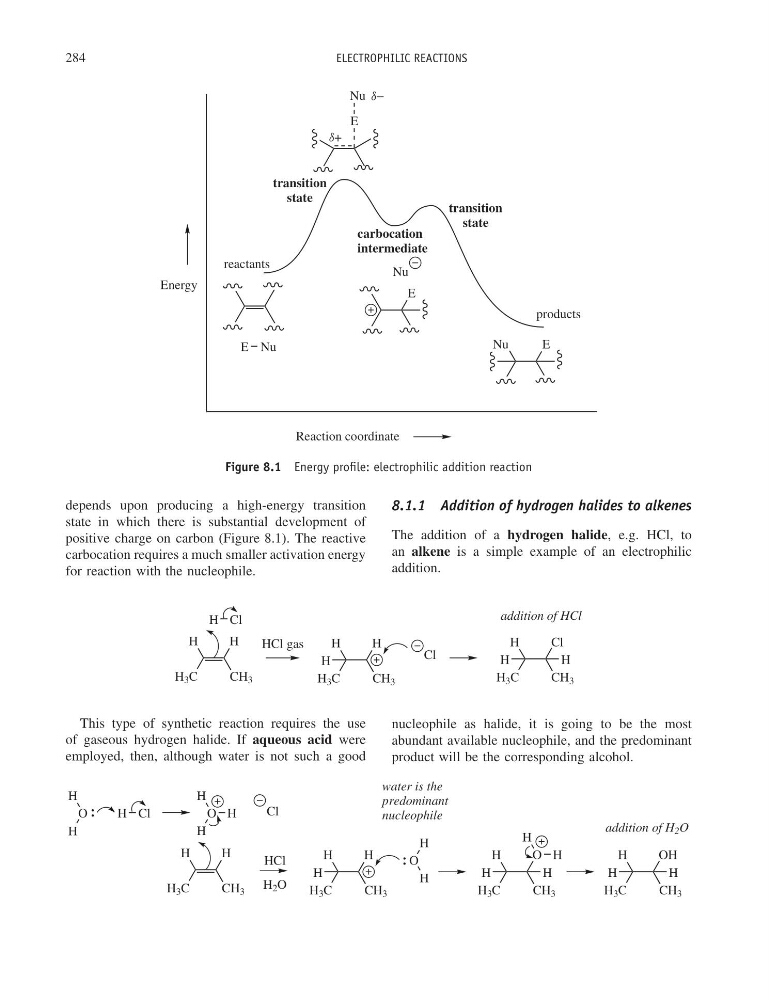
Figure 8.1 Energy profile: electrophilic addition reaction
depends upon producing a high-energy transition
state in which there is substantial development of
positive charge on carbon (Figure 8.1). The reactive
carbocation requires a much smaller activation energy
for reaction with the nucleophile.
8.1.1 Addition of hydrogen halides to alkenes
The addition of a hydrogen halide, e.g. HCl, to
an alkene is a simple example of an electrophilic
addition.
H 3 C
H
CH 3
H
H Cl
H 3 C
H
CH 3
H
H
Cl
H 3 C
H
CH 3
Cl
H
H
HCl gas
addition of HCl
This type of synthetic reaction requires the use
of gaseous hydrogen halide. If aqueous acid were
employed, then, although water is not such a good
nucleophile as halide, it is going to be the most
abundant available nucleophile, and the predominant
product will be the corresponding alcohol.
H 3 C
H
CH 3
H
H Cl
H 3 C
H
CH 3
H
H
H 3 C
H
CH 3
O
H
H
HCl
H 2 O
O
H
H
O H
H
H
Cl
O
H
H
H
H
H 3 C
H
CH 3
OH
H
H
addition of H 2 O
water is the
predominant
nucleophile
ELECTROPHILIC REACTIONS
Energy
Reaction coordinate
E
Nu
E
d+
d−
Nu
Nu
E
E Nu
transition
state
transition
state
carbocation
intermediate
reactants
products
Figure 8.1 Energy profile: electrophilic addition reaction
depends upon producing a high-energy transition
state in which there is substantial development of
positive charge on carbon (Figure 8.1). The reactive
carbocation requires a much smaller activation energy
for reaction with the nucleophile.
8.1.1 Addition of hydrogen halides to alkenes
The addition of a hydrogen halide, e.g. HCl, to
an alkene is a simple example of an electrophilic
addition.
H 3 C
H
CH 3
H
H Cl
H 3 C
H
CH 3
H
H
Cl
H 3 C
H
CH 3
Cl
H
H
HCl gas
addition of HCl
This type of synthetic reaction requires the use
of gaseous hydrogen halide. If aqueous acid were
employed, then, although water is not such a good
nucleophile as halide, it is going to be the most
abundant available nucleophile, and the predominant
product will be the corresponding alcohol.
H 3 C
H
CH 3
H
H Cl
H 3 C
H
CH 3
H
H
H 3 C
H
CH 3
O
H
H
HCl
H 2 O
O
H
H
O H
H
H
Cl
O
H
H
H
H
H 3 C
H
CH 3
OH
H
H
addition of H 2 O
water is the
predominant
nucleophile