

8
Electrophilic reactions
In the preceding chapters we have seen how new
bonds may be formed between nucleophilic reagents
and various substrates that have electrophilic centres,
the latter typically arising as a result of uneven electron distribution in the molecule. The nucleophile
was considered to be the reactive species. In this
chapter we shall consider reactions in which electrophilic reagents become bonded to substrates that
are electron rich, especially those that contain multiple bonds, i.e. alkenes, alkynes, and aromatics. The
π electrons in these systems provide regions of high
electron density, and electrophilic reactions feature as
the principal reactivity in these classes of compounds.
We term the reactions electrophilic rather than nucleophilic, since it is the electrophile that provides the
reactive species.
8.1 Electrophilic addition to
unsaturated carbon
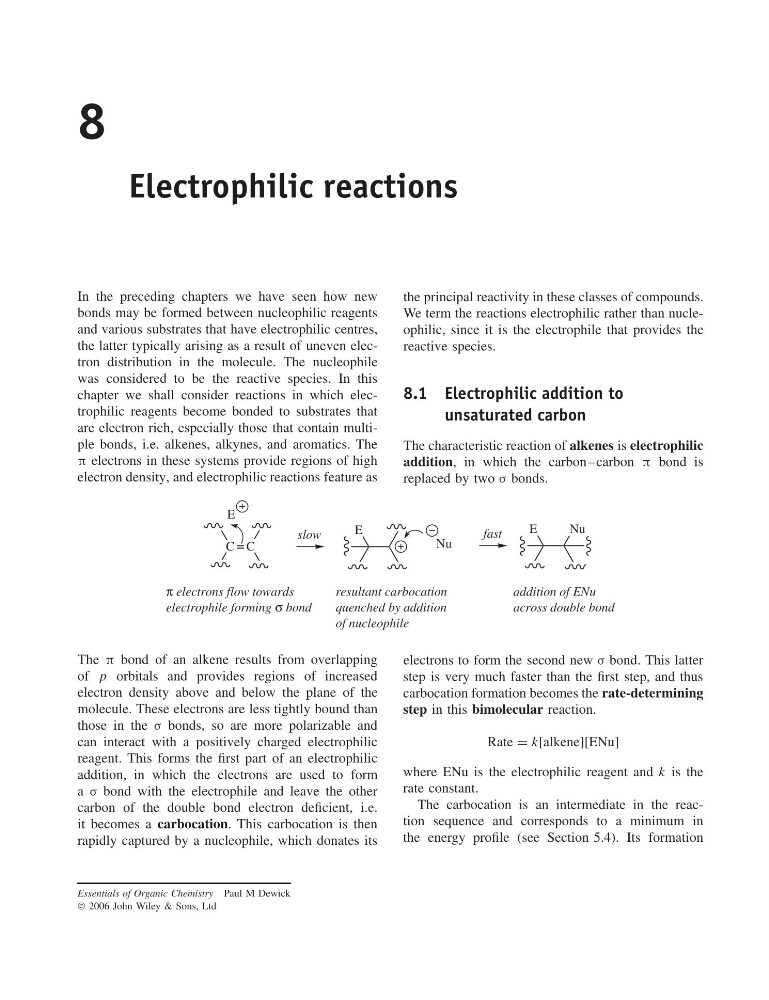
The characteristic reaction of alkenes is electrophilic
addition, in which the carbon–carbon π bond is
replaced by two σ bonds.
C C
E
E
Nu
E
Nu
slow
fast
π electrons flow towards
electrophile forming σ bond
resultant carbocation
quenched by addition
of nucleophile
addition of ENu
across double bond
The π bond of an alkene results from overlapping
of p orbitals and provides regions of increased
electron density above and below the plane of the
molecule. These electrons are less tightly bound than
those in the σ bonds, so are more polarizable and
can interact with a positively charged electrophilic
reagent. This forms the first part of an electrophilic
addition, in which the electrons are used to form
a σ bond with the electrophile and leave the other
carbon of the double bond electron deficient, i.e.
it becomes a carbocation. This carbocation is then
rapidly captured by a nucleophile, which donates its
electrons to form the second new σ bond. This latter
step is very much faster than the first step, and thus
carbocation formation becomes the rate-determining
step in this bimolecular reaction.
Rate = k[alkene][ENu]
where ENu is the electrophilic reagent and k is the
rate constant.
The carbocation is an intermediate in the reaction sequence and corresponds to a minimum in
the energy profile (see Section 5.4). Its formation
Essentials of Organic Chemistry Paul M Dewick
2006 John Wiley & Sons, Ltd
Electrophilic reactions
In the preceding chapters we have seen how new
bonds may be formed between nucleophilic reagents
and various substrates that have electrophilic centres,
the latter typically arising as a result of uneven electron distribution in the molecule. The nucleophile
was considered to be the reactive species. In this
chapter we shall consider reactions in which electrophilic reagents become bonded to substrates that
are electron rich, especially those that contain multiple bonds, i.e. alkenes, alkynes, and aromatics. The
π electrons in these systems provide regions of high
electron density, and electrophilic reactions feature as
the principal reactivity in these classes of compounds.
We term the reactions electrophilic rather than nucleophilic, since it is the electrophile that provides the
reactive species.
8.1 Electrophilic addition to
unsaturated carbon
The characteristic reaction of alkenes is electrophilic
addition, in which the carbon–carbon π bond is
replaced by two σ bonds.
C C
E
E
Nu
E
Nu
slow
fast
π electrons flow towards
electrophile forming σ bond
resultant carbocation
quenched by addition
of nucleophile
addition of ENu
across double bond
The π bond of an alkene results from overlapping
of p orbitals and provides regions of increased
electron density above and below the plane of the
molecule. These electrons are less tightly bound than
those in the σ bonds, so are more polarizable and
can interact with a positively charged electrophilic
reagent. This forms the first part of an electrophilic
addition, in which the electrons are used to form
a σ bond with the electrophile and leave the other
carbon of the double bond electron deficient, i.e.
it becomes a carbocation. This carbocation is then
rapidly captured by a nucleophile, which donates its
electrons to form the second new σ bond. This latter
step is very much faster than the first step, and thus
carbocation formation becomes the rate-determining
step in this bimolecular reaction.
Rate = k[alkene][ENu]
where ENu is the electrophilic reagent and k is the
rate constant.
The carbocation is an intermediate in the reaction sequence and corresponds to a minimum in
the energy profile (see Section 5.4). Its formation
Essentials of Organic Chemistry Paul M Dewick
2006 John Wiley & Sons, Ltd