

282
NUCLEOPHILIC REACTIONS OF CARBONYL GROUPS
(ATP)
1,3-diphosphoglycerate
3-phosphoglycerate
O
P
O
OH
OH
O
HO
CH 2 OP
(ADP)
anhydride
ester
O
P
O
OH
OH
O
HO
CH 2 OP
OR
H
OH
O
HO
CH 2 OP
POR
HOR
succinyl phosphate
CO 2 H
CO 2 H
succinate
(GTP)
anhydride
O
P
OH
OH
O
O
CO 2 H
(GDP)
POR
HOR
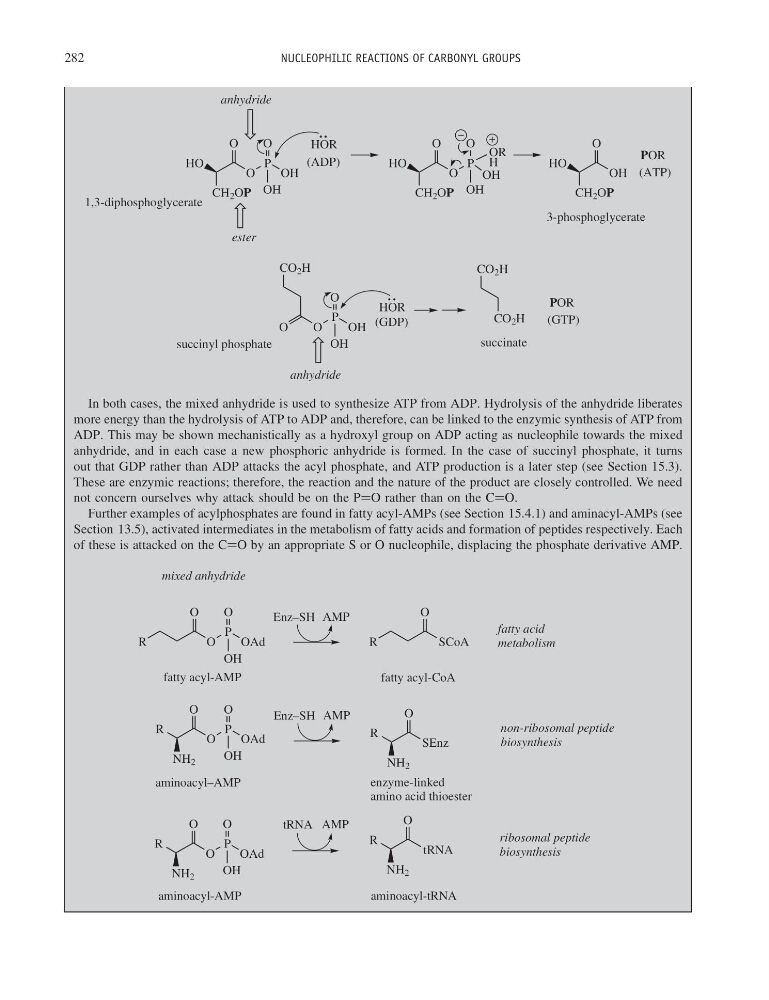
In both cases, the mixed anhydride is used to synthesize ATP from ADP. Hydrolysis of the anhydride liberates
more energy than the hydrolysis of ATP to ADP and, therefore, can be linked to the enzymic synthesis of ATP from
ADP. This may be shown mechanistically as a hydroxyl group on ADP acting as nucleophile towards the mixed
anhydride, and in each case a new phosphoric anhydride is formed. In the case of succinyl phosphate, it turns
out that GDP rather than ADP attacks the acyl phosphate, and ATP production is a later step (see Section 15.3).
These are enzymic reactions; therefore, the reaction and the nature of the product are closely controlled. We need
not concern ourselves why attack should be on the P=O rather than on the C=O.
Further examples of acylphosphates are found in fatty acyl-AMPs (see Section 15.4.1) and aminacyl-AMPs (see
Section 13.5), activated intermediates in the metabolism of fatty acids and formation of peptides respectively. Each
of these is attacked on the C=O by an appropriate S or O nucleophile, displacing the phosphate derivative AMP.
R
NH 2
O
mixed anhydride
O
fatty acyl-AMP
fatty acyl-CoA
R
NH 2
O
SEnz
Enz–SH
aminoacyl–AMP
AMP
Enz–SH AMP
R
O
SCoA
R
enzyme-linked
amino acid thioester
fatty acid
metabolism
non-ribosomal peptide
biosynthesis
R
NH 2
O
tRNA
aminoacyl-tRNA
aminoacyl-AMP
tRNA AMP
R
NH 2
O
ribosomal peptide
biosynthesis
O
P
O
OAd
OH
O
P
O
OAd
OH
O
P
O
OAd
OH
NUCLEOPHILIC REACTIONS OF CARBONYL GROUPS
(ATP)
1,3-diphosphoglycerate
3-phosphoglycerate
O
P
O
OH
OH
O
HO
CH 2 OP
(ADP)
anhydride
ester
O
P
O
OH
OH
O
HO
CH 2 OP
OR
H
OH
O
HO
CH 2 OP
POR
HOR
succinyl phosphate
CO 2 H
CO 2 H
succinate
(GTP)
anhydride
O
P
OH
OH
O
O
CO 2 H
(GDP)
POR
HOR
In both cases, the mixed anhydride is used to synthesize ATP from ADP. Hydrolysis of the anhydride liberates
more energy than the hydrolysis of ATP to ADP and, therefore, can be linked to the enzymic synthesis of ATP from
ADP. This may be shown mechanistically as a hydroxyl group on ADP acting as nucleophile towards the mixed
anhydride, and in each case a new phosphoric anhydride is formed. In the case of succinyl phosphate, it turns
out that GDP rather than ADP attacks the acyl phosphate, and ATP production is a later step (see Section 15.3).
These are enzymic reactions; therefore, the reaction and the nature of the product are closely controlled. We need
not concern ourselves why attack should be on the P=O rather than on the C=O.
Further examples of acylphosphates are found in fatty acyl-AMPs (see Section 15.4.1) and aminacyl-AMPs (see
Section 13.5), activated intermediates in the metabolism of fatty acids and formation of peptides respectively. Each
of these is attacked on the C=O by an appropriate S or O nucleophile, displacing the phosphate derivative AMP.
R
NH 2
O
mixed anhydride
O
fatty acyl-AMP
fatty acyl-CoA
R
NH 2
O
SEnz
Enz–SH
aminoacyl–AMP
AMP
Enz–SH AMP
R
O
SCoA
R
enzyme-linked
amino acid thioester
fatty acid
metabolism
non-ribosomal peptide
biosynthesis
R
NH 2
O
tRNA
aminoacyl-tRNA
aminoacyl-AMP
tRNA AMP
R
NH 2
O
ribosomal peptide
biosynthesis
O
P
O
OAd
OH
O
P
O
OAd
OH
O
P
O
OAd
OH