

NUCLEOPHILIC SUBSTITUTION ON DERIVATIVES OF SULFURIC AND PHOSPHORIC ACIDS
281
enzyme, and its action is thus totally inhibited. The insect becomes subjected to a build up of acetylcholine that
eventually proves fatal. Malathion is much less toxic to mammals because of the two carboxylic ester functions
that allow metabolism through hydrolysis to inactive products.
Even more reactive towards acetylcholinesterase are the organophosphorus derivatives developed as chemical
warfare nerve agents, e.g. sarin. Such compounds react readily with the enzyme and form very stable addition
intermediates. It is unusual to see fluoride as a leaving group, as in sarin, but its presence provides a huge
inductive effect, thus accelerating the initial nucleophilic addition step (see also Section 13.7).
Box 7.27
Acylphosphates: mixed anhydrides of phosphoric and carboxylic acids
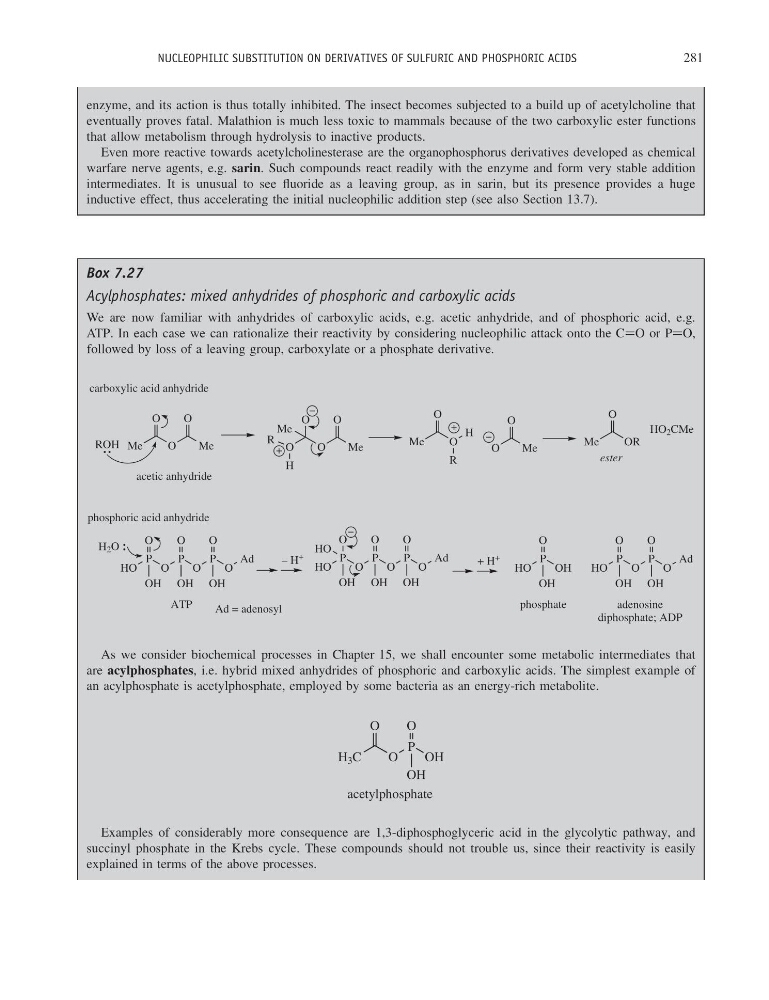
We are now familiar with anhydrides of carboxylic acids, e.g. acetic anhydride, and of phosphoric acid, e.g.
ATP. In each case we can rationalize their reactivity by considering nucleophilic attack onto the C=O or P=O,
followed by loss of a leaving group, carboxylate or a phosphate derivative.
Me
O
Me
O
O
O
O
Me
O
O
R
H
Me
OR
O
ester
Me
O
O
H
R
O
Me
O
carboxylic acid anhydride
acetic anhydride
phosphoric acid anhydride
O
P
HO
O
P
O
O
OH OH
P
O
O
OH
Ad
– H
+
O
P
HO
O
P
O
O
OH OH
P
O
O
OH
Ad
HO
+ H
+
O
P
HO
OH
OH
O
P
HO
O
P
O
O
OH OH
Ad
ATP
phosphate
adenosine
diphosphate; ADP
Ad = adenosyl
Me
ROH
HO 2 CMe
H 2 O
As we consider biochemical processes in Chapter 15, we shall encounter some metabolic intermediates that
are acylphosphates, i.e. hybrid mixed anhydrides of phosphoric and carboxylic acids. The simplest example of
an acylphosphate is acetylphosphate, employed by some bacteria as an energy-rich metabolite.
acetylphosphate
O
H 3 C
O
P
O
OH
OH
Examples of considerably more consequence are 1,3-diphosphoglyceric acid in the glycolytic pathway, and
succinyl phosphate in the Krebs cycle. These compounds should not trouble us, since their reactivity is easily
explained in terms of the above processes.
281
enzyme, and its action is thus totally inhibited. The insect becomes subjected to a build up of acetylcholine that
eventually proves fatal. Malathion is much less toxic to mammals because of the two carboxylic ester functions
that allow metabolism through hydrolysis to inactive products.
Even more reactive towards acetylcholinesterase are the organophosphorus derivatives developed as chemical
warfare nerve agents, e.g. sarin. Such compounds react readily with the enzyme and form very stable addition
intermediates. It is unusual to see fluoride as a leaving group, as in sarin, but its presence provides a huge
inductive effect, thus accelerating the initial nucleophilic addition step (see also Section 13.7).
Box 7.27
Acylphosphates: mixed anhydrides of phosphoric and carboxylic acids
We are now familiar with anhydrides of carboxylic acids, e.g. acetic anhydride, and of phosphoric acid, e.g.
ATP. In each case we can rationalize their reactivity by considering nucleophilic attack onto the C=O or P=O,
followed by loss of a leaving group, carboxylate or a phosphate derivative.
Me
O
Me
O
O
O
O
Me
O
O
R
H
Me
OR
O
ester
Me
O
O
H
R
O
Me
O
carboxylic acid anhydride
acetic anhydride
phosphoric acid anhydride
O
P
HO
O
P
O
O
OH OH
P
O
O
OH
Ad
– H
+
O
P
HO
O
P
O
O
OH OH
P
O
O
OH
Ad
HO
+ H
+
O
P
HO
OH
OH
O
P
HO
O
P
O
O
OH OH
Ad
ATP
phosphate
adenosine
diphosphate; ADP
Ad = adenosyl
Me
ROH
HO 2 CMe
H 2 O
As we consider biochemical processes in Chapter 15, we shall encounter some metabolic intermediates that
are acylphosphates, i.e. hybrid mixed anhydrides of phosphoric and carboxylic acids. The simplest example of
an acylphosphate is acetylphosphate, employed by some bacteria as an energy-rich metabolite.
acetylphosphate
O
H 3 C
O
P
O
OH
OH
Examples of considerably more consequence are 1,3-diphosphoglyceric acid in the glycolytic pathway, and
succinyl phosphate in the Krebs cycle. These compounds should not trouble us, since their reactivity is easily
explained in terms of the above processes.