

280
NUCLEOPHILIC REACTIONS OF CARBONYL GROUPS
Box 7.26 (continued)
MeHN
O
Ar
O
Ser
OH
Ser
O
O
MeHN
Ser
O
O
MeHN
Ser
OH
acetylcholinesterase
slow
hydrolysis
phenoxide system
provides good leaving
group
resonance stabilization
decreases carbonyl character
and slows rate of hydrolysis
O
Ar
O
Ser
O
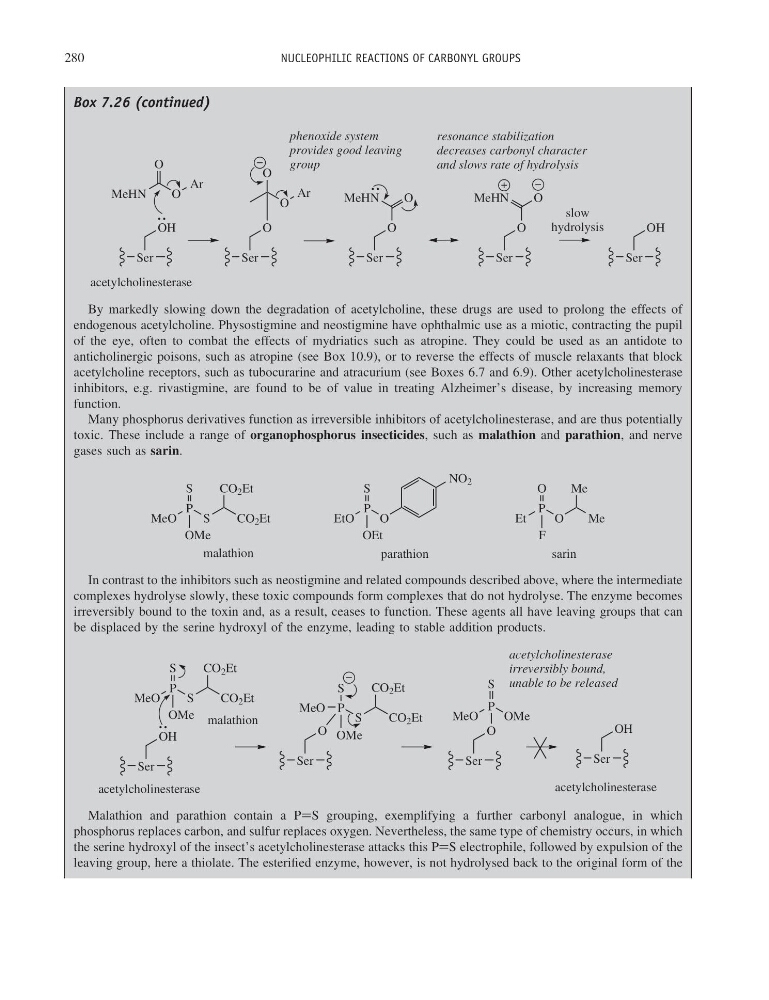
By markedly slowing down the degradation of acetylcholine, these drugs are used to prolong the effects of
endogenous acetylcholine. Physostigmine and neostigmine have ophthalmic use as a miotic, contracting the pupil
of the eye, often to combat the effects of mydriatics such as atropine. They could be used as an antidote to
anticholinergic poisons, such as atropine (see Box 10.9), or to reverse the effects of muscle relaxants that block
acetylcholine receptors, such as tubocurarine and atracurium (see Boxes 6.7 and 6.9). Other acetylcholinesterase
inhibitors, e.g. rivastigmine, are found to be of value in treating Alzheimer’s disease, by increasing memory
function.
Many phosphorus derivatives function as irreversible inhibitors of acetylcholinesterase, and are thus potentially
toxic. These include a range of organophosphorus insecticides, such as malathion and parathion, and nerve
gases such as sarin.
malathion
sarin
parathion
O
P
Et
O
F
S
P
EtO
O
OEt
NO 2
Me
Me
S
P
MeO
S
OMe
CO 2 Et
CO 2 Et
In contrast to the inhibitors such as neostigmine and related compounds described above, where the intermediate
complexes hydrolyse slowly, these toxic compounds form complexes that do not hydrolyse. The enzyme becomes
irreversibly bound to the toxin and, as a result, ceases to function. These agents all have leaving groups that can
be displaced by the serine hydroxyl of the enzyme, leading to stable addition products.
Ser
OH
Ser
O
P
S
malathion
Ser
OH
acetylcholinesterase
acetylcholinesterase
irreversibly bound,
unable to be released
acetylcholinesterase
S
P
MeO
S
OMe
CO 2 Et
CO 2 Et
S
MeO
S
OMe
CO 2 Et
CO 2 Et
P
Ser
O
OMe
MeO
Malathion and parathion contain a P=S grouping, exemplifying a further carbonyl analogue, in which
phosphorus replaces carbon, and sulfur replaces oxygen. Nevertheless, the same type of chemistry occurs, in which
the serine hydroxyl of the insect’s acetylcholinesterase attacks this P=S electrophile, followed by expulsion of the
leaving group, here a thiolate. The esterified enzyme, however, is not hydrolysed back to the original form of the
NUCLEOPHILIC REACTIONS OF CARBONYL GROUPS
Box 7.26 (continued)
MeHN
O
Ar
O
Ser
OH
Ser
O
O
MeHN
Ser
O
O
MeHN
Ser
OH
acetylcholinesterase
slow
hydrolysis
phenoxide system
provides good leaving
group
resonance stabilization
decreases carbonyl character
and slows rate of hydrolysis
O
Ar
O
Ser
O
By markedly slowing down the degradation of acetylcholine, these drugs are used to prolong the effects of
endogenous acetylcholine. Physostigmine and neostigmine have ophthalmic use as a miotic, contracting the pupil
of the eye, often to combat the effects of mydriatics such as atropine. They could be used as an antidote to
anticholinergic poisons, such as atropine (see Box 10.9), or to reverse the effects of muscle relaxants that block
acetylcholine receptors, such as tubocurarine and atracurium (see Boxes 6.7 and 6.9). Other acetylcholinesterase
inhibitors, e.g. rivastigmine, are found to be of value in treating Alzheimer’s disease, by increasing memory
function.
Many phosphorus derivatives function as irreversible inhibitors of acetylcholinesterase, and are thus potentially
toxic. These include a range of organophosphorus insecticides, such as malathion and parathion, and nerve
gases such as sarin.
malathion
sarin
parathion
O
P
Et
O
F
S
P
EtO
O
OEt
NO 2
Me
Me
S
P
MeO
S
OMe
CO 2 Et
CO 2 Et
In contrast to the inhibitors such as neostigmine and related compounds described above, where the intermediate
complexes hydrolyse slowly, these toxic compounds form complexes that do not hydrolyse. The enzyme becomes
irreversibly bound to the toxin and, as a result, ceases to function. These agents all have leaving groups that can
be displaced by the serine hydroxyl of the enzyme, leading to stable addition products.
Ser
OH
Ser
O
P
S
malathion
Ser
OH
acetylcholinesterase
acetylcholinesterase
irreversibly bound,
unable to be released
acetylcholinesterase
S
P
MeO
S
OMe
CO 2 Et
CO 2 Et
S
MeO
S
OMe
CO 2 Et
CO 2 Et
P
Ser
O
OMe
MeO
Malathion and parathion contain a P=S grouping, exemplifying a further carbonyl analogue, in which
phosphorus replaces carbon, and sulfur replaces oxygen. Nevertheless, the same type of chemistry occurs, in which
the serine hydroxyl of the insect’s acetylcholinesterase attacks this P=S electrophile, followed by expulsion of the
leaving group, here a thiolate. The esterified enzyme, however, is not hydrolysed back to the original form of the