

NUCLEOPHILIC SUBSTITUTION ON DERIVATIVES OF SULFURIC AND PHOSPHORIC ACIDS
279
Box 7.26
Inhibitors of acetylcholinesterase
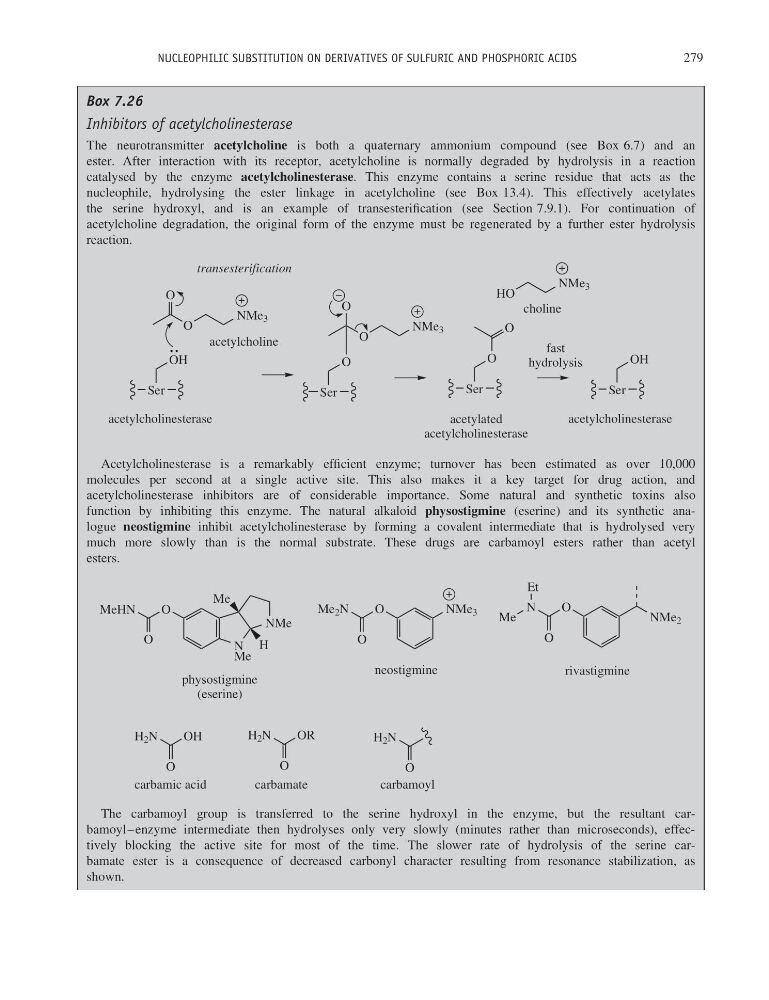
The neurotransmitter acetylcholine is both a quaternary ammonium compound (see Box 6.7) and an
ester. After interaction with its receptor, acetylcholine is normally degraded by hydrolysis in a reaction
catalysed by the enzyme acetylcholinesterase. This enzyme contains a serine residue that acts as the
nucleophile, hydrolysing the ester linkage in acetylcholine (see Box 13.4). This effectively acetylates
the serine hydroxyl, and is an example of transesterification (see Section 7.9.1). For continuation of
acetylcholine degradation, the original form of the enzyme must be regenerated by a further ester hydrolysis
reaction.
O
NMe 3
O
Ser
OH
Ser
O
O
Ser
OH
O
NMe 3
O
Ser
O
HO
NMe 3
acetylcholinesterase
acetylcholine
fast
hydrolysis
acetylcholinesterase
acetylated
acetylcholinesterase
choline
transesterification
Acetylcholinesterase is a remarkably efficient enzyme; turnover has been estimated as over 10,000
molecules per second at a single active site. This also makes it a key target for drug action, and
acetylcholinesterase inhibitors are of considerable importance. Some natural and synthetic toxins also
function by inhibiting this enzyme. The natural alkaloid physostigmine (eserine) and its synthetic analogue neostigmine inhibit acetylcholinesterase by forming a covalent intermediate that is hydrolysed very
much more slowly than is the normal substrate. These drugs are carbamoyl esters rather than acetyl
esters.
O
Me 2 N
NMe 3
O
neostigmine
N
Me
NMe
Me
H
O
MeHN
O
physostigmine
(eserine)
O
NMe 2
N
O
Me
Et
rivastigmine
O
H 2 N
OH
carbamic acid
O
H 2 N
OR
carbamate
O
H 2 N
carbamoyl
The carbamoyl group is transferred to the serine hydroxyl in the enzyme, but the resultant carbamoyl–enzyme intermediate then hydrolyses only very slowly (minutes rather than microseconds), effectively blocking the active site for most of the time. The slower rate of hydrolysis of the serine carbamate ester is a consequence of decreased carbonyl character resulting from resonance stabilization, as
shown.
279
Box 7.26
Inhibitors of acetylcholinesterase
The neurotransmitter acetylcholine is both a quaternary ammonium compound (see Box 6.7) and an
ester. After interaction with its receptor, acetylcholine is normally degraded by hydrolysis in a reaction
catalysed by the enzyme acetylcholinesterase. This enzyme contains a serine residue that acts as the
nucleophile, hydrolysing the ester linkage in acetylcholine (see Box 13.4). This effectively acetylates
the serine hydroxyl, and is an example of transesterification (see Section 7.9.1). For continuation of
acetylcholine degradation, the original form of the enzyme must be regenerated by a further ester hydrolysis
reaction.
O
NMe 3
O
Ser
OH
Ser
O
O
Ser
OH
O
NMe 3
O
Ser
O
HO
NMe 3
acetylcholinesterase
acetylcholine
fast
hydrolysis
acetylcholinesterase
acetylated
acetylcholinesterase
choline
transesterification
Acetylcholinesterase is a remarkably efficient enzyme; turnover has been estimated as over 10,000
molecules per second at a single active site. This also makes it a key target for drug action, and
acetylcholinesterase inhibitors are of considerable importance. Some natural and synthetic toxins also
function by inhibiting this enzyme. The natural alkaloid physostigmine (eserine) and its synthetic analogue neostigmine inhibit acetylcholinesterase by forming a covalent intermediate that is hydrolysed very
much more slowly than is the normal substrate. These drugs are carbamoyl esters rather than acetyl
esters.
O
Me 2 N
NMe 3
O
neostigmine
N
Me
NMe
Me
H
O
MeHN
O
physostigmine
(eserine)
O
NMe 2
N
O
Me
Et
rivastigmine
O
H 2 N
OH
carbamic acid
O
H 2 N
OR
carbamate
O
H 2 N
carbamoyl
The carbamoyl group is transferred to the serine hydroxyl in the enzyme, but the resultant carbamoyl–enzyme intermediate then hydrolyses only very slowly (minutes rather than microseconds), effectively blocking the active site for most of the time. The slower rate of hydrolysis of the serine carbamate ester is a consequence of decreased carbonyl character resulting from resonance stabilization, as
shown.