

278
NUCLEOPHILIC REACTIONS OF CARBONYL GROUPS
Box 7.25
Adenosine triphosphate
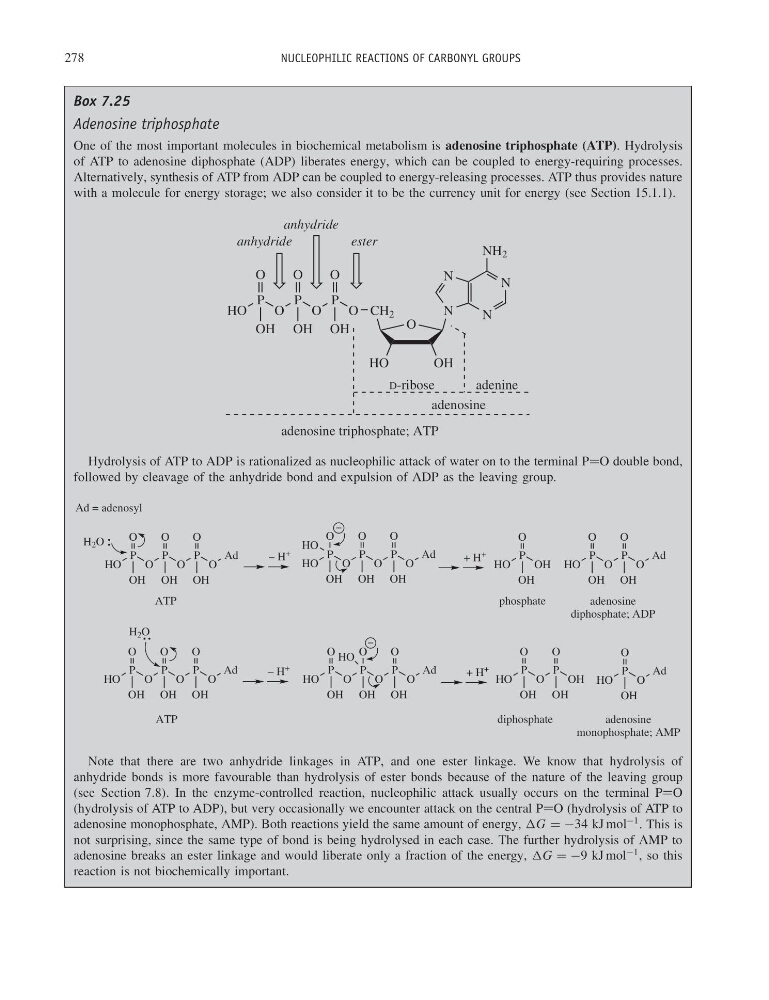
One of the most important molecules in biochemical metabolism is adenosine triphosphate (ATP). Hydrolysis
of ATP to adenosine diphosphate (ADP) liberates energy, which can be coupled to energy-requiring processes.
Alternatively, synthesis of ATP from ADP can be coupled to energy-releasing processes. ATP thus provides nature
with a molecule for energy storage; we also consider it to be the currency unit for energy (see Section 15.1.1).
N
N
N
NH 2
O
HO
OH
N
CH 2
anhydride
adenosine triphosphate; ATP
adenosine
adenine
D-ribose
anhydride
ester
O
P
HO
O
P
O
O
OH OH
P
O
O
OH
Hydrolysis of ATP to ADP is rationalized as nucleophilic attack of water on to the terminal P=O double bond,
followed by cleavage of the anhydride bond and expulsion of ADP as the leaving group.
O
P
HO
O
P
O
O
OH OH
P
O
O
OH
Ad
– H
+
O
P
HO
O
P
O
O
OH OH
P
O
O
OH
Ad
HO
+ H
+
O
P
HO
OH
OH
O
P
HO
O
P
O
O
OH OH
Ad
ATP
phosphate
adenosine
diphosphate; ADP
Ad = adenosyl
O
P
HO
O
P
O
O
OH OH
P
O
O
OH
Ad
– H
+
O
P
HO
O
P
O
O
OH OH
P
O
O
OH
Ad
+ H
+
HO
O
P
HO
O
OH
O
P
HO
O
P
OH
O
OH OH
Ad
diphosphate
adenosine
monophosphate; AMP
ATP
H 2 O
H 2 O
Note that there are two anhydride linkages in ATP, and one ester linkage. We know that hydrolysis of
anhydride bonds is more favourable than hydrolysis of ester bonds because of the nature of the leaving group
(see Section 7.8). In the enzyme-controlled reaction, nucleophilic attack usually occurs on the terminal P=O
(hydrolysis of ATP to ADP), but very occasionally we encounter attack on the central P=O (hydrolysis of ATP to
adenosine monophosphate, AMP). Both reactions yield the same amount of energy, G = −34 kJ mol
−1 . This is
not surprising, since the same type of bond is being hydrolysed in each case. The further hydrolysis of AMP to
adenosine breaks an ester linkage and would liberate only a fraction of the energy, G = −9 kJ mol
−1 , so this
reaction is not biochemically important.
NUCLEOPHILIC REACTIONS OF CARBONYL GROUPS
Box 7.25
Adenosine triphosphate
One of the most important molecules in biochemical metabolism is adenosine triphosphate (ATP). Hydrolysis
of ATP to adenosine diphosphate (ADP) liberates energy, which can be coupled to energy-requiring processes.
Alternatively, synthesis of ATP from ADP can be coupled to energy-releasing processes. ATP thus provides nature
with a molecule for energy storage; we also consider it to be the currency unit for energy (see Section 15.1.1).
N
N
N
NH 2
O
HO
OH
N
CH 2
anhydride
adenosine triphosphate; ATP
adenosine
adenine
D-ribose
anhydride
ester
O
P
HO
O
P
O
O
OH OH
P
O
O
OH
Hydrolysis of ATP to ADP is rationalized as nucleophilic attack of water on to the terminal P=O double bond,
followed by cleavage of the anhydride bond and expulsion of ADP as the leaving group.
O
P
HO
O
P
O
O
OH OH
P
O
O
OH
Ad
– H
+
O
P
HO
O
P
O
O
OH OH
P
O
O
OH
Ad
HO
+ H
+
O
P
HO
OH
OH
O
P
HO
O
P
O
O
OH OH
Ad
ATP
phosphate
adenosine
diphosphate; ADP
Ad = adenosyl
O
P
HO
O
P
O
O
OH OH
P
O
O
OH
Ad
– H
+
O
P
HO
O
P
O
O
OH OH
P
O
O
OH
Ad
+ H
+
HO
O
P
HO
O
OH
O
P
HO
O
P
OH
O
OH OH
Ad
diphosphate
adenosine
monophosphate; AMP
ATP
H 2 O
H 2 O
Note that there are two anhydride linkages in ATP, and one ester linkage. We know that hydrolysis of
anhydride bonds is more favourable than hydrolysis of ester bonds because of the nature of the leaving group
(see Section 7.8). In the enzyme-controlled reaction, nucleophilic attack usually occurs on the terminal P=O
(hydrolysis of ATP to ADP), but very occasionally we encounter attack on the central P=O (hydrolysis of ATP to
adenosine monophosphate, AMP). Both reactions yield the same amount of energy, G = −34 kJ mol
−1 . This is
not surprising, since the same type of bond is being hydrolysed in each case. The further hydrolysis of AMP to
adenosine breaks an ester linkage and would liberate only a fraction of the energy, G = −9 kJ mol
−1 , so this
reaction is not biochemically important.