

NUCLEOPHILIC SUBSTITUTION ON DERIVATIVES OF SULFURIC AND PHOSPHORIC ACIDS
277
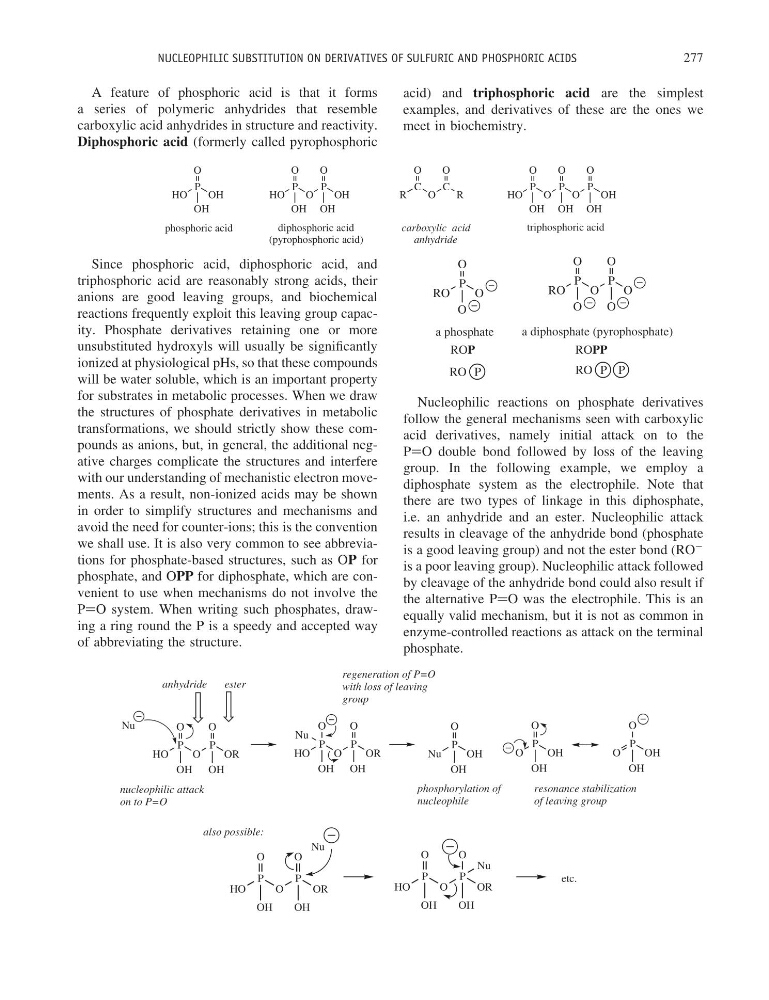
A feature of phosphoric acid is that it forms
a series of polymeric anhydrides that resemble
carboxylic acid anhydrides in structure and reactivity.
Diphosphoric acid (formerly called pyrophosphoric
acid) and triphosphoric acid are the simplest
examples, and derivatives of these are the ones we
meet in biochemistry.
O
C
R
O
C
R
O
phosphoric acid
diphosphoric acid
(pyrophosphoric acid)
triphosphoric acid
carboxylic acid
anhydride
O
P
HO
OH
OH
O
P
HO
O
P
OH
O
OH OH
O
P
HO
O
P
O
O
OH OH
P
OH
O
OH
Since phosphoric acid, diphosphoric acid, and
triphosphoric acid are reasonably strong acids, their
anions are good leaving groups, and biochemical
reactions frequently exploit this leaving group capacity. Phosphate derivatives retaining one or more
unsubstituted hydroxyls will usually be significantly
ionized at physiological pHs, so that these compounds
will be water soluble, which is an important property
for substrates in metabolic processes. When we draw
the structures of phosphate derivatives in metabolic
transformations, we should strictly show these compounds as anions, but, in general, the additional negative charges complicate the structures and interfere
with our understanding of mechanistic electron movements. As a result, non-ionized acids may be shown
in order to simplify structures and mechanisms and
avoid the need for counter-ions; this is the convention
we shall use. It is also very common to see abbreviations for phosphate-based structures, such as OP for
phosphate, and OPP for diphosphate, which are convenient to use when mechanisms do not involve the
P=O system. When writing such phosphates, drawing a ring round the P is a speedy and accepted way
of abbreviating the structure.
ROPP
ROP
a phosphate
a diphosphate (pyrophosphate)
RO
RO
O
P
RO
O
O
O
P
RO
O
P
O
O
O
O
P
P
P
Nucleophilic reactions on phosphate derivatives
follow the general mechanisms seen with carboxylic
acid derivatives, namely initial attack on to the
P=O double bond followed by loss of the leaving
group. In the following example, we employ a
diphosphate system as the electrophile. Note that
there are two types of linkage in this diphosphate,
i.e. an anhydride and an ester. Nucleophilic attack
results in cleavage of the anhydride bond (phosphate
is a good leaving group) and not the ester bond (RO
−
is a poor leaving group). Nucleophilic attack followed
by cleavage of the anhydride bond could also result if
the alternative P=O was the electrophile. This is an
equally valid mechanism, but it is not as common in
enzyme-controlled reactions as attack on the terminal
phosphate.
Nu
phosphorylation of
nucleophile
regeneration of P=O
with loss of leaving
group
resonance stabilization
of leaving group
nucleophilic attack
on to P=O
anhydride
ester
O
P
HO
O
P
OR
O
OH OH
O
P
HO
O
P
OR
O
OH OH
Nu
O
P
Nu
OH
OH
O
P
O
OH
OH
O
P
O
OH
OH
Nu
etc.
also possible:
O
P
HO
O
P
OR
O
OH
OH
O
P
HO
O
P
OR
O
OH
OH
Nu
277
A feature of phosphoric acid is that it forms
a series of polymeric anhydrides that resemble
carboxylic acid anhydrides in structure and reactivity.
Diphosphoric acid (formerly called pyrophosphoric
acid) and triphosphoric acid are the simplest
examples, and derivatives of these are the ones we
meet in biochemistry.
O
C
R
O
C
R
O
phosphoric acid
diphosphoric acid
(pyrophosphoric acid)
triphosphoric acid
carboxylic acid
anhydride
O
P
HO
OH
OH
O
P
HO
O
P
OH
O
OH OH
O
P
HO
O
P
O
O
OH OH
P
OH
O
OH
Since phosphoric acid, diphosphoric acid, and
triphosphoric acid are reasonably strong acids, their
anions are good leaving groups, and biochemical
reactions frequently exploit this leaving group capacity. Phosphate derivatives retaining one or more
unsubstituted hydroxyls will usually be significantly
ionized at physiological pHs, so that these compounds
will be water soluble, which is an important property
for substrates in metabolic processes. When we draw
the structures of phosphate derivatives in metabolic
transformations, we should strictly show these compounds as anions, but, in general, the additional negative charges complicate the structures and interfere
with our understanding of mechanistic electron movements. As a result, non-ionized acids may be shown
in order to simplify structures and mechanisms and
avoid the need for counter-ions; this is the convention
we shall use. It is also very common to see abbreviations for phosphate-based structures, such as OP for
phosphate, and OPP for diphosphate, which are convenient to use when mechanisms do not involve the
P=O system. When writing such phosphates, drawing a ring round the P is a speedy and accepted way
of abbreviating the structure.
ROPP
ROP
a phosphate
a diphosphate (pyrophosphate)
RO
RO
O
P
RO
O
O
O
P
RO
O
P
O
O
O
O
P
P
P
Nucleophilic reactions on phosphate derivatives
follow the general mechanisms seen with carboxylic
acid derivatives, namely initial attack on to the
P=O double bond followed by loss of the leaving
group. In the following example, we employ a
diphosphate system as the electrophile. Note that
there are two types of linkage in this diphosphate,
i.e. an anhydride and an ester. Nucleophilic attack
results in cleavage of the anhydride bond (phosphate
is a good leaving group) and not the ester bond (RO
−
is a poor leaving group). Nucleophilic attack followed
by cleavage of the anhydride bond could also result if
the alternative P=O was the electrophile. This is an
equally valid mechanism, but it is not as common in
enzyme-controlled reactions as attack on the terminal
phosphate.
Nu
phosphorylation of
nucleophile
regeneration of P=O
with loss of leaving
group
resonance stabilization
of leaving group
nucleophilic attack
on to P=O
anhydride
ester
O
P
HO
O
P
OR
O
OH OH
O
P
HO
O
P
OR
O
OH OH
Nu
O
P
Nu
OH
OH
O
P
O
OH
OH
O
P
O
OH
OH
Nu
etc.
also possible:
O
P
HO
O
P
OR
O
OH
OH
O
P
HO
O
P
OR
O
OH
OH
Nu