

276
NUCLEOPHILIC REACTIONS OF CARBONYL GROUPS
acid (pK a 5). It is also a tribasic acid; ionizations
and pK a values are as shown. It follows that, at
pH 7, there will be considerable ionization, and by
application of the Henderson–Hasselbalch equation
(see Section 4.9) the major species at pH 7 can also
be determined.
major species at pH 7
phosphoric acid
O
P
HO
OH
OH
pK a 2.1
O
P
HO
O
OH
pK a 7.2
O
P
HO
O
O
pK a 12.4
O
P
O
O
O
As a tribasic acid it has three replaceable hydroxyls, so that mono-, di-, and tri-substituted derivatives
are possible.
phosphoric acid mono-, di- and tri-substituted derivatives
O
P
HO
OH
OH
O
P
HO
R
OH
O
P
R
R
OH
O
P
R
R
R
Box 7.24
The nucleic acids DNA and RNA feature diesters of phosphoric acid
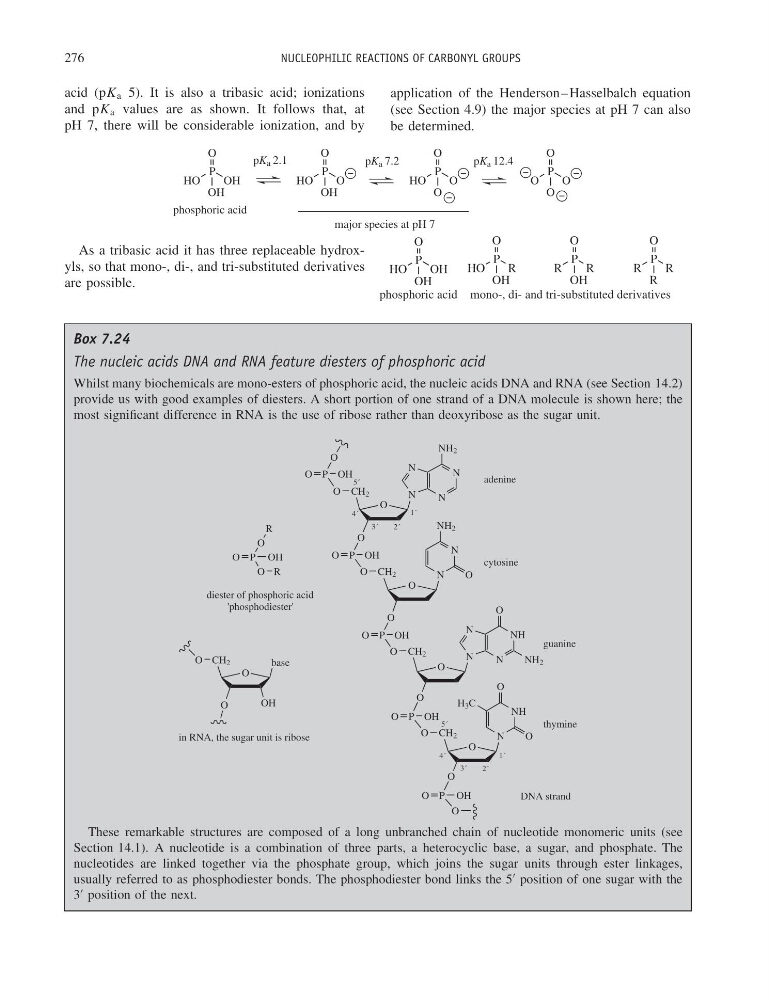
Whilst many biochemicals are mono-esters of phosphoric acid, the nucleic acids DNA and RNA (see Section 14.2)
provide us with good examples of diesters. A short portion of one strand of a DNA molecule is shown here; the
most significant difference in RNA is the use of ribose rather than deoxyribose as the sugar unit.
O
P
O
O
CH 2
N
N
N
NH 2
N
N
NH
N
O
O
N
O
N
N
O
NH 2
O
N
NH
O
O
H 3 C
O
P
O
CH 2
O
P
O
CH 2
O
P
O
CH 2
O
P
O
adenine
cytosine
guanine
thymine
1´
2´
3´
4´
5´
1´
2´
3´
4´
5´
diester of phosphoric acid
'phosphodiester'
DNA strand
O
base
O CH 2
O
OH
in RNA, the sugar unit is ribose
NH 2
P
O
O
O
OH
R
R
O
OH
O
O
O
OH
OH
OH
O
OH
These remarkable structures are composed of a long unbranched chain of nucleotide monomeric units (see
Section 14.1). A nucleotide is a combination of three parts, a heterocyclic base, a sugar, and phosphate. The
nucleotides are linked together via the phosphate group, which joins the sugar units through ester linkages,
usually referred to as phosphodiester bonds. The phosphodiester bond links the 5
position of one sugar with the
3
position of the next.
NUCLEOPHILIC REACTIONS OF CARBONYL GROUPS
acid (pK a 5). It is also a tribasic acid; ionizations
and pK a values are as shown. It follows that, at
pH 7, there will be considerable ionization, and by
application of the Henderson–Hasselbalch equation
(see Section 4.9) the major species at pH 7 can also
be determined.
major species at pH 7
phosphoric acid
O
P
HO
OH
OH
pK a 2.1
O
P
HO
O
OH
pK a 7.2
O
P
HO
O
O
pK a 12.4
O
P
O
O
O
As a tribasic acid it has three replaceable hydroxyls, so that mono-, di-, and tri-substituted derivatives
are possible.
phosphoric acid mono-, di- and tri-substituted derivatives
O
P
HO
OH
OH
O
P
HO
R
OH
O
P
R
R
OH
O
P
R
R
R
Box 7.24
The nucleic acids DNA and RNA feature diesters of phosphoric acid
Whilst many biochemicals are mono-esters of phosphoric acid, the nucleic acids DNA and RNA (see Section 14.2)
provide us with good examples of diesters. A short portion of one strand of a DNA molecule is shown here; the
most significant difference in RNA is the use of ribose rather than deoxyribose as the sugar unit.
O
P
O
O
CH 2
N
N
N
NH 2
N
N
NH
N
O
O
N
O
N
N
O
NH 2
O
N
NH
O
O
H 3 C
O
P
O
CH 2
O
P
O
CH 2
O
P
O
CH 2
O
P
O
adenine
cytosine
guanine
thymine
1´
2´
3´
4´
5´
1´
2´
3´
4´
5´
diester of phosphoric acid
'phosphodiester'
DNA strand
O
base
O CH 2
O
OH
in RNA, the sugar unit is ribose
NH 2
P
O
O
O
OH
R
R
O
OH
O
O
O
OH
OH
OH
O
OH
These remarkable structures are composed of a long unbranched chain of nucleotide monomeric units (see
Section 14.1). A nucleotide is a combination of three parts, a heterocyclic base, a sugar, and phosphate. The
nucleotides are linked together via the phosphate group, which joins the sugar units through ester linkages,
usually referred to as phosphodiester bonds. The phosphodiester bond links the 5
position of one sugar with the
3
position of the next.