

NUCLEOPHILIC SUBSTITUTION ON DERIVATIVES OF SULFURIC AND PHOSPHORIC ACIDS
275
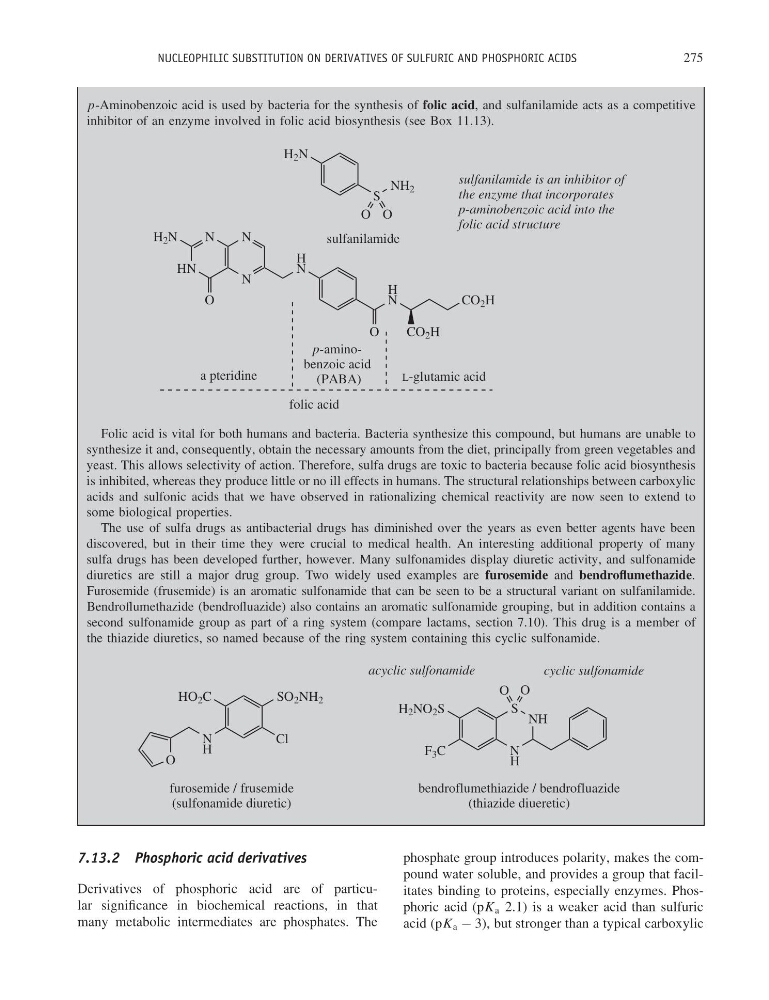
p-Aminobenzoic acid is used by bacteria for the synthesis of folic acid, and sulfanilamide acts as a competitive
inhibitor of an enzyme involved in folic acid biosynthesis (see Box 11.13).
H
N
H
N
CO 2 H
O
CO 2 H
HN
N
N
N
H 2 N
O
folic acid
a pteridine
p-aminobenzoic acid
(PABA)
L-glutamic acid
sulfanilamide
sulfanilamide is an inhibitor of
the enzyme that incorporates
p-aminobenzoic acid into the
folic acid structure
S
NH 2
O
O
H 2 N
Folic acid is vital for both humans and bacteria. Bacteria synthesize this compound, but humans are unable to
synthesize it and, consequently, obtain the necessary amounts from the diet, principally from green vegetables and
yeast. This allows selectivity of action. Therefore, sulfa drugs are toxic to bacteria because folic acid biosynthesis
is inhibited, whereas they produce little or no ill effects in humans. The structural relationships between carboxylic
acids and sulfonic acids that we have observed in rationalizing chemical reactivity are now seen to extend to
some biological properties.
The use of sulfa drugs as antibacterial drugs has diminished over the years as even better agents have been
discovered, but in their time they were crucial to medical health. An interesting additional property of many
sulfa drugs has been developed further, however. Many sulfonamides display diuretic activity, and sulfonamide
diuretics are still a major drug group. Two widely used examples are furosemide and bendroflumethazide.
Furosemide (frusemide) is an aromatic sulfonamide that can be seen to be a structural variant on sulfanilamide.
Bendroflumethazide (bendrofluazide) also contains an aromatic sulfonamide grouping, but in addition contains a
second sulfonamide group as part of a ring system (compare lactams, section 7.10). This drug is a member of
the thiazide diuretics, so named because of the ring system containing this cyclic sulfonamide.
HO 2 C
SO 2 NH 2
Cl
N
H
O
N
H
NH
S
H 2 NO 2 S
F 3 C
acyclic sulfonamide
furosemide / frusemide
(sulfonamide diuretic)
O O
bendroflumethiazide / bendrofluazide
(thiazide diueretic)
cyclic sulfonamide
7.13.2 Phosphoric acid derivatives
Derivatives of phosphoric acid are of particular significance in biochemical reactions, in that
many metabolic intermediates are phosphates. The
phosphate group introduces polarity, makes the compound water soluble, and provides a group that facilitates binding to proteins, especially enzymes. Phosphoric acid (pK a 2.1) is a weaker acid than sulfuric
acid (pK a − 3), but stronger than a typical carboxylic
275
p-Aminobenzoic acid is used by bacteria for the synthesis of folic acid, and sulfanilamide acts as a competitive
inhibitor of an enzyme involved in folic acid biosynthesis (see Box 11.13).
H
N
H
N
CO 2 H
O
CO 2 H
HN
N
N
N
H 2 N
O
folic acid
a pteridine
p-aminobenzoic acid
(PABA)
L-glutamic acid
sulfanilamide
sulfanilamide is an inhibitor of
the enzyme that incorporates
p-aminobenzoic acid into the
folic acid structure
S
NH 2
O
O
H 2 N
Folic acid is vital for both humans and bacteria. Bacteria synthesize this compound, but humans are unable to
synthesize it and, consequently, obtain the necessary amounts from the diet, principally from green vegetables and
yeast. This allows selectivity of action. Therefore, sulfa drugs are toxic to bacteria because folic acid biosynthesis
is inhibited, whereas they produce little or no ill effects in humans. The structural relationships between carboxylic
acids and sulfonic acids that we have observed in rationalizing chemical reactivity are now seen to extend to
some biological properties.
The use of sulfa drugs as antibacterial drugs has diminished over the years as even better agents have been
discovered, but in their time they were crucial to medical health. An interesting additional property of many
sulfa drugs has been developed further, however. Many sulfonamides display diuretic activity, and sulfonamide
diuretics are still a major drug group. Two widely used examples are furosemide and bendroflumethazide.
Furosemide (frusemide) is an aromatic sulfonamide that can be seen to be a structural variant on sulfanilamide.
Bendroflumethazide (bendrofluazide) also contains an aromatic sulfonamide grouping, but in addition contains a
second sulfonamide group as part of a ring system (compare lactams, section 7.10). This drug is a member of
the thiazide diuretics, so named because of the ring system containing this cyclic sulfonamide.
HO 2 C
SO 2 NH 2
Cl
N
H
O
N
H
NH
S
H 2 NO 2 S
F 3 C
acyclic sulfonamide
furosemide / frusemide
(sulfonamide diuretic)
O O
bendroflumethiazide / bendrofluazide
(thiazide diueretic)
cyclic sulfonamide
7.13.2 Phosphoric acid derivatives
Derivatives of phosphoric acid are of particular significance in biochemical reactions, in that
many metabolic intermediates are phosphates. The
phosphate group introduces polarity, makes the compound water soluble, and provides a group that facilitates binding to proteins, especially enzymes. Phosphoric acid (pK a 2.1) is a weaker acid than sulfuric
acid (pK a − 3), but stronger than a typical carboxylic