

274
NUCLEOPHILIC REACTIONS OF CARBONYL GROUPS
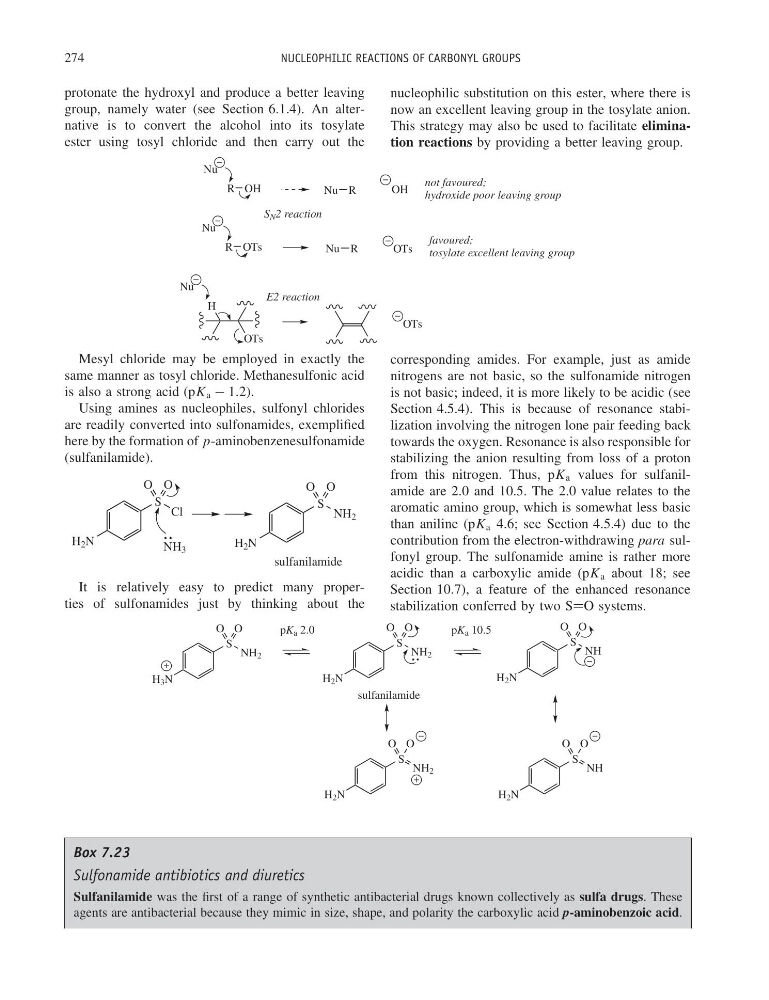
protonate the hydroxyl and produce a better leaving
group, namely water (see Section 6.1.4). An alternative is to convert the alcohol into its tosylate
ester using tosyl chloride and then carry out the
nucleophilic substitution on this ester, where there is
now an excellent leaving group in the tosylate anion.
This strategy may also be used to facilitate elimination reactions by providing a better leaving group.
R OH
Nu
R OTs
E2 reaction
Nu R
S N 2 reaction
Nu R
Nu
Nu
not favoured;
hydroxide poor leaving group
favoured;
tosylate excellent leaving group
H
OTs
OTs
OH
OTs
Mesyl chloride may be employed in exactly the
same manner as tosyl chloride. Methanesulfonic acid
is also a strong acid (pK a − 1.2).
Using amines as nucleophiles, sulfonyl chlorides
are readily converted into sulfonamides, exemplified
here by the formation of p-aminobenzenesulfonamide
(sulfanilamide).
S
Cl
O
O
H 2 N
sulfanilamide
S
NH 2
O
O
H 2 N
NH 3
It is relatively easy to predict many properties of sulfonamides just by thinking about the
corresponding amides. For example, just as amide
nitrogens are not basic, so the sulfonamide nitrogen
is not basic; indeed, it is more likely to be acidic (see
Section 4.5.4). This is because of resonance stabilization involving the nitrogen lone pair feeding back
towards the oxygen. Resonance is also responsible for
stabilizing the anion resulting from loss of a proton
from this nitrogen. Thus, pK a values for sulfanilamide are 2.0 and 10.5. The 2.0 value relates to the
aromatic amino group, which is somewhat less basic
than aniline (pK a 4.6; see Section 4.5.4) due to the
contribution from the electron-withdrawing para sulfonyl group. The sulfonamide amine is rather more
acidic than a carboxylic amide (pK a about 18; see
Section 10.7), a feature of the enhanced resonance
stabilization conferred by two S=O systems.
sulfanilamide
pK a 2.0
pK a 10.5
S
NH 2
O
O
H 2 N
S
NH 2
O
O
H 3 N
S
NH
O
O
H 2 N
S
NH 2
O
O
H 2 N
S
NH
O
O
H 2 N
Box 7.23
Sulfonamide antibiotics and diuretics
Sulfanilamide was the first of a range of synthetic antibacterial drugs known collectively as sulfa drugs. These
agents are antibacterial because they mimic in size, shape, and polarity the carboxylic acid p-aminobenzoic acid.
NUCLEOPHILIC REACTIONS OF CARBONYL GROUPS
protonate the hydroxyl and produce a better leaving
group, namely water (see Section 6.1.4). An alternative is to convert the alcohol into its tosylate
ester using tosyl chloride and then carry out the
nucleophilic substitution on this ester, where there is
now an excellent leaving group in the tosylate anion.
This strategy may also be used to facilitate elimination reactions by providing a better leaving group.
R OH
Nu
R OTs
E2 reaction
Nu R
S N 2 reaction
Nu R
Nu
Nu
not favoured;
hydroxide poor leaving group
favoured;
tosylate excellent leaving group
H
OTs
OTs
OH
OTs
Mesyl chloride may be employed in exactly the
same manner as tosyl chloride. Methanesulfonic acid
is also a strong acid (pK a − 1.2).
Using amines as nucleophiles, sulfonyl chlorides
are readily converted into sulfonamides, exemplified
here by the formation of p-aminobenzenesulfonamide
(sulfanilamide).
S
Cl
O
O
H 2 N
sulfanilamide
S
NH 2
O
O
H 2 N
NH 3
It is relatively easy to predict many properties of sulfonamides just by thinking about the
corresponding amides. For example, just as amide
nitrogens are not basic, so the sulfonamide nitrogen
is not basic; indeed, it is more likely to be acidic (see
Section 4.5.4). This is because of resonance stabilization involving the nitrogen lone pair feeding back
towards the oxygen. Resonance is also responsible for
stabilizing the anion resulting from loss of a proton
from this nitrogen. Thus, pK a values for sulfanilamide are 2.0 and 10.5. The 2.0 value relates to the
aromatic amino group, which is somewhat less basic
than aniline (pK a 4.6; see Section 4.5.4) due to the
contribution from the electron-withdrawing para sulfonyl group. The sulfonamide amine is rather more
acidic than a carboxylic amide (pK a about 18; see
Section 10.7), a feature of the enhanced resonance
stabilization conferred by two S=O systems.
sulfanilamide
pK a 2.0
pK a 10.5
S
NH 2
O
O
H 2 N
S
NH 2
O
O
H 3 N
S
NH
O
O
H 2 N
S
NH 2
O
O
H 2 N
S
NH
O
O
H 2 N
Box 7.23
Sulfonamide antibiotics and diuretics
Sulfanilamide was the first of a range of synthetic antibacterial drugs known collectively as sulfa drugs. These
agents are antibacterial because they mimic in size, shape, and polarity the carboxylic acid p-aminobenzoic acid.