

ELECTROPHILIC ADDITION TO UNSATURATED CARBON
291
Box 8.1
Halohydrins: biological activity of semi-synthetic corticosteroids
Corticosteroids are produced by the adrenal glands, and display two main types of biological activity.
Glucocorticoids are concerned with the synthesis of carbohydrate from protein and the deposition of glycogen
in the liver. They also play an important role in inflammatory processes. Mineralocorticoids are concerned with
the control of electrolyte balance, promoting the retention of Na
+ and Cl
− , and the excretion of K
+ . Synthetic
and semi-synthetic corticosteroid drugs are widely used in medicine. Glucocorticoids are primarily used for their
antirheumatic and anti-inflammatory activities, and mineralocorticoids are used to maintain electrolyte balance
where there is adrenal insufficiency.
The two groups of steroids share considerable structural similarity, and it is difficult to separate entirely the
two types of activity in one molecule. Extensive synthetic effort has been applied to optimize anti-inflammatory
activity, whilst minimizing the mineralocorticoid activity, which tends to produce undesirable side-effects. One
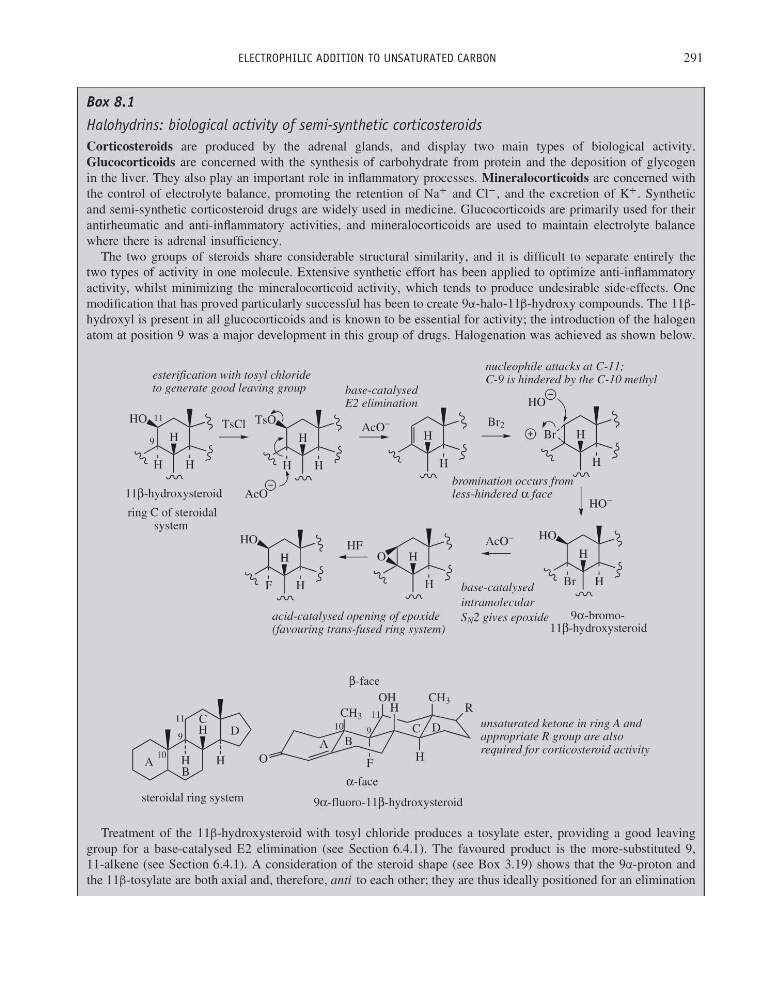
modification that has proved particularly successful has been to create 9α-halo-11β-hydroxy compounds. The 11βhydroxyl is present in all glucocorticoids and is known to be essential for activity; the introduction of the halogen
atom at position 9 was a major development in this group of drugs. Halogenation was achieved as shown below.
TsO
HO
Br
H
H
Br
HO
O
F
HO
H
H
H
H
H
H
H
H
H
H
H
H
H
H
11
9
esterification with tosyl chloride
to generate good leaving group
base-catalysed
E2 elimination
bromination occurs from
less-hindered α face
base-catalysed
intramolecular
S N 2 gives epoxide
acid-catalysed opening of epoxide
(favouring trans-fused ring system)
CH 3
H
CH 3
F
H
OH
O
AcO −
HO −
AcO −
nucleophile attacks at C-11;
C-9 is hindered by the C-10 methyl
9
11
10
β-face
α-face
AcO
9α-fluoro-11β-hydroxysteroid
H
H
H
D
A
B
C
ring C of steroidal
system
A
D
B
C
11
9
10
steroidal ring system
unsaturated ketone in ring A and
appropriate R group are also
required for corticosteroid activity
R
9α-bromo11β-hydroxysteroid
11β-hydroxysteroid
HO
Br 2
TsCl
HF
Treatment of the 11β-hydroxysteroid with tosyl chloride produces a tosylate ester, providing a good leaving
group for a base-catalysed E2 elimination (see Section 6.4.1). The favoured product is the more-substituted 9,
11-alkene (see Section 6.4.1). A consideration of the steroid shape (see Box 3.19) shows that the 9α-proton and
the 11β-tosylate are both axial and, therefore, anti to each other; they are thus ideally positioned for an elimination
291
Box 8.1
Halohydrins: biological activity of semi-synthetic corticosteroids
Corticosteroids are produced by the adrenal glands, and display two main types of biological activity.
Glucocorticoids are concerned with the synthesis of carbohydrate from protein and the deposition of glycogen
in the liver. They also play an important role in inflammatory processes. Mineralocorticoids are concerned with
the control of electrolyte balance, promoting the retention of Na
+ and Cl
− , and the excretion of K
+ . Synthetic
and semi-synthetic corticosteroid drugs are widely used in medicine. Glucocorticoids are primarily used for their
antirheumatic and anti-inflammatory activities, and mineralocorticoids are used to maintain electrolyte balance
where there is adrenal insufficiency.
The two groups of steroids share considerable structural similarity, and it is difficult to separate entirely the
two types of activity in one molecule. Extensive synthetic effort has been applied to optimize anti-inflammatory
activity, whilst minimizing the mineralocorticoid activity, which tends to produce undesirable side-effects. One
modification that has proved particularly successful has been to create 9α-halo-11β-hydroxy compounds. The 11βhydroxyl is present in all glucocorticoids and is known to be essential for activity; the introduction of the halogen
atom at position 9 was a major development in this group of drugs. Halogenation was achieved as shown below.
TsO
HO
Br
H
H
Br
HO
O
F
HO
H
H
H
H
H
H
H
H
H
H
H
H
H
H
11
9
esterification with tosyl chloride
to generate good leaving group
base-catalysed
E2 elimination
bromination occurs from
less-hindered α face
base-catalysed
intramolecular
S N 2 gives epoxide
acid-catalysed opening of epoxide
(favouring trans-fused ring system)
CH 3
H
CH 3
F
H
OH
O
AcO −
HO −
AcO −
nucleophile attacks at C-11;
C-9 is hindered by the C-10 methyl
9
11
10
β-face
α-face
AcO
9α-fluoro-11β-hydroxysteroid
H
H
H
D
A
B
C
ring C of steroidal
system
A
D
B
C
11
9
10
steroidal ring system
unsaturated ketone in ring A and
appropriate R group are also
required for corticosteroid activity
R
9α-bromo11β-hydroxysteroid
11β-hydroxysteroid
HO
Br 2
TsCl
HF
Treatment of the 11β-hydroxysteroid with tosyl chloride produces a tosylate ester, providing a good leaving
group for a base-catalysed E2 elimination (see Section 6.4.1). The favoured product is the more-substituted 9,
11-alkene (see Section 6.4.1). A consideration of the steroid shape (see Box 3.19) shows that the 9α-proton and
the 11β-tosylate are both axial and, therefore, anti to each other; they are thus ideally positioned for an elimination