

270
NUCLEOPHILIC REACTIONS OF CARBONYL GROUPS
Box 7.22 (continued)
R
H
O
Nu
R
H
O
Nu
R
L
O
Nu
R
L
O
Nu
R
Nu
O
R
H
O
R
H
O
Nu
R
H
OH
Nu
H +
− Nu −
− L −
if nucleophile is a good leaving
group, reaction is reversible
if nucleophile is a poor leaving
group, reaction becomes irreversible;
get protonation
in the presence of a good leaving
group, get substitution
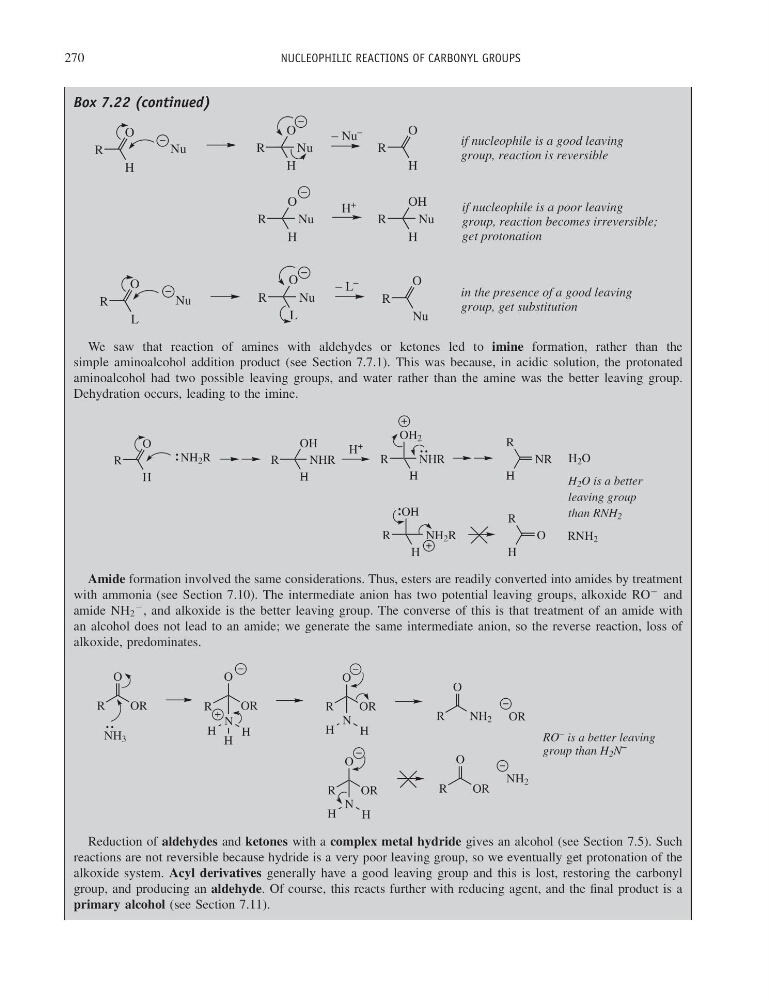
We saw that reaction of amines with aldehydes or ketones led to imine formation, rather than the
simple aminoalcohol addition product (see Section 7.7.1). This was because, in acidic solution, the protonated
aminoalcohol had two possible leaving groups, and water rather than the amine was the better leaving group.
Dehydration occurs, leading to the imine.
R
H
O
NH 2 R
R
H
OH
NHR
R
H
OH 2
NHR
NR
H
R
H 2 O is a better
leaving group
than RNH 2
R
H
OH
NH 2 R
O
H
R
H 2 O
RNH 2
H +
Amide formation involved the same considerations. Thus, esters are readily converted into amides by treatment
with ammonia (see Section 7.10). The intermediate anion has two potential leaving groups, alkoxide RO
− and
amide NH 2
− , and alkoxide is the better leaving group. The converse of this is that treatment of an amide with
an alcohol does not lead to an amide; we generate the same intermediate anion, so the reverse reaction, loss of
alkoxide, predominates.
R
O
OR
R
O
NH 2
R
O
OR
N
H
H
H
R
O
OR
N
H
H
R
O
OR
N
H
H
R
O
OR
OR
RO − is a better leaving
group than H 2 N −
NH 3
NH 2
Reduction of aldehydes and ketones with a complex metal hydride gives an alcohol (see Section 7.5). Such
reactions are not reversible because hydride is a very poor leaving group, so we eventually get protonation of the
alkoxide system. Acyl derivatives generally have a good leaving group and this is lost, restoring the carbonyl
group, and producing an aldehyde. Of course, this reacts further with reducing agent, and the final product is a
primary alcohol (see Section 7.11).
NUCLEOPHILIC REACTIONS OF CARBONYL GROUPS
Box 7.22 (continued)
R
H
O
Nu
R
H
O
Nu
R
L
O
Nu
R
L
O
Nu
R
Nu
O
R
H
O
R
H
O
Nu
R
H
OH
Nu
H +
− Nu −
− L −
if nucleophile is a good leaving
group, reaction is reversible
if nucleophile is a poor leaving
group, reaction becomes irreversible;
get protonation
in the presence of a good leaving
group, get substitution
We saw that reaction of amines with aldehydes or ketones led to imine formation, rather than the
simple aminoalcohol addition product (see Section 7.7.1). This was because, in acidic solution, the protonated
aminoalcohol had two possible leaving groups, and water rather than the amine was the better leaving group.
Dehydration occurs, leading to the imine.
R
H
O
NH 2 R
R
H
OH
NHR
R
H
OH 2
NHR
NR
H
R
H 2 O is a better
leaving group
than RNH 2
R
H
OH
NH 2 R
O
H
R
H 2 O
RNH 2
H +
Amide formation involved the same considerations. Thus, esters are readily converted into amides by treatment
with ammonia (see Section 7.10). The intermediate anion has two potential leaving groups, alkoxide RO
− and
amide NH 2
− , and alkoxide is the better leaving group. The converse of this is that treatment of an amide with
an alcohol does not lead to an amide; we generate the same intermediate anion, so the reverse reaction, loss of
alkoxide, predominates.
R
O
OR
R
O
NH 2
R
O
OR
N
H
H
H
R
O
OR
N
H
H
R
O
OR
N
H
H
R
O
OR
OR
RO − is a better leaving
group than H 2 N −
NH 3
NH 2
Reduction of aldehydes and ketones with a complex metal hydride gives an alcohol (see Section 7.5). Such
reactions are not reversible because hydride is a very poor leaving group, so we eventually get protonation of the
alkoxide system. Acyl derivatives generally have a good leaving group and this is lost, restoring the carbonyl
group, and producing an aldehyde. Of course, this reacts further with reducing agent, and the final product is a
primary alcohol (see Section 7.11).