

CARBON AS A NUCLEOPHILE: GRIGNARD REAGENTS
271
O
R
L
O
H
AlH 3
O
R
H
aldehyde
primary alcohol
H AlH 3
L
R
H
− and R
− are poor leaving
groups, reaction irreversible
and get protonation
good leaving group,
carbonyl reforms and is
subsequently reduced
H
+
O
R
H
O
H
AlH 3
OH
R
H
H AlH 3
H
R
H
H
+
RCH 2 OH
Li
Li
Li
Li
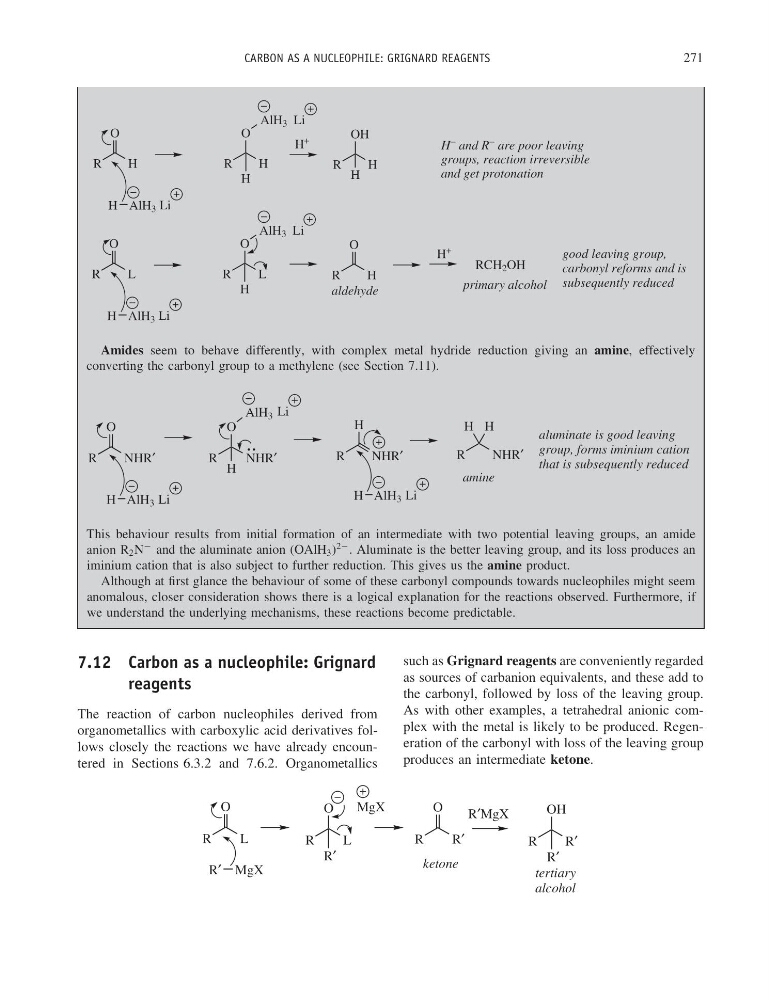
Amides seem to behave differently, with complex metal hydride reduction giving an amine, effectively
converting the carbonyl group to a methylene (see Section 7.11).
O
R
NHR′
H
AlH 3
H
R
NHR′
H AlH 3
O
R
NHR′
H AlH 3
R
NHR′
H
H
amine
aluminate is good leaving
group, forms iminium cation
that is subsequently reduced
Li
Li
Li
This behaviour results from initial formation of an intermediate with two potential leaving groups, an amide
anion R 2 N
− and the aluminate anion (OAlH 3 )
2− . Aluminate is the better leaving group, and its loss produces an
iminium cation that is also subject to further reduction. This gives us the amine product.
Although at first glance the behaviour of some of these carbonyl compounds towards nucleophiles might seem
anomalous, closer consideration shows there is a logical explanation for the reactions observed. Furthermore, if
we understand the underlying mechanisms, these reactions become predictable.
7.12 Carbon as a nucleophile: Grignard
reagents
The reaction of carbon nucleophiles derived from
organometallics with carboxylic acid derivatives follows closely the reactions we have already encountered in Sections 6.3.2 and 7.6.2. Organometallics
such as Grignard reagents are conveniently regarded
as sources of carbanion equivalents, and these add to
the carbonyl, followed by loss of the leaving group.
As with other examples, a tetrahedral anionic complex with the metal is likely to be produced. Regeneration of the carbonyl with loss of the leaving group
produces an intermediate ketone.
R′ MgX
O
R
L
O
R′
O
R
R′
OH
R′
tertiary
alcohol
ketone
R′MgX
R
L
R
R′
MgX
271
O
R
L
O
H
AlH 3
O
R
H
aldehyde
primary alcohol
H AlH 3
L
R
H
− and R
− are poor leaving
groups, reaction irreversible
and get protonation
good leaving group,
carbonyl reforms and is
subsequently reduced
H
+
O
R
H
O
H
AlH 3
OH
R
H
H AlH 3
H
R
H
H
+
RCH 2 OH
Li
Li
Li
Li
Amides seem to behave differently, with complex metal hydride reduction giving an amine, effectively
converting the carbonyl group to a methylene (see Section 7.11).
O
R
NHR′
H
AlH 3
H
R
NHR′
H AlH 3
O
R
NHR′
H AlH 3
R
NHR′
H
H
amine
aluminate is good leaving
group, forms iminium cation
that is subsequently reduced
Li
Li
Li
This behaviour results from initial formation of an intermediate with two potential leaving groups, an amide
anion R 2 N
− and the aluminate anion (OAlH 3 )
2− . Aluminate is the better leaving group, and its loss produces an
iminium cation that is also subject to further reduction. This gives us the amine product.
Although at first glance the behaviour of some of these carbonyl compounds towards nucleophiles might seem
anomalous, closer consideration shows there is a logical explanation for the reactions observed. Furthermore, if
we understand the underlying mechanisms, these reactions become predictable.
7.12 Carbon as a nucleophile: Grignard
reagents
The reaction of carbon nucleophiles derived from
organometallics with carboxylic acid derivatives follows closely the reactions we have already encountered in Sections 6.3.2 and 7.6.2. Organometallics
such as Grignard reagents are conveniently regarded
as sources of carbanion equivalents, and these add to
the carbonyl, followed by loss of the leaving group.
As with other examples, a tetrahedral anionic complex with the metal is likely to be produced. Regeneration of the carbonyl with loss of the leaving group
produces an intermediate ketone.
R′ MgX
O
R
L
O
R′
O
R
R′
OH
R′
tertiary
alcohol
ketone
R′MgX
R
L
R
R′
MgX