

HYDRIDE AS A NUCLEOPHILE: REDUCTION OF CARBOXYLIC ACID DERIVATIVES
269
Therefore, it is possible to reduce both carbonyl groups in the ketoester methyl 4-oxocyclohexanecarboxylate
using LAH. Sodium borohydride will reduce only the ketone, giving the hydroxyester. However, by using a ketal
as protecting group (see Section 7.2) it is possible to reduce just the ester with LAH, and the original ketone can
be regenerated by hydrolysis of the ketal.
Amides behave differently towards LAH than the
other carboxylic acid derivatives, and the overall
reaction observed is reduction of the carbonyl to a
methylene group, with retention of the amino group.
LAH
primary amide
primary amine
RCONH 2
RCH 2 NH 2
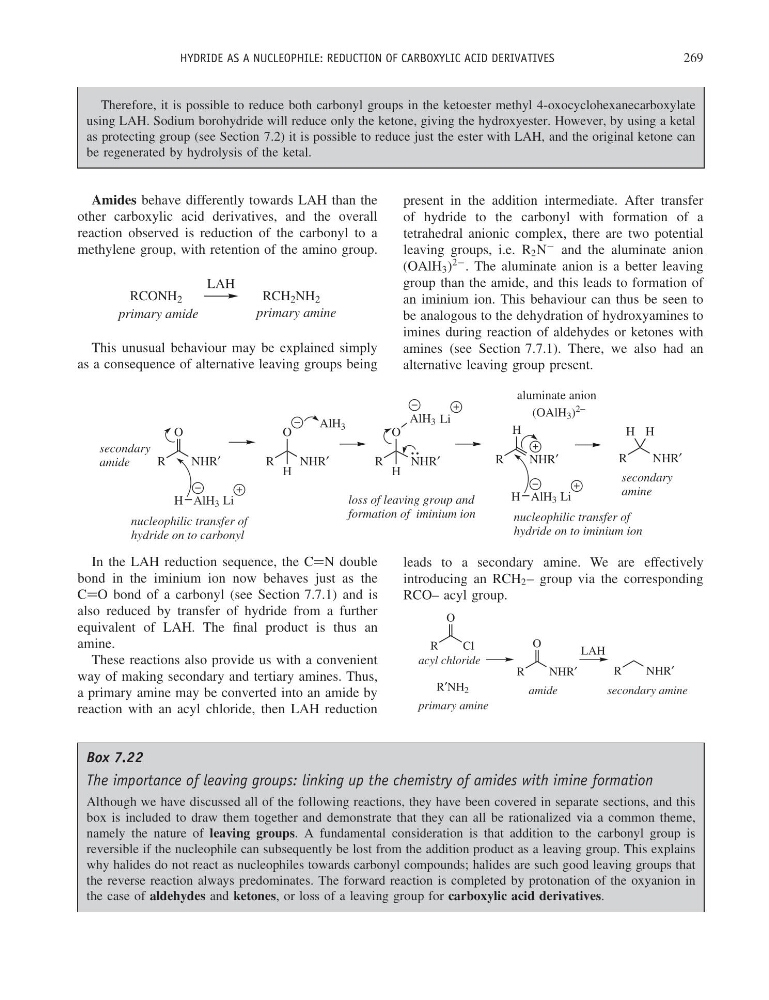
This unusual behaviour may be explained simply
as a consequence of alternative leaving groups being
present in the addition intermediate. After transfer
of hydride to the carbonyl with formation of a
tetrahedral anionic complex, there are two potential
leaving groups, i.e. R 2 N
− and the aluminate anion
(OAlH 3 )
2− . The aluminate anion is a better leaving
group than the amide, and this leads to formation of
an iminium ion. This behaviour can thus be seen to
be analogous to the dehydration of hydroxyamines to
imines during reaction of aldehydes or ketones with
amines (see Section 7.7.1). There, we also had an
alternative leaving group present.
O
R
NHR′
H
AlH 3
H
R
NHR′
H AlH 3
O
R
NHR′
H AlH 3
O
R
NHR′
H
AlH 3
R
NHR′
H
H
secondary
amine
nucleophilic transfer of
hydride on to iminium ion
nucleophilic transfer of
hydride on to carbonyl
(OAlH 3 )
2−
aluminate anion
loss of leaving group and
formation of iminium ion
secondary
amide
Li
Li
Li
In the LAH reduction sequence, the C=N double
bond in the iminium ion now behaves just as the
C=O bond of a carbonyl (see Section 7.7.1) and is
also reduced by transfer of hydride from a further
equivalent of LAH. The final product is thus an
amine.
These reactions also provide us with a convenient
way of making secondary and tertiary amines. Thus,
a primary amine may be converted into an amide by
reaction with an acyl chloride, then LAH reduction
leads to a secondary amine. We are effectively
introducing an RCH 2 – group via the corresponding
RCO– acyl group.
O
R
NHR′
O
R
Cl
R′NH 2
R
NHR′
LAH
acyl chloride
primary amine
amide
secondary amine
Box 7.22
The importance of leaving groups: linking up the chemistry of amides with imine formation
Although we have discussed all of the following reactions, they have been covered in separate sections, and this
box is included to draw them together and demonstrate that they can all be rationalized via a common theme,
namely the nature of leaving groups. A fundamental consideration is that addition to the carbonyl group is
reversible if the nucleophile can subsequently be lost from the addition product as a leaving group. This explains
why halides do not react as nucleophiles towards carbonyl compounds; halides are such good leaving groups that
the reverse reaction always predominates. The forward reaction is completed by protonation of the oxyanion in
the case of aldehydes and ketones, or loss of a leaving group for carboxylic acid derivatives.
269
Therefore, it is possible to reduce both carbonyl groups in the ketoester methyl 4-oxocyclohexanecarboxylate
using LAH. Sodium borohydride will reduce only the ketone, giving the hydroxyester. However, by using a ketal
as protecting group (see Section 7.2) it is possible to reduce just the ester with LAH, and the original ketone can
be regenerated by hydrolysis of the ketal.
Amides behave differently towards LAH than the
other carboxylic acid derivatives, and the overall
reaction observed is reduction of the carbonyl to a
methylene group, with retention of the amino group.
LAH
primary amide
primary amine
RCONH 2
RCH 2 NH 2
This unusual behaviour may be explained simply
as a consequence of alternative leaving groups being
present in the addition intermediate. After transfer
of hydride to the carbonyl with formation of a
tetrahedral anionic complex, there are two potential
leaving groups, i.e. R 2 N
− and the aluminate anion
(OAlH 3 )
2− . The aluminate anion is a better leaving
group than the amide, and this leads to formation of
an iminium ion. This behaviour can thus be seen to
be analogous to the dehydration of hydroxyamines to
imines during reaction of aldehydes or ketones with
amines (see Section 7.7.1). There, we also had an
alternative leaving group present.
O
R
NHR′
H
AlH 3
H
R
NHR′
H AlH 3
O
R
NHR′
H AlH 3
O
R
NHR′
H
AlH 3
R
NHR′
H
H
secondary
amine
nucleophilic transfer of
hydride on to iminium ion
nucleophilic transfer of
hydride on to carbonyl
(OAlH 3 )
2−
aluminate anion
loss of leaving group and
formation of iminium ion
secondary
amide
Li
Li
Li
In the LAH reduction sequence, the C=N double
bond in the iminium ion now behaves just as the
C=O bond of a carbonyl (see Section 7.7.1) and is
also reduced by transfer of hydride from a further
equivalent of LAH. The final product is thus an
amine.
These reactions also provide us with a convenient
way of making secondary and tertiary amines. Thus,
a primary amine may be converted into an amide by
reaction with an acyl chloride, then LAH reduction
leads to a secondary amine. We are effectively
introducing an RCH 2 – group via the corresponding
RCO– acyl group.
O
R
NHR′
O
R
Cl
R′NH 2
R
NHR′
LAH
acyl chloride
primary amine
amide
secondary amine
Box 7.22
The importance of leaving groups: linking up the chemistry of amides with imine formation
Although we have discussed all of the following reactions, they have been covered in separate sections, and this
box is included to draw them together and demonstrate that they can all be rationalized via a common theme,
namely the nature of leaving groups. A fundamental consideration is that addition to the carbonyl group is
reversible if the nucleophile can subsequently be lost from the addition product as a leaving group. This explains
why halides do not react as nucleophiles towards carbonyl compounds; halides are such good leaving groups that
the reverse reaction always predominates. The forward reaction is completed by protonation of the oxyanion in
the case of aldehydes and ketones, or loss of a leaving group for carboxylic acid derivatives.