

268
NUCLEOPHILIC REACTIONS OF CARBONYL GROUPS
O
R
L
O
H
AlH 3
O
R
H
AlH 3
aldehyde
LAH
primary alcohol
LiAlH 3 L
or
carbonyl oxygen combines
with Lewis acid AlH 3
loss of leaving group,
regeneration of carbonyl
aldehyde reacts further with
LAH; more reactive than
carboxylic acid derivative
H AlH 3
O
R
L
H
L
R
nucleophilic transfer of
hydride on to carbonyl
RCH 2 OH
H 2 O
Li
Li
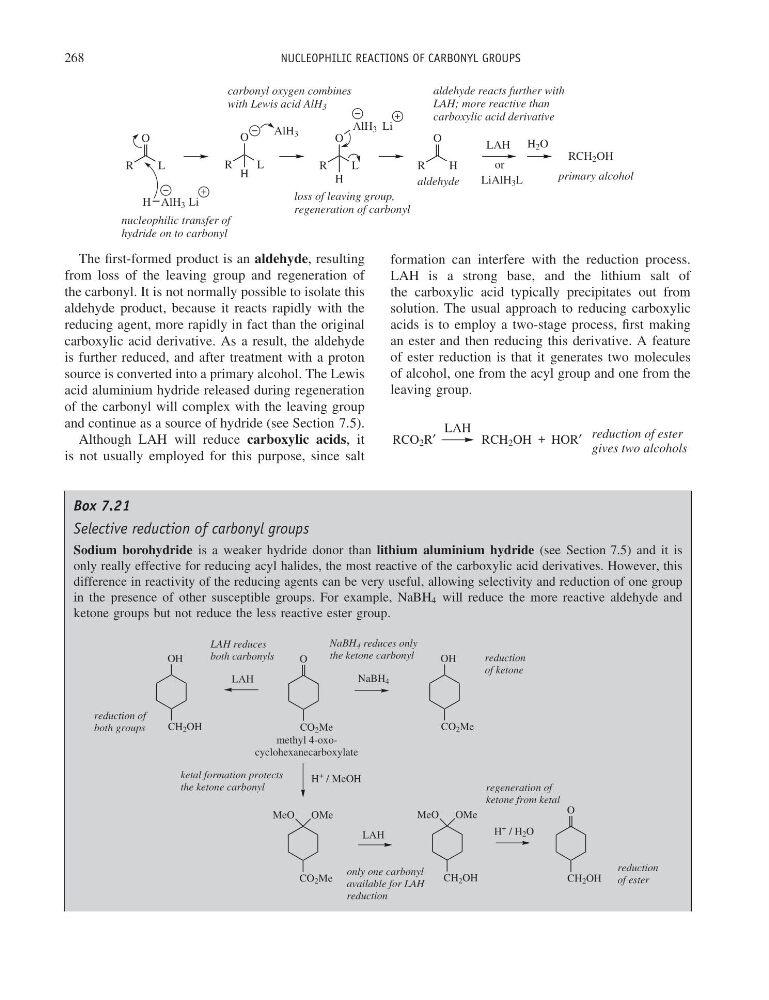
The first-formed product is an aldehyde, resulting
from loss of the leaving group and regeneration of
the carbonyl. It is not normally possible to isolate this
aldehyde product, because it reacts rapidly with the
reducing agent, more rapidly in fact than the original
carboxylic acid derivative. As a result, the aldehyde
is further reduced, and after treatment with a proton
source is converted into a primary alcohol. The Lewis
acid aluminium hydride released during regeneration
of the carbonyl will complex with the leaving group
and continue as a source of hydride (see Section 7.5).
Although LAH will reduce carboxylic acids, it
is not usually employed for this purpose, since salt
formation can interfere with the reduction process.
LAH is a strong base, and the lithium salt of
the carboxylic acid typically precipitates out from
solution. The usual approach to reducing carboxylic
acids is to employ a two-stage process, first making
an ester and then reducing this derivative. A feature
of ester reduction is that it generates two molecules
of alcohol, one from the acyl group and one from the
leaving group.
RCO 2 R′
HOR′
LAH
+
reduction of ester
gives two alcohols
RCH 2 OH
Box 7.21
Selective reduction of carbonyl groups
Sodium borohydride is a weaker hydride donor than lithium aluminium hydride (see Section 7.5) and it is
only really effective for reducing acyl halides, the most reactive of the carboxylic acid derivatives. However, this
difference in reactivity of the reducing agents can be very useful, allowing selectivity and reduction of one group
in the presence of other susceptible groups. For example, NaBH 4 will reduce the more reactive aldehyde and
ketone groups but not reduce the less reactive ester group.
O
CO 2 Me
OH
CH 2 OH
OH
CO 2 Me
CO 2 Me
OMe
MeO
CH 2 OH
OMe
MeO
O
CH 2 OH
LAH
H
+ / MeOH
LAH
H
+ / H 2 O
ketal formation protects
the ketone carbonyl
NaBH 4 reduces only
the ketone carbonyl
methyl 4-oxocyclohexanecarboxylate
only one carbonyl
available for LAH
reduction
LAH reduces
both carbonyls
regeneration of
ketone from ketal
reduction of
both groups
reduction
of ketone
reduction
of ester
NaBH 4
NUCLEOPHILIC REACTIONS OF CARBONYL GROUPS
O
R
L
O
H
AlH 3
O
R
H
AlH 3
aldehyde
LAH
primary alcohol
LiAlH 3 L
or
carbonyl oxygen combines
with Lewis acid AlH 3
loss of leaving group,
regeneration of carbonyl
aldehyde reacts further with
LAH; more reactive than
carboxylic acid derivative
H AlH 3
O
R
L
H
L
R
nucleophilic transfer of
hydride on to carbonyl
RCH 2 OH
H 2 O
Li
Li
The first-formed product is an aldehyde, resulting
from loss of the leaving group and regeneration of
the carbonyl. It is not normally possible to isolate this
aldehyde product, because it reacts rapidly with the
reducing agent, more rapidly in fact than the original
carboxylic acid derivative. As a result, the aldehyde
is further reduced, and after treatment with a proton
source is converted into a primary alcohol. The Lewis
acid aluminium hydride released during regeneration
of the carbonyl will complex with the leaving group
and continue as a source of hydride (see Section 7.5).
Although LAH will reduce carboxylic acids, it
is not usually employed for this purpose, since salt
formation can interfere with the reduction process.
LAH is a strong base, and the lithium salt of
the carboxylic acid typically precipitates out from
solution. The usual approach to reducing carboxylic
acids is to employ a two-stage process, first making
an ester and then reducing this derivative. A feature
of ester reduction is that it generates two molecules
of alcohol, one from the acyl group and one from the
leaving group.
RCO 2 R′
HOR′
LAH
+
reduction of ester
gives two alcohols
RCH 2 OH
Box 7.21
Selective reduction of carbonyl groups
Sodium borohydride is a weaker hydride donor than lithium aluminium hydride (see Section 7.5) and it is
only really effective for reducing acyl halides, the most reactive of the carboxylic acid derivatives. However, this
difference in reactivity of the reducing agents can be very useful, allowing selectivity and reduction of one group
in the presence of other susceptible groups. For example, NaBH 4 will reduce the more reactive aldehyde and
ketone groups but not reduce the less reactive ester group.
O
CO 2 Me
OH
CH 2 OH
OH
CO 2 Me
CO 2 Me
OMe
MeO
CH 2 OH
OMe
MeO
O
CH 2 OH
LAH
H
+ / MeOH
LAH
H
+ / H 2 O
ketal formation protects
the ketone carbonyl
NaBH 4 reduces only
the ketone carbonyl
methyl 4-oxocyclohexanecarboxylate
only one carbonyl
available for LAH
reduction
LAH reduces
both carbonyls
regeneration of
ketone from ketal
reduction of
both groups
reduction
of ketone
reduction
of ester
NaBH 4