

HYDRIDE AS A NUCLEOPHILE: REDUCTION OF CARBOXYLIC ACID DERIVATIVES
267
H
N
N
O
R
O
H
CO 2 H
Ser
OH
H
N
HN
O
R
O
H
CO 2 H
Ser
O
H
N
N
O
R
O
H
CO 2 H
Ser
OH
NH 2
CO 2 H
HO
the common substructure
in β-lactam antibiotics
hydrolysis
of β-lactam
amide bond
Enzyme
Enzyme
Enzyme
Serine
H 2 O
H
N
HN
R
O
H
CO 2 H
Ser
O
Enzyme
O
HO
H
N
HO 2 C HN
R
O
H
CO 2 H
Ser
OH
Enzyme
penicilloic acid
derivative − inactive
hydrolysis of
ester function,
release from
enzyme
antibiotic inactivated
by ring opening and
binding to enzyme
H
H
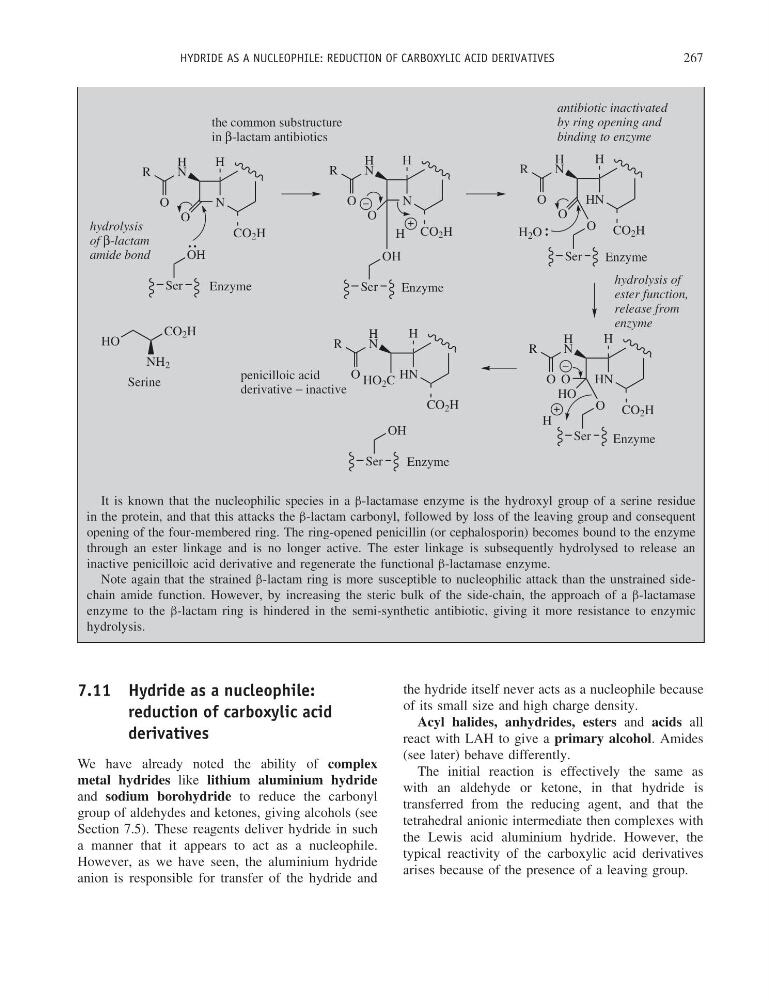
It is known that the nucleophilic species in a β-lactamase enzyme is the hydroxyl group of a serine residue
in the protein, and that this attacks the β-lactam carbonyl, followed by loss of the leaving group and consequent
opening of the four-membered ring. The ring-opened penicillin (or cephalosporin) becomes bound to the enzyme
through an ester linkage and is no longer active. The ester linkage is subsequently hydrolysed to release an
inactive penicilloic acid derivative and regenerate the functional β-lactamase enzyme.
Note again that the strained β-lactam ring is more susceptible to nucleophilic attack than the unstrained sidechain amide function. However, by increasing the steric bulk of the side-chain, the approach of a β-lactamase
enzyme to the β-lactam ring is hindered in the semi-synthetic antibiotic, giving it more resistance to enzymic
hydrolysis.
7.11 Hydride as a nucleophile:
reduction of carboxylic acid
derivatives
We have already noted the ability of complex
metal hydrides like lithium aluminium hydride
and sodium borohydride to reduce the carbonyl
group of aldehydes and ketones, giving alcohols (see
Section 7.5). These reagents deliver hydride in such
a manner that it appears to act as a nucleophile.
However, as we have seen, the aluminium hydride
anion is responsible for transfer of the hydride and
the hydride itself never acts as a nucleophile because
of its small size and high charge density.
Acyl halides, anhydrides, esters and acids all
react with LAH to give a primary alcohol. Amides
(see later) behave differently.
The initial reaction is effectively the same as
with an aldehyde or ketone, in that hydride is
transferred from the reducing agent, and that the
tetrahedral anionic intermediate then complexes with
the Lewis acid aluminium hydride. However, the
typical reactivity of the carboxylic acid derivatives
arises because of the presence of a leaving group.
267
H
N
N
O
R
O
H
CO 2 H
Ser
OH
H
N
HN
O
R
O
H
CO 2 H
Ser
O
H
N
N
O
R
O
H
CO 2 H
Ser
OH
NH 2
CO 2 H
HO
the common substructure
in β-lactam antibiotics
hydrolysis
of β-lactam
amide bond
Enzyme
Enzyme
Enzyme
Serine
H 2 O
H
N
HN
R
O
H
CO 2 H
Ser
O
Enzyme
O
HO
H
N
HO 2 C HN
R
O
H
CO 2 H
Ser
OH
Enzyme
penicilloic acid
derivative − inactive
hydrolysis of
ester function,
release from
enzyme
antibiotic inactivated
by ring opening and
binding to enzyme
H
H
It is known that the nucleophilic species in a β-lactamase enzyme is the hydroxyl group of a serine residue
in the protein, and that this attacks the β-lactam carbonyl, followed by loss of the leaving group and consequent
opening of the four-membered ring. The ring-opened penicillin (or cephalosporin) becomes bound to the enzyme
through an ester linkage and is no longer active. The ester linkage is subsequently hydrolysed to release an
inactive penicilloic acid derivative and regenerate the functional β-lactamase enzyme.
Note again that the strained β-lactam ring is more susceptible to nucleophilic attack than the unstrained sidechain amide function. However, by increasing the steric bulk of the side-chain, the approach of a β-lactamase
enzyme to the β-lactam ring is hindered in the semi-synthetic antibiotic, giving it more resistance to enzymic
hydrolysis.
7.11 Hydride as a nucleophile:
reduction of carboxylic acid
derivatives
We have already noted the ability of complex
metal hydrides like lithium aluminium hydride
and sodium borohydride to reduce the carbonyl
group of aldehydes and ketones, giving alcohols (see
Section 7.5). These reagents deliver hydride in such
a manner that it appears to act as a nucleophile.
However, as we have seen, the aluminium hydride
anion is responsible for transfer of the hydride and
the hydride itself never acts as a nucleophile because
of its small size and high charge density.
Acyl halides, anhydrides, esters and acids all
react with LAH to give a primary alcohol. Amides
(see later) behave differently.
The initial reaction is effectively the same as
with an aldehyde or ketone, in that hydride is
transferred from the reducing agent, and that the
tetrahedral anionic intermediate then complexes with
the Lewis acid aluminium hydride. However, the
typical reactivity of the carboxylic acid derivatives
arises because of the presence of a leaving group.