

OXYGEN AND SULFUR AS NUCLEOPHILES: ESTERS AND CARBOXYLIC ACIDS
261
Box 7.17
Amide hydrolysis: peptides and proteins
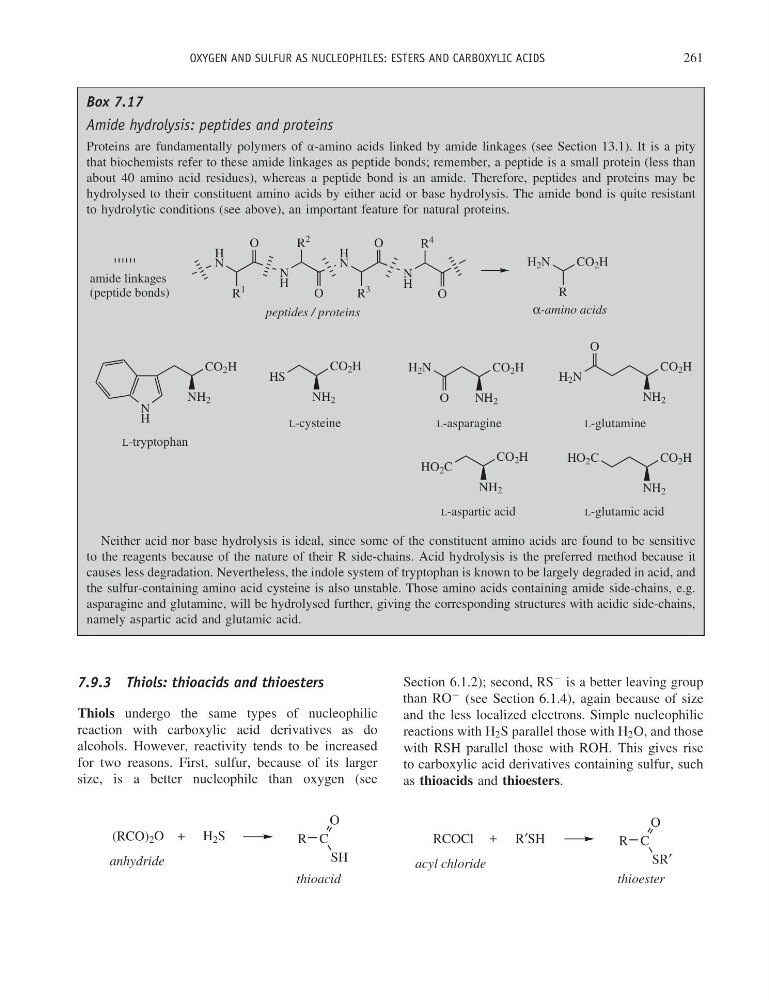
Proteins are fundamentally polymers of α-amino acids linked by amide linkages (see Section 13.1). It is a pity
that biochemists refer to these amide linkages as peptide bonds; remember, a peptide is a small protein (less than
about 40 amino acid residues), whereas a peptide bond is an amide. Therefore, peptides and proteins may be
hydrolysed to their constituent amino acids by either acid or base hydrolysis. The amide bond is quite resistant
to hydrolytic conditions (see above), an important feature for natural proteins.
H
N
N
H
H
N
R
1
O
R 2
O
R
3
N
H
O
R 4
O
H 2 N
CO 2 H
R
H 2 N
O
CO 2 H
NH 2
CO 2 H
NH 2
H 2 N
O
HO 2 C
CO 2 H
NH 2
HO 2 C
CO 2 H
NH 2
L-asparagine
α-amino acids
L-aspartic acid
peptides / proteins
L-glutamine
L-glutamic acid
amide linkages
(peptide bonds)
N
H
CO 2 H
NH 2
L-tryptophan
HS
CO 2 H
NH 2
L-cysteine
Neither acid nor base hydrolysis is ideal, since some of the constituent amino acids are found to be sensitive
to the reagents because of the nature of their R side-chains. Acid hydrolysis is the preferred method because it
causes less degradation. Nevertheless, the indole system of tryptophan is known to be largely degraded in acid, and
the sulfur-containing amino acid cysteine is also unstable. Those amino acids containing amide side-chains, e.g.
asparagine and glutamine, will be hydrolysed further, giving the corresponding structures with acidic side-chains,
namely aspartic acid and glutamic acid.
7.9.3 Thiols: thioacids and thioesters
Thiols undergo the same types of nucleophilic
reaction with carboxylic acid derivatives as do
alcohols. However, reactivity tends to be increased
for two reasons. First, sulfur, because of its larger
size, is a better nucleophile than oxygen (see
Section 6.1.2); second, RS
− is a better leaving group
than RO
− (see Section 6.1.4), again because of size
and the less localized electrons. Simple nucleophilic
reactions with H 2 S parallel those with H 2 O, and those
with RSH parallel those with ROH. This gives rise
to carboxylic acid derivatives containing sulfur, such
as thioacids and thioesters.
R C
O
SH
R C
O
SR′
thioacid
+
R′SH
+
thioester
anhydride
acyl chloride
(RCO) 2 O
H 2 S
RCOCl
261
Box 7.17
Amide hydrolysis: peptides and proteins
Proteins are fundamentally polymers of α-amino acids linked by amide linkages (see Section 13.1). It is a pity
that biochemists refer to these amide linkages as peptide bonds; remember, a peptide is a small protein (less than
about 40 amino acid residues), whereas a peptide bond is an amide. Therefore, peptides and proteins may be
hydrolysed to their constituent amino acids by either acid or base hydrolysis. The amide bond is quite resistant
to hydrolytic conditions (see above), an important feature for natural proteins.
H
N
N
H
H
N
R
1
O
R 2
O
R
3
N
H
O
R 4
O
H 2 N
CO 2 H
R
H 2 N
O
CO 2 H
NH 2
CO 2 H
NH 2
H 2 N
O
HO 2 C
CO 2 H
NH 2
HO 2 C
CO 2 H
NH 2
L-asparagine
α-amino acids
L-aspartic acid
peptides / proteins
L-glutamine
L-glutamic acid
amide linkages
(peptide bonds)
N
H
CO 2 H
NH 2
L-tryptophan
HS
CO 2 H
NH 2
L-cysteine
Neither acid nor base hydrolysis is ideal, since some of the constituent amino acids are found to be sensitive
to the reagents because of the nature of their R side-chains. Acid hydrolysis is the preferred method because it
causes less degradation. Nevertheless, the indole system of tryptophan is known to be largely degraded in acid, and
the sulfur-containing amino acid cysteine is also unstable. Those amino acids containing amide side-chains, e.g.
asparagine and glutamine, will be hydrolysed further, giving the corresponding structures with acidic side-chains,
namely aspartic acid and glutamic acid.
7.9.3 Thiols: thioacids and thioesters
Thiols undergo the same types of nucleophilic
reaction with carboxylic acid derivatives as do
alcohols. However, reactivity tends to be increased
for two reasons. First, sulfur, because of its larger
size, is a better nucleophile than oxygen (see
Section 6.1.2); second, RS
− is a better leaving group
than RO
− (see Section 6.1.4), again because of size
and the less localized electrons. Simple nucleophilic
reactions with H 2 S parallel those with H 2 O, and those
with RSH parallel those with ROH. This gives rise
to carboxylic acid derivatives containing sulfur, such
as thioacids and thioesters.
R C
O
SH
R C
O
SR′
thioacid
+
R′SH
+
thioester
anhydride
acyl chloride
(RCO) 2 O
H 2 S
RCOCl