

260
NUCLEOPHILIC REACTIONS OF CARBONYL GROUPS
OH
R
NHMe
OH
R
OH
O
R
OH
O
R
NHMe
acid hydrolysis of amides
nucleophilic attack on to
protonated carbonyl
equilibrium:
loss of proton to solvent, then
reprotonation from solvent;
nitrogen is more basic than oxygen
secondary amide
carboxylic acid
protonation of
carbonyl oxygen;
formation of
conjugate acid
OH
R
NHMe
OH 2
OH
R
NHMe
OH
OH
R
NH 2 Me
HO
− H +
+ H +
H
H 2 O
H
NH 2 Me
H
NH 2 Me
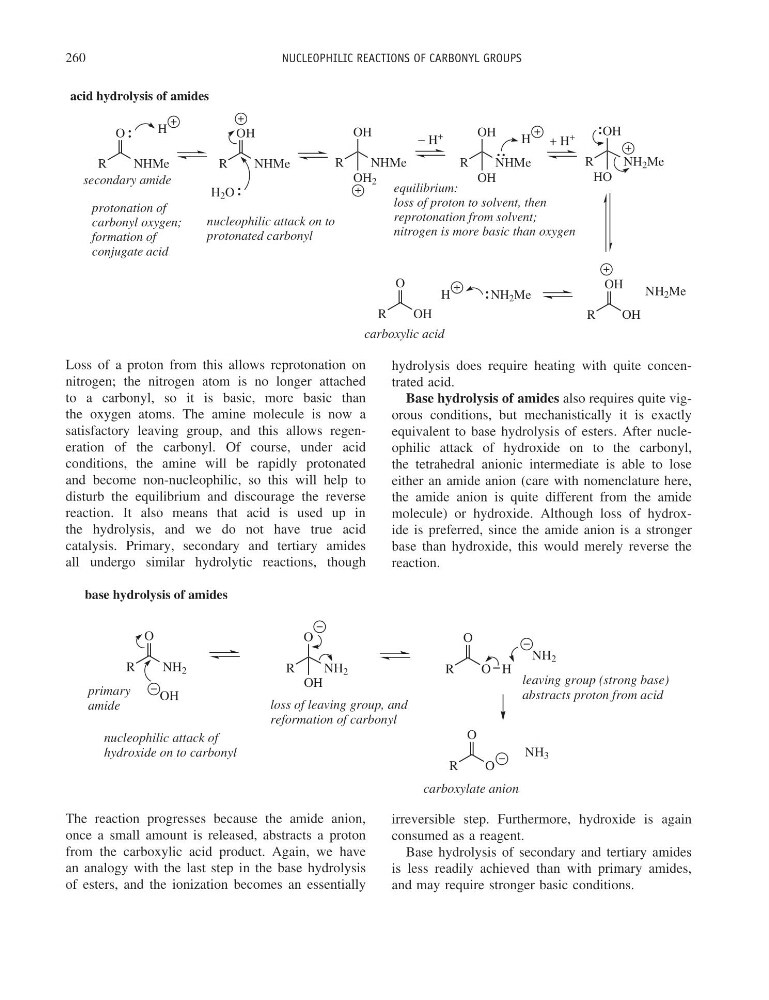
Loss of a proton from this allows reprotonation on
nitrogen; the nitrogen atom is no longer attached
to a carbonyl, so it is basic, more basic than
the oxygen atoms. The amine molecule is now a
satisfactory leaving group, and this allows regeneration of the carbonyl. Of course, under acid
conditions, the amine will be rapidly protonated
and become non-nucleophilic, so this will help to
disturb the equilibrium and discourage the reverse
reaction. It also means that acid is used up in
the hydrolysis, and we do not have true acid
catalysis. Primary, secondary and tertiary amides
all undergo similar hydrolytic reactions, though
hydrolysis does require heating with quite concentrated acid.
Base hydrolysis of amides also requires quite vigorous conditions, but mechanistically it is exactly
equivalent to base hydrolysis of esters. After nucleophilic attack of hydroxide on to the carbonyl,
the tetrahedral anionic intermediate is able to lose
either an amide anion (care with nomenclature here,
the amide anion is quite different from the amide
molecule) or hydroxide. Although loss of hydroxide is preferred, since the amide anion is a stronger
base than hydroxide, this would merely reverse the
reaction.
O
R
NH 2
O
R
O
O
R
O
H
base hydrolysis of amides
nucleophilic attack of
hydroxide on to carbonyl
primary
amide
carboxylate anion
loss of leaving group, and
reformation of carbonyl
leaving group (strong base)
abstracts proton from acid
O
R
NH 2
OH
OH
NH 2
NH 3
The reaction progresses because the amide anion,
once a small amount is released, abstracts a proton
from the carboxylic acid product. Again, we have
an analogy with the last step in the base hydrolysis
of esters, and the ionization becomes an essentially
irreversible step. Furthermore, hydroxide is again
consumed as a reagent.
Base hydrolysis of secondary and tertiary amides
is less readily achieved than with primary amides,
and may require stronger basic conditions.
NUCLEOPHILIC REACTIONS OF CARBONYL GROUPS
OH
R
NHMe
OH
R
OH
O
R
OH
O
R
NHMe
acid hydrolysis of amides
nucleophilic attack on to
protonated carbonyl
equilibrium:
loss of proton to solvent, then
reprotonation from solvent;
nitrogen is more basic than oxygen
secondary amide
carboxylic acid
protonation of
carbonyl oxygen;
formation of
conjugate acid
OH
R
NHMe
OH 2
OH
R
NHMe
OH
OH
R
NH 2 Me
HO
− H +
+ H +
H
H 2 O
H
NH 2 Me
H
NH 2 Me
Loss of a proton from this allows reprotonation on
nitrogen; the nitrogen atom is no longer attached
to a carbonyl, so it is basic, more basic than
the oxygen atoms. The amine molecule is now a
satisfactory leaving group, and this allows regeneration of the carbonyl. Of course, under acid
conditions, the amine will be rapidly protonated
and become non-nucleophilic, so this will help to
disturb the equilibrium and discourage the reverse
reaction. It also means that acid is used up in
the hydrolysis, and we do not have true acid
catalysis. Primary, secondary and tertiary amides
all undergo similar hydrolytic reactions, though
hydrolysis does require heating with quite concentrated acid.
Base hydrolysis of amides also requires quite vigorous conditions, but mechanistically it is exactly
equivalent to base hydrolysis of esters. After nucleophilic attack of hydroxide on to the carbonyl,
the tetrahedral anionic intermediate is able to lose
either an amide anion (care with nomenclature here,
the amide anion is quite different from the amide
molecule) or hydroxide. Although loss of hydroxide is preferred, since the amide anion is a stronger
base than hydroxide, this would merely reverse the
reaction.
O
R
NH 2
O
R
O
O
R
O
H
base hydrolysis of amides
nucleophilic attack of
hydroxide on to carbonyl
primary
amide
carboxylate anion
loss of leaving group, and
reformation of carbonyl
leaving group (strong base)
abstracts proton from acid
O
R
NH 2
OH
OH
NH 2
NH 3
The reaction progresses because the amide anion,
once a small amount is released, abstracts a proton
from the carboxylic acid product. Again, we have
an analogy with the last step in the base hydrolysis
of esters, and the ionization becomes an essentially
irreversible step. Furthermore, hydroxide is again
consumed as a reagent.
Base hydrolysis of secondary and tertiary amides
is less readily achieved than with primary amides,
and may require stronger basic conditions.