

OXYGEN AND SULFUR AS NUCLEOPHILES: ESTERS AND CARBOXYLIC ACIDS
259
encountered are stearic acid (C 18 ) and palmitic acid (C 16 ), especially in animal fats, and the unsaturated acids
oleic acid (C 18 ) and linoleic acid (C 18 ) in plant oils.
soap
glycerol
e.g. CH 3 (CH 2 ) 16 CO 2 H
stearic acid
base hydrolysis of esters is often termed saponification
fat
palmitic acid
oleic acid
linoleic acid
OCOR
OCOR
OCOR
OH
OH
OH
RCO 2 H = fatty acid
NaOH
RCO 2 Na
CH 3 (CH 2 ) 14 CO 2 H
CH 3 (CH 2 ) 7 CH=CH(CH 2 ) 7 CO 2 H
CH 3 (CH 2 ) 4 CH=CHCH 2 CH=CH(CH 2 ) 7 CO 2 H
Base hydrolysis of fats with sodium or potassium hydroxide liberates glycerol and the salt of the carboxylic
acid(s). This reaction was the basis of soap making; the salt, or mixture of salts, is a soap with characteristic
detergent properties. The relationship of ester hydrolysis to soap-making remains, in that base hydrolysis of esters
is still commonly referred to as saponification.
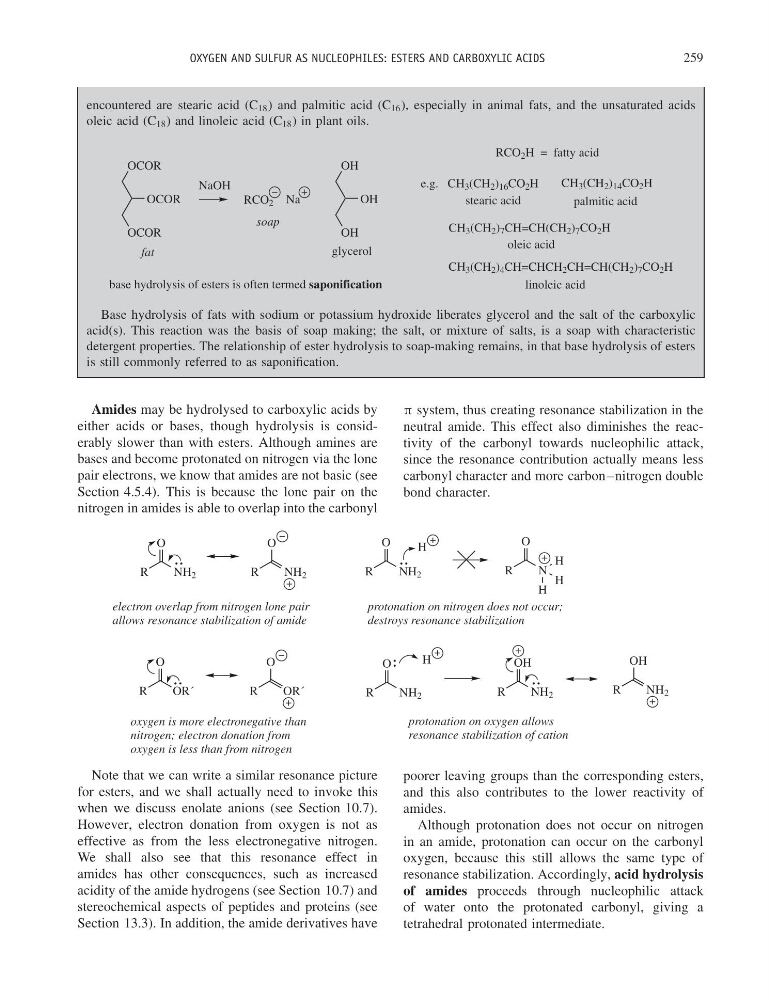
Amides may be hydrolysed to carboxylic acids by
either acids or bases, though hydrolysis is considerably slower than with esters. Although amines are
bases and become protonated on nitrogen via the lone
pair electrons, we know that amides are not basic (see
Section 4.5.4). This is because the lone pair on the
nitrogen in amides is able to overlap into the carbonyl
π system, thus creating resonance stabilization in the
neutral amide. This effect also diminishes the reactivity of the carbonyl towards nucleophilic attack,
since the resonance contribution actually means less
carbonyl character and more carbon–nitrogen double
bond character.
O
R
NH 2
O
R
NH 2
O
R
NH 2
OH
R
NH 2
OH
R
NH 2
O
R
NH 2
O
R
N
H
H
H
protonation on nitrogen does not occur;
destroys resonance stabilization
electron overlap from nitrogen lone pair
allows resonance stabilization of amide
protonation on oxygen allows
resonance stabilization of cation
O
R
OR´
O
R
OR´
oxygen is more electronegative than
nitrogen; electron donation from
oxygen is less than from nitrogen
H
H
Note that we can write a similar resonance picture
for esters, and we shall actually need to invoke this
when we discuss enolate anions (see Section 10.7).
However, electron donation from oxygen is not as
effective as from the less electronegative nitrogen.
We shall also see that this resonance effect in
amides has other consequences, such as increased
acidity of the amide hydrogens (see Section 10.7) and
stereochemical aspects of peptides and proteins (see
Section 13.3). In addition, the amide derivatives have
poorer leaving groups than the corresponding esters,
and this also contributes to the lower reactivity of
amides.
Although protonation does not occur on nitrogen
in an amide, protonation can occur on the carbonyl
oxygen, because this still allows the same type of
resonance stabilization. Accordingly, acid hydrolysis
of amides proceeds through nucleophilic attack
of water onto the protonated carbonyl, giving a
tetrahedral protonated intermediate.
259
encountered are stearic acid (C 18 ) and palmitic acid (C 16 ), especially in animal fats, and the unsaturated acids
oleic acid (C 18 ) and linoleic acid (C 18 ) in plant oils.
soap
glycerol
e.g. CH 3 (CH 2 ) 16 CO 2 H
stearic acid
base hydrolysis of esters is often termed saponification
fat
palmitic acid
oleic acid
linoleic acid
OCOR
OCOR
OCOR
OH
OH
OH
RCO 2 H = fatty acid
NaOH
RCO 2 Na
CH 3 (CH 2 ) 14 CO 2 H
CH 3 (CH 2 ) 7 CH=CH(CH 2 ) 7 CO 2 H
CH 3 (CH 2 ) 4 CH=CHCH 2 CH=CH(CH 2 ) 7 CO 2 H
Base hydrolysis of fats with sodium or potassium hydroxide liberates glycerol and the salt of the carboxylic
acid(s). This reaction was the basis of soap making; the salt, or mixture of salts, is a soap with characteristic
detergent properties. The relationship of ester hydrolysis to soap-making remains, in that base hydrolysis of esters
is still commonly referred to as saponification.
Amides may be hydrolysed to carboxylic acids by
either acids or bases, though hydrolysis is considerably slower than with esters. Although amines are
bases and become protonated on nitrogen via the lone
pair electrons, we know that amides are not basic (see
Section 4.5.4). This is because the lone pair on the
nitrogen in amides is able to overlap into the carbonyl
π system, thus creating resonance stabilization in the
neutral amide. This effect also diminishes the reactivity of the carbonyl towards nucleophilic attack,
since the resonance contribution actually means less
carbonyl character and more carbon–nitrogen double
bond character.
O
R
NH 2
O
R
NH 2
O
R
NH 2
OH
R
NH 2
OH
R
NH 2
O
R
NH 2
O
R
N
H
H
H
protonation on nitrogen does not occur;
destroys resonance stabilization
electron overlap from nitrogen lone pair
allows resonance stabilization of amide
protonation on oxygen allows
resonance stabilization of cation
O
R
OR´
O
R
OR´
oxygen is more electronegative than
nitrogen; electron donation from
oxygen is less than from nitrogen
H
H
Note that we can write a similar resonance picture
for esters, and we shall actually need to invoke this
when we discuss enolate anions (see Section 10.7).
However, electron donation from oxygen is not as
effective as from the less electronegative nitrogen.
We shall also see that this resonance effect in
amides has other consequences, such as increased
acidity of the amide hydrogens (see Section 10.7) and
stereochemical aspects of peptides and proteins (see
Section 13.3). In addition, the amide derivatives have
poorer leaving groups than the corresponding esters,
and this also contributes to the lower reactivity of
amides.
Although protonation does not occur on nitrogen
in an amide, protonation can occur on the carbonyl
oxygen, because this still allows the same type of
resonance stabilization. Accordingly, acid hydrolysis
of amides proceeds through nucleophilic attack
of water onto the protonated carbonyl, giving a
tetrahedral protonated intermediate.