

258
NUCLEOPHILIC REACTIONS OF CARBONYL GROUPS
Aspirin is an ester, but it still contains a carboxylic acid function (pK a 3.5). In aqueous solution, there will
thus be significant ionization. However, this ionization now provides an acid catalyst for ester hydrolysis and
initiates autolysis (autohydrolysis). The hydrolysis product salicylic acid (pK a 3.0) is also acidic; both aspirin and
salicylic acid are aromatic acids and are rather stronger acids than aliphatic compounds such as acetic acid (pK a
4.8) (see Section 4.3.5). An aqueous solution of aspirin has a half-life of about 40 days at room temperature. In
other words, after about 40 days, half of the material has been hydrolysed, and the biological activity will have
deteriorated similarly.
Even aspirin tablets that have been stored under less than ideal conditions and, therefore, have absorbed some
water from the atmosphere, are likely to have suffered partial hydrolysis. The characteristic odour of acetic acid
(vinegar) from a bottle of aspirin tablets will be an indicator that some hydrolysis has occurred.
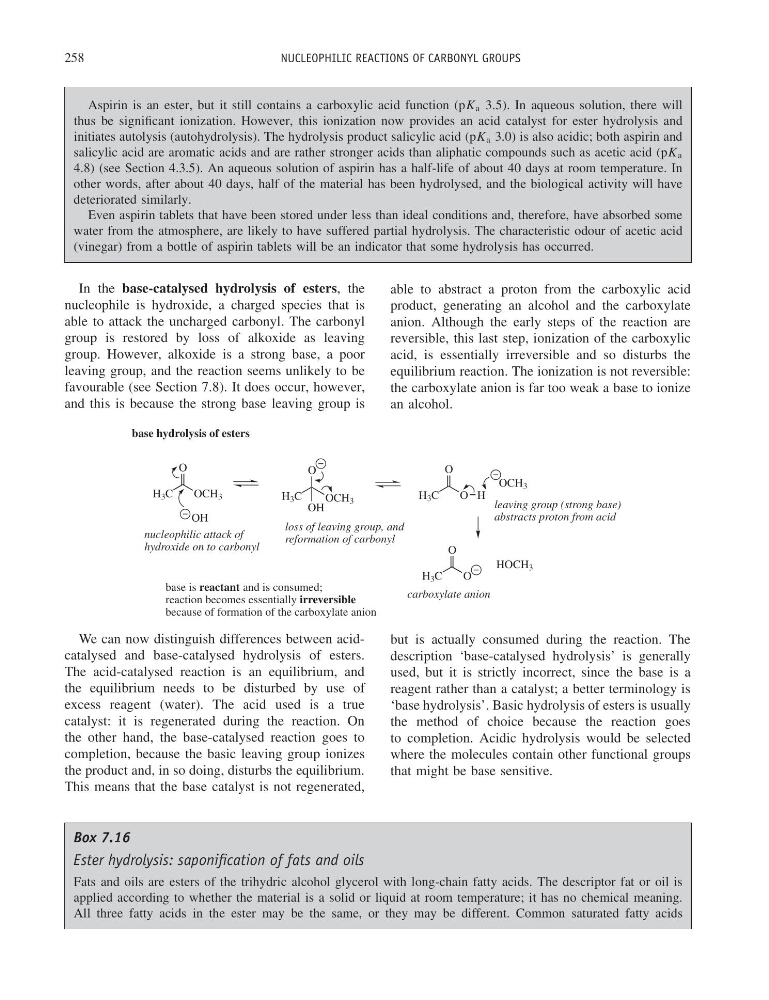
In the base-catalysed hydrolysis of esters, the
nucleophile is hydroxide, a charged species that is
able to attack the uncharged carbonyl. The carbonyl
group is restored by loss of alkoxide as leaving
group. However, alkoxide is a strong base, a poor
leaving group, and the reaction seems unlikely to be
favourable (see Section 7.8). It does occur, however,
and this is because the strong base leaving group is
able to abstract a proton from the carboxylic acid
product, generating an alcohol and the carboxylate
anion. Although the early steps of the reaction are
reversible, this last step, ionization of the carboxylic
acid, is essentially irreversible and so disturbs the
equilibrium reaction. The ionization is not reversible:
the carboxylate anion is far too weak a base to ionize
an alcohol.
O
H 3 C
OCH 3
O
H 3 C
O
O
H 3 C
O
H
base hydrolysis of esters
base is reactant and is consumed;
reaction becomes essentially irreversible
because of formation of the carboxylate anion
nucleophilic attack of
hydroxide on to carbonyl
loss of leaving group, and
reformation of carbonyl
leaving group (strong base)
abstracts proton from acid
carboxylate anion
O
H 3 C
OCH 3
OH
OH
OCH 3
HOCH 3
We can now distinguish differences between acidcatalysed and base-catalysed hydrolysis of esters.
The acid-catalysed reaction is an equilibrium, and
the equilibrium needs to be disturbed by use of
excess reagent (water). The acid used is a true
catalyst: it is regenerated during the reaction. On
the other hand, the base-catalysed reaction goes to
completion, because the basic leaving group ionizes
the product and, in so doing, disturbs the equilibrium.
This means that the base catalyst is not regenerated,
but is actually consumed during the reaction. The
description ‘base-catalysed hydrolysis’ is generally
used, but it is strictly incorrect, since the base is a
reagent rather than a catalyst; a better terminology is
‘base hydrolysis’. Basic hydrolysis of esters is usually
the method of choice because the reaction goes
to completion. Acidic hydrolysis would be selected
where the molecules contain other functional groups
that might be base sensitive.
Box 7.16
Ester hydrolysis: saponification of fats and oils
Fats and oils are esters of the trihydric alcohol glycerol with long-chain fatty acids. The descriptor fat or oil is
applied according to whether the material is a solid or liquid at room temperature; it has no chemical meaning.
All three fatty acids in the ester may be the same, or they may be different. Common saturated fatty acids
NUCLEOPHILIC REACTIONS OF CARBONYL GROUPS
Aspirin is an ester, but it still contains a carboxylic acid function (pK a 3.5). In aqueous solution, there will
thus be significant ionization. However, this ionization now provides an acid catalyst for ester hydrolysis and
initiates autolysis (autohydrolysis). The hydrolysis product salicylic acid (pK a 3.0) is also acidic; both aspirin and
salicylic acid are aromatic acids and are rather stronger acids than aliphatic compounds such as acetic acid (pK a
4.8) (see Section 4.3.5). An aqueous solution of aspirin has a half-life of about 40 days at room temperature. In
other words, after about 40 days, half of the material has been hydrolysed, and the biological activity will have
deteriorated similarly.
Even aspirin tablets that have been stored under less than ideal conditions and, therefore, have absorbed some
water from the atmosphere, are likely to have suffered partial hydrolysis. The characteristic odour of acetic acid
(vinegar) from a bottle of aspirin tablets will be an indicator that some hydrolysis has occurred.
In the base-catalysed hydrolysis of esters, the
nucleophile is hydroxide, a charged species that is
able to attack the uncharged carbonyl. The carbonyl
group is restored by loss of alkoxide as leaving
group. However, alkoxide is a strong base, a poor
leaving group, and the reaction seems unlikely to be
favourable (see Section 7.8). It does occur, however,
and this is because the strong base leaving group is
able to abstract a proton from the carboxylic acid
product, generating an alcohol and the carboxylate
anion. Although the early steps of the reaction are
reversible, this last step, ionization of the carboxylic
acid, is essentially irreversible and so disturbs the
equilibrium reaction. The ionization is not reversible:
the carboxylate anion is far too weak a base to ionize
an alcohol.
O
H 3 C
OCH 3
O
H 3 C
O
O
H 3 C
O
H
base hydrolysis of esters
base is reactant and is consumed;
reaction becomes essentially irreversible
because of formation of the carboxylate anion
nucleophilic attack of
hydroxide on to carbonyl
loss of leaving group, and
reformation of carbonyl
leaving group (strong base)
abstracts proton from acid
carboxylate anion
O
H 3 C
OCH 3
OH
OH
OCH 3
HOCH 3
We can now distinguish differences between acidcatalysed and base-catalysed hydrolysis of esters.
The acid-catalysed reaction is an equilibrium, and
the equilibrium needs to be disturbed by use of
excess reagent (water). The acid used is a true
catalyst: it is regenerated during the reaction. On
the other hand, the base-catalysed reaction goes to
completion, because the basic leaving group ionizes
the product and, in so doing, disturbs the equilibrium.
This means that the base catalyst is not regenerated,
but is actually consumed during the reaction. The
description ‘base-catalysed hydrolysis’ is generally
used, but it is strictly incorrect, since the base is a
reagent rather than a catalyst; a better terminology is
‘base hydrolysis’. Basic hydrolysis of esters is usually
the method of choice because the reaction goes
to completion. Acidic hydrolysis would be selected
where the molecules contain other functional groups
that might be base sensitive.
Box 7.16
Ester hydrolysis: saponification of fats and oils
Fats and oils are esters of the trihydric alcohol glycerol with long-chain fatty acids. The descriptor fat or oil is
applied according to whether the material is a solid or liquid at room temperature; it has no chemical meaning.
All three fatty acids in the ester may be the same, or they may be different. Common saturated fatty acids