

262
NUCLEOPHILIC REACTIONS OF CARBONYL GROUPS
Box 7.18
Thioesters: coenzyme A
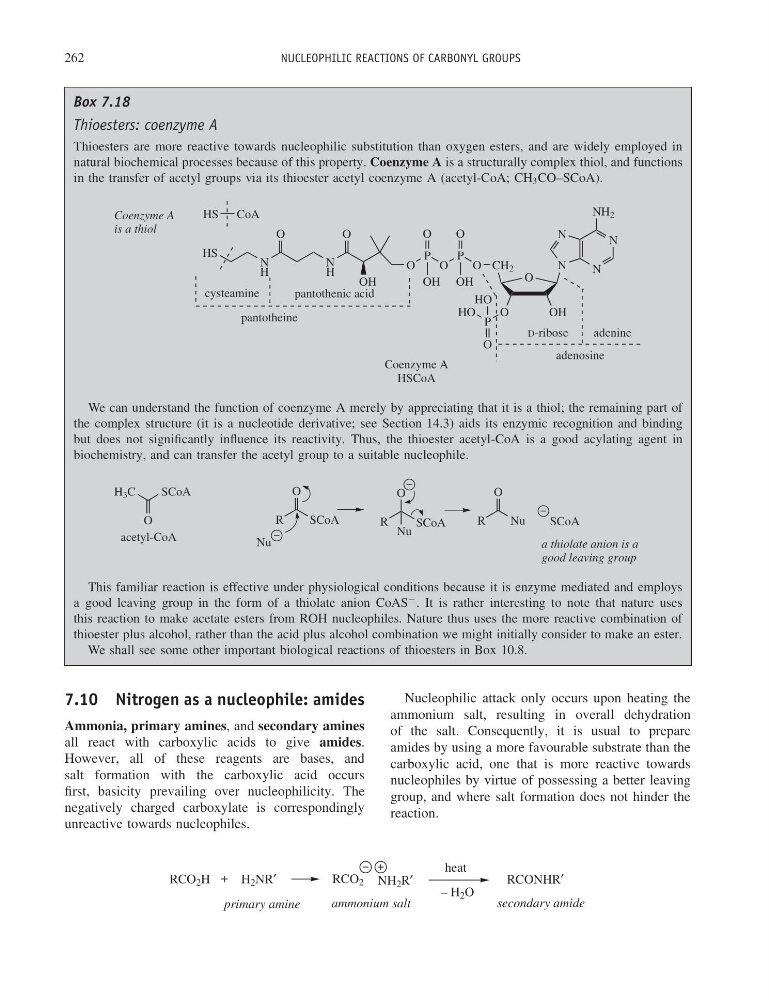
Thioesters are more reactive towards nucleophilic substitution than oxygen esters, and are widely employed in
natural biochemical processes because of this property. Coenzyme A is a structurally complex thiol, and functions
in the transfer of acetyl groups via its thioester acetyl coenzyme A (acetyl-CoA; CH 3 CO–SCoA).
HS CoA
Coenzyme A
is a thiol
N
N
N
NH 2
O
OH
N
CH 2
N
H
N
H
OH
O
O
HS
Coenzyme A
HSCoA
cysteamine
pantothenic acid
pantotheine
adenosine
adenine
D-ribose
O
P
O
O
OH
P
O
O
OH
O
P
HO
O
HO
We can understand the function of coenzyme A merely by appreciating that it is a thiol; the remaining part of
the complex structure (it is a nucleotide derivative; see Section 14.3) aids its enzymic recognition and binding
but does not significantly influence its reactivity. Thus, the thioester acetyl-CoA is a good acylating agent in
biochemistry, and can transfer the acetyl group to a suitable nucleophile.
H 3 C
SCoA
O
acetyl-CoA
Nu
O
R
SCoA
O
R
SCoA
Nu
O
R
Nu
a thiolate anion is a
good leaving group
SCoA
This familiar reaction is effective under physiological conditions because it is enzyme mediated and employs
a good leaving group in the form of a thiolate anion CoAS
− . It is rather interesting to note that nature uses
this reaction to make acetate esters from ROH nucleophiles. Nature thus uses the more reactive combination of
thioester plus alcohol, rather than the acid plus alcohol combination we might initially consider to make an ester.
We shall see some other important biological reactions of thioesters in Box 10.8.
7.10 Nitrogen as a nucleophile: amides
Ammonia, primary amines, and secondary amines
all react with carboxylic acids to give amides.
However, all of these reagents are bases, and
salt formation with the carboxylic acid occurs
first, basicity prevailing over nucleophilicity. The
negatively charged carboxylate is correspondingly
unreactive towards nucleophiles.
Nucleophilic attack only occurs upon heating the
ammonium salt, resulting in overall dehydration
of the salt. Consequently, it is usual to prepare
amides by using a more favourable substrate than the
carboxylic acid, one that is more reactive towards
nucleophiles by virtue of possessing a better leaving
group, and where salt formation does not hinder the
reaction.
ammonium salt
+ H 2 NR′
NH 2 R′
RCONHR′
heat
secondary amide
primary amine
– H 2 O
RCO 2
RCO 2 H
NUCLEOPHILIC REACTIONS OF CARBONYL GROUPS
Box 7.18
Thioesters: coenzyme A
Thioesters are more reactive towards nucleophilic substitution than oxygen esters, and are widely employed in
natural biochemical processes because of this property. Coenzyme A is a structurally complex thiol, and functions
in the transfer of acetyl groups via its thioester acetyl coenzyme A (acetyl-CoA; CH 3 CO–SCoA).
HS CoA
Coenzyme A
is a thiol
N
N
N
NH 2
O
OH
N
CH 2
N
H
N
H
OH
O
O
HS
Coenzyme A
HSCoA
cysteamine
pantothenic acid
pantotheine
adenosine
adenine
D-ribose
O
P
O
O
OH
P
O
O
OH
O
P
HO
O
HO
We can understand the function of coenzyme A merely by appreciating that it is a thiol; the remaining part of
the complex structure (it is a nucleotide derivative; see Section 14.3) aids its enzymic recognition and binding
but does not significantly influence its reactivity. Thus, the thioester acetyl-CoA is a good acylating agent in
biochemistry, and can transfer the acetyl group to a suitable nucleophile.
H 3 C
SCoA
O
acetyl-CoA
Nu
O
R
SCoA
O
R
SCoA
Nu
O
R
Nu
a thiolate anion is a
good leaving group
SCoA
This familiar reaction is effective under physiological conditions because it is enzyme mediated and employs
a good leaving group in the form of a thiolate anion CoAS
− . It is rather interesting to note that nature uses
this reaction to make acetate esters from ROH nucleophiles. Nature thus uses the more reactive combination of
thioester plus alcohol, rather than the acid plus alcohol combination we might initially consider to make an ester.
We shall see some other important biological reactions of thioesters in Box 10.8.
7.10 Nitrogen as a nucleophile: amides
Ammonia, primary amines, and secondary amines
all react with carboxylic acids to give amides.
However, all of these reagents are bases, and
salt formation with the carboxylic acid occurs
first, basicity prevailing over nucleophilicity. The
negatively charged carboxylate is correspondingly
unreactive towards nucleophiles.
Nucleophilic attack only occurs upon heating the
ammonium salt, resulting in overall dehydration
of the salt. Consequently, it is usual to prepare
amides by using a more favourable substrate than the
carboxylic acid, one that is more reactive towards
nucleophiles by virtue of possessing a better leaving
group, and where salt formation does not hinder the
reaction.
ammonium salt
+ H 2 NR′
NH 2 R′
RCONHR′
heat
secondary amide
primary amine
– H 2 O
RCO 2
RCO 2 H