

252
NUCLEOPHILIC REACTIONS OF CARBONYL GROUPS
The leaving group is chloride, and after proton loss, we generate what may be considered a mixed anhydride
having both C=O and S=O functionalities. The C=O group in this mixed anhydride is then attacked
by chloride, and the good leaving group (–SO 2 Cl) this time dissociates into sulfur dioxide and chloride,
as shown.
7.9 Oxygen and sulfur as nucleophiles:
esters and carboxylic acids
7.9.1 Alcohols: ester formation
A well-known reaction of carboxylic acids is that they
react with alcohols under acidic conditions to yield
esters.
+
+
the equilibrium constant is not particularly favourable –
may have to remove water or use excess of one reagent,
e.g. use the alcohol as solvent
ester
H +
CH 3 CO 2 Et
EtOH
H 2 O
CH 3 CO 2 H
This reaction is, in fact, an equilibrium that often
does not favour the product. Thus, to make it a
useful procedure for the synthesis of esters, one has to
disturb the equilibrium by either removing the water
as it is formed, or by using an excess of one reagent,
typically the alcohol. It is an easy way to make simple
methyl or ethyl esters, where one can employ an
excess of methanol or ethanol to act both as solvent
and to disturb the equilibrium.
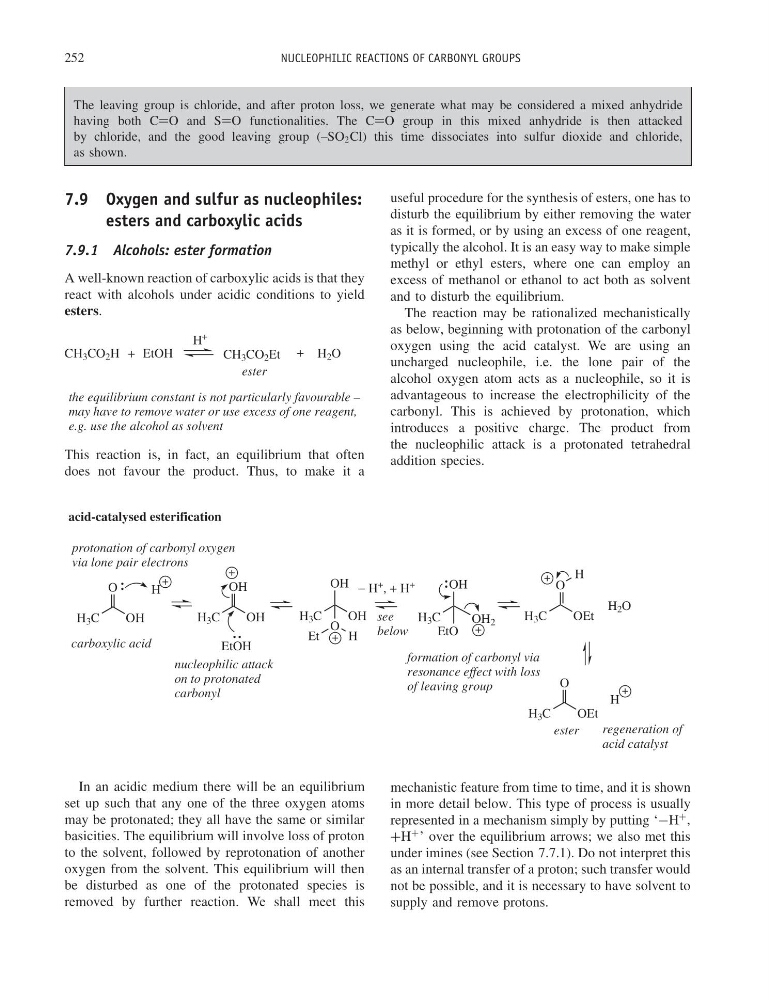
The reaction may be rationalized mechanistically
as below, beginning with protonation of the carbonyl
oxygen using the acid catalyst. We are using an
uncharged nucleophile, i.e. the lone pair of the
alcohol oxygen atom acts as a nucleophile, so it is
advantageous to increase the electrophilicity of the
carbonyl. This is achieved by protonation, which
introduces a positive charge. The product from
the nucleophilic attack is a protonated tetrahedral
addition species.
O
H 3 C
OH
OH
H 3 C
OH
O
Et
H
OH
O
H 3 C
OEt
O
H 3 C
OEt
H
protonation of carbonyl oxygen
via lone pair electrons
ester
nucleophilic attack
on to protonated
carbonyl
formation of carbonyl via
resonance effect with loss
of leaving group
regeneration of
acid catalyst
OH
H 3 C
EtO
OH
H 3 C
OH 2
− H
+
, + H
+
see
below
carboxylic acid
acid-catalysed esterification
H
EtOH
H 2 O
H
In an acidic medium there will be an equilibrium
set up such that any one of the three oxygen atoms
may be protonated; they all have the same or similar
basicities. The equilibrium will involve loss of proton
to the solvent, followed by reprotonation of another
oxygen from the solvent. This equilibrium will then
be disturbed as one of the protonated species is
removed by further reaction. We shall meet this
mechanistic feature from time to time, and it is shown
in more detail below. This type of process is usually
represented in a mechanism simply by putting ‘−H
+ ,
+H
+ ’ over the equilibrium arrows; we also met this
under imines (see Section 7.7.1). Do not interpret this
as an internal transfer of a proton; such transfer would
not be possible, and it is necessary to have solvent to
supply and remove protons.
NUCLEOPHILIC REACTIONS OF CARBONYL GROUPS
The leaving group is chloride, and after proton loss, we generate what may be considered a mixed anhydride
having both C=O and S=O functionalities. The C=O group in this mixed anhydride is then attacked
by chloride, and the good leaving group (–SO 2 Cl) this time dissociates into sulfur dioxide and chloride,
as shown.
7.9 Oxygen and sulfur as nucleophiles:
esters and carboxylic acids
7.9.1 Alcohols: ester formation
A well-known reaction of carboxylic acids is that they
react with alcohols under acidic conditions to yield
esters.
+
+
the equilibrium constant is not particularly favourable –
may have to remove water or use excess of one reagent,
e.g. use the alcohol as solvent
ester
H +
CH 3 CO 2 Et
EtOH
H 2 O
CH 3 CO 2 H
This reaction is, in fact, an equilibrium that often
does not favour the product. Thus, to make it a
useful procedure for the synthesis of esters, one has to
disturb the equilibrium by either removing the water
as it is formed, or by using an excess of one reagent,
typically the alcohol. It is an easy way to make simple
methyl or ethyl esters, where one can employ an
excess of methanol or ethanol to act both as solvent
and to disturb the equilibrium.
The reaction may be rationalized mechanistically
as below, beginning with protonation of the carbonyl
oxygen using the acid catalyst. We are using an
uncharged nucleophile, i.e. the lone pair of the
alcohol oxygen atom acts as a nucleophile, so it is
advantageous to increase the electrophilicity of the
carbonyl. This is achieved by protonation, which
introduces a positive charge. The product from
the nucleophilic attack is a protonated tetrahedral
addition species.
O
H 3 C
OH
OH
H 3 C
OH
O
Et
H
OH
O
H 3 C
OEt
O
H 3 C
OEt
H
protonation of carbonyl oxygen
via lone pair electrons
ester
nucleophilic attack
on to protonated
carbonyl
formation of carbonyl via
resonance effect with loss
of leaving group
regeneration of
acid catalyst
OH
H 3 C
EtO
OH
H 3 C
OH 2
− H
+
, + H
+
see
below
carboxylic acid
acid-catalysed esterification
H
EtOH
H 2 O
H
In an acidic medium there will be an equilibrium
set up such that any one of the three oxygen atoms
may be protonated; they all have the same or similar
basicities. The equilibrium will involve loss of proton
to the solvent, followed by reprotonation of another
oxygen from the solvent. This equilibrium will then
be disturbed as one of the protonated species is
removed by further reaction. We shall meet this
mechanistic feature from time to time, and it is shown
in more detail below. This type of process is usually
represented in a mechanism simply by putting ‘−H
+ ,
+H
+ ’ over the equilibrium arrows; we also met this
under imines (see Section 7.7.1). Do not interpret this
as an internal transfer of a proton; such transfer would
not be possible, and it is necessary to have solvent to
supply and remove protons.