

NUCLEOPHILIC SUBSTITUTION ON CARBONYL GROUPS: CARBOXYLIC ACID DERIVATIVES
251
Box 7.12
Synthesis of anhydrides and acyl halides
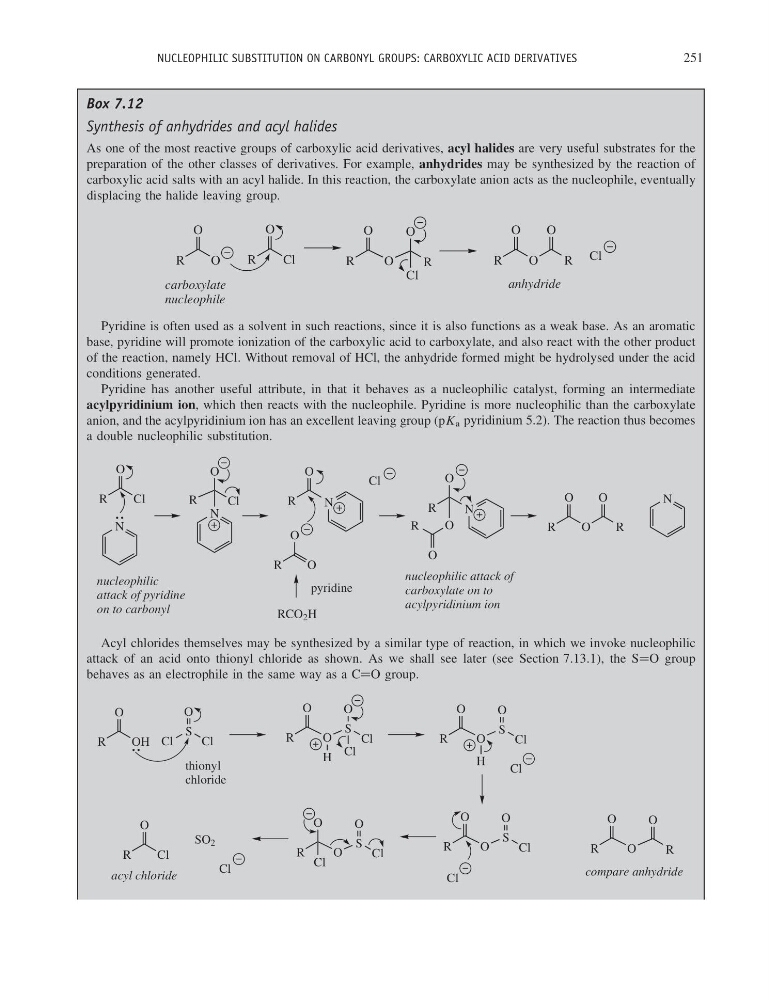
As one of the most reactive groups of carboxylic acid derivatives, acyl halides are very useful substrates for the
preparation of the other classes of derivatives. For example, anhydrides may be synthesized by the reaction of
carboxylic acid salts with an acyl halide. In this reaction, the carboxylate anion acts as the nucleophile, eventually
displacing the halide leaving group.
O
R
O
O
R
Cl
O
R
O
R
O
Cl
O
R
O
R
O
anhydride
Cl
carboxylate
nucleophile
Pyridine is often used as a solvent in such reactions, since it is also functions as a weak base. As an aromatic
base, pyridine will promote ionization of the carboxylic acid to carboxylate, and also react with the other product
of the reaction, namely HCl. Without removal of HCl, the anhydride formed might be hydrolysed under the acid
conditions generated.
Pyridine has another useful attribute, in that it behaves as a nucleophilic catalyst, forming an intermediate
acylpyridinium ion, which then reacts with the nucleophile. Pyridine is more nucleophilic than the carboxylate
anion, and the acylpyridinium ion has an excellent leaving group (pK a pyridinium 5.2). The reaction thus becomes
a double nucleophilic substitution.
O
R
Cl
N
R
Cl
O
N
N
R
O
N
R
O
O
Cl
N
nucleophilic
attack of pyridine
on to carbonyl
nucleophilic attack of
carboxylate on to
acylpyridinium ion
O
R
O
R
O
O
R
O
R
O
RCO 2 H
pyridine
Acyl chlorides themselves may be synthesized by a similar type of reaction, in which we invoke nucleophilic
attack of an acid onto thionyl chloride as shown. As we shall see later (see Section 7.13.1), the S=O group
behaves as an electrophile in the same way as a C=O group.
O
R
OH
O
S
Cl
Cl
O
R
O
S
Cl
O
Cl
H
O
R
O
S
Cl
O
H
O
R
O
S
Cl
O
Cl
Cl
O
R
O
S
Cl
O
Cl
SO 2
Cl
O
R
Cl
acyl chloride
O
R
O
R
O
thionyl
chloride
compare anhydride
251
Box 7.12
Synthesis of anhydrides and acyl halides
As one of the most reactive groups of carboxylic acid derivatives, acyl halides are very useful substrates for the
preparation of the other classes of derivatives. For example, anhydrides may be synthesized by the reaction of
carboxylic acid salts with an acyl halide. In this reaction, the carboxylate anion acts as the nucleophile, eventually
displacing the halide leaving group.
O
R
O
O
R
Cl
O
R
O
R
O
Cl
O
R
O
R
O
anhydride
Cl
carboxylate
nucleophile
Pyridine is often used as a solvent in such reactions, since it is also functions as a weak base. As an aromatic
base, pyridine will promote ionization of the carboxylic acid to carboxylate, and also react with the other product
of the reaction, namely HCl. Without removal of HCl, the anhydride formed might be hydrolysed under the acid
conditions generated.
Pyridine has another useful attribute, in that it behaves as a nucleophilic catalyst, forming an intermediate
acylpyridinium ion, which then reacts with the nucleophile. Pyridine is more nucleophilic than the carboxylate
anion, and the acylpyridinium ion has an excellent leaving group (pK a pyridinium 5.2). The reaction thus becomes
a double nucleophilic substitution.
O
R
Cl
N
R
Cl
O
N
N
R
O
N
R
O
O
Cl
N
nucleophilic
attack of pyridine
on to carbonyl
nucleophilic attack of
carboxylate on to
acylpyridinium ion
O
R
O
R
O
O
R
O
R
O
RCO 2 H
pyridine
Acyl chlorides themselves may be synthesized by a similar type of reaction, in which we invoke nucleophilic
attack of an acid onto thionyl chloride as shown. As we shall see later (see Section 7.13.1), the S=O group
behaves as an electrophile in the same way as a C=O group.
O
R
OH
O
S
Cl
Cl
O
R
O
S
Cl
O
Cl
H
O
R
O
S
Cl
O
H
O
R
O
S
Cl
O
Cl
Cl
O
R
O
S
Cl
O
Cl
SO 2
Cl
O
R
Cl
acyl chloride
O
R
O
R
O
thionyl
chloride
compare anhydride