

250
NUCLEOPHILIC REACTIONS OF CARBONYL GROUPS
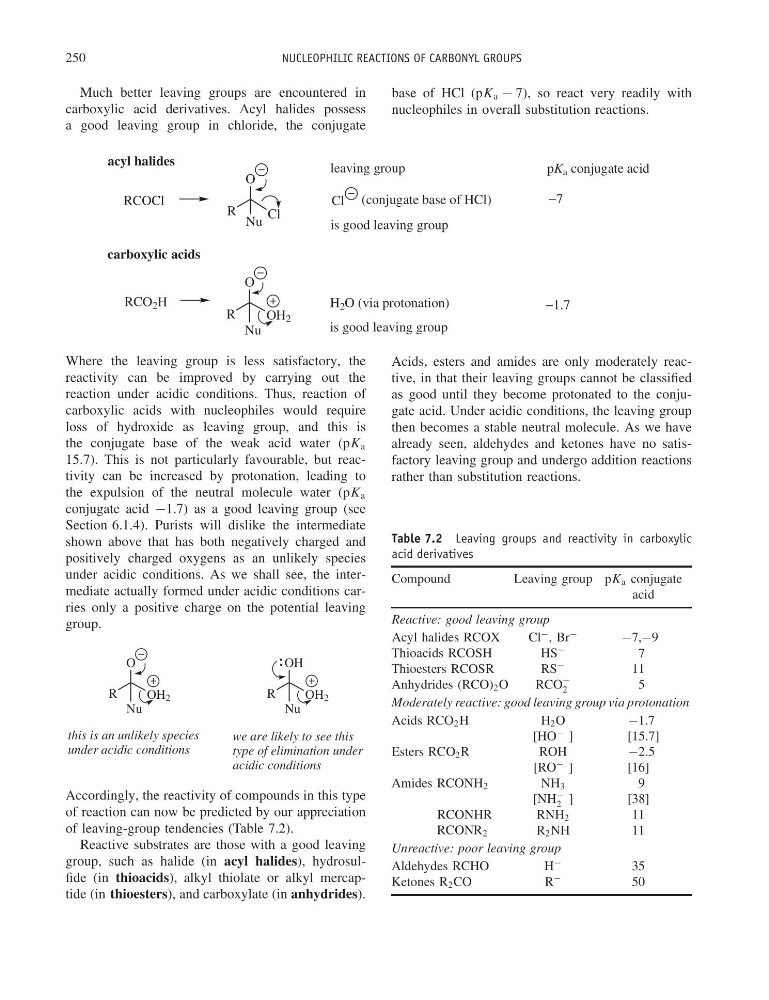
Much better leaving groups are encountered in
carboxylic acid derivatives. Acyl halides possess
a good leaving group in chloride, the conjugate
base of HCl (pK a − 7), so react very readily with
nucleophiles in overall substitution reactions.
acyl halides
carboxylic acids
(conjugate base of HCl)
is good leaving group
H 2 O (via protonation)
is good leaving group
O
Nu
R
Cl
O
Nu
R
OH 2
−7
−1.7
pK a conjugate acid
leaving group
RCOCl
RCO 2 H
Cl
Where the leaving group is less satisfactory, the
reactivity can be improved by carrying out the
reaction under acidic conditions. Thus, reaction of
carboxylic acids with nucleophiles would require
loss of hydroxide as leaving group, and this is
the conjugate base of the weak acid water (pK a
15.7). This is not particularly favourable, but reactivity can be increased by protonation, leading to
the expulsion of the neutral molecule water (pK a
conjugate acid −1.7) as a good leaving group (see
Section 6.1.4). Purists will dislike the intermediate
shown above that has both negatively charged and
positively charged oxygens as an unlikely species
under acidic conditions. As we shall see, the intermediate actually formed under acidic conditions carries only a positive charge on the potential leaving
group.
OH
Nu
R
OH 2
O
Nu
R
OH 2
this is an unlikely species
under acidic conditions
we are likely to see this
type of elimination under
acidic conditions
Accordingly, the reactivity of compounds in this type
of reaction can now be predicted by our appreciation
of leaving-group tendencies (Table 7.2).
Reactive substrates are those with a good leaving
group, such as halide (in acyl halides), hydrosulfide (in thioacids), alkyl thiolate or alkyl mercaptide (in thioesters), and carboxylate (in anhydrides).
Acids, esters and amides are only moderately reactive, in that their leaving groups cannot be classified
as good until they become protonated to the conjugate acid. Under acidic conditions, the leaving group
then becomes a stable neutral molecule. As we have
already seen, aldehydes and ketones have no satisfactory leaving group and undergo addition reactions
rather than substitution reactions.
Table 7.2 Leaving groups and reactivity in carboxylic
acid derivatives
Compound
Leaving group pK a conjugate
acid
Reactive: good leaving group
Acyl halides RCOX
Cl
− , Br
−
−7,−9
Thioacids RCOSH
HS
−
7
Thioesters RCOSR
RS
−
11
Anhydrides (RCO) 2 O
RCO
−
2
5
Moderately reactive: good leaving group via protonation
Acids RCO 2 H
H 2 O
−1.7
[HO
− ]
[15.7]
Esters RCO 2 R
R O H
−2.5
[RO
− ]
[16]
Amides RCONH 2
NH 3
9
[NH
−
2 ]
[38]
RCONHR
RNH 2
11
RCONR 2
R 2 NH
11
Unreactive: poor leaving group
Aldehydes RCHO
H
−
35
Ketones R 2 CO
R
−
50
NUCLEOPHILIC REACTIONS OF CARBONYL GROUPS
Much better leaving groups are encountered in
carboxylic acid derivatives. Acyl halides possess
a good leaving group in chloride, the conjugate
base of HCl (pK a − 7), so react very readily with
nucleophiles in overall substitution reactions.
acyl halides
carboxylic acids
(conjugate base of HCl)
is good leaving group
H 2 O (via protonation)
is good leaving group
O
Nu
R
Cl
O
Nu
R
OH 2
−7
−1.7
pK a conjugate acid
leaving group
RCOCl
RCO 2 H
Cl
Where the leaving group is less satisfactory, the
reactivity can be improved by carrying out the
reaction under acidic conditions. Thus, reaction of
carboxylic acids with nucleophiles would require
loss of hydroxide as leaving group, and this is
the conjugate base of the weak acid water (pK a
15.7). This is not particularly favourable, but reactivity can be increased by protonation, leading to
the expulsion of the neutral molecule water (pK a
conjugate acid −1.7) as a good leaving group (see
Section 6.1.4). Purists will dislike the intermediate
shown above that has both negatively charged and
positively charged oxygens as an unlikely species
under acidic conditions. As we shall see, the intermediate actually formed under acidic conditions carries only a positive charge on the potential leaving
group.
OH
Nu
R
OH 2
O
Nu
R
OH 2
this is an unlikely species
under acidic conditions
we are likely to see this
type of elimination under
acidic conditions
Accordingly, the reactivity of compounds in this type
of reaction can now be predicted by our appreciation
of leaving-group tendencies (Table 7.2).
Reactive substrates are those with a good leaving
group, such as halide (in acyl halides), hydrosulfide (in thioacids), alkyl thiolate or alkyl mercaptide (in thioesters), and carboxylate (in anhydrides).
Acids, esters and amides are only moderately reactive, in that their leaving groups cannot be classified
as good until they become protonated to the conjugate acid. Under acidic conditions, the leaving group
then becomes a stable neutral molecule. As we have
already seen, aldehydes and ketones have no satisfactory leaving group and undergo addition reactions
rather than substitution reactions.
Table 7.2 Leaving groups and reactivity in carboxylic
acid derivatives
Compound
Leaving group pK a conjugate
acid
Reactive: good leaving group
Acyl halides RCOX
Cl
− , Br
−
−7,−9
Thioacids RCOSH
HS
−
7
Thioesters RCOSR
RS
−
11
Anhydrides (RCO) 2 O
RCO
−
2
5
Moderately reactive: good leaving group via protonation
Acids RCO 2 H
H 2 O
−1.7
[HO
− ]
[15.7]
Esters RCO 2 R
R O H
−2.5
[RO
− ]
[16]
Amides RCONH 2
NH 3
9
[NH
−
2 ]
[38]
RCONHR
RNH 2
11
RCONR 2
R 2 NH
11
Unreactive: poor leaving group
Aldehydes RCHO
H
−
35
Ketones R 2 CO
R
−
50