

OXYGEN AND SULFUR AS NUCLEOPHILES: ESTERS AND CARBOXYLIC ACIDS
253
O
Et
H
OH
OEt
OH
an equilibrium:
loss of proton to solvent, then
reprotonation from solvent;
the molecule may have any one
of the three oxygens protonated
OH
H 3 C
H 3 C
OH
OEt
OH
H 3 C
OH 2
OEt
OH 2
H 3 C
OH
H
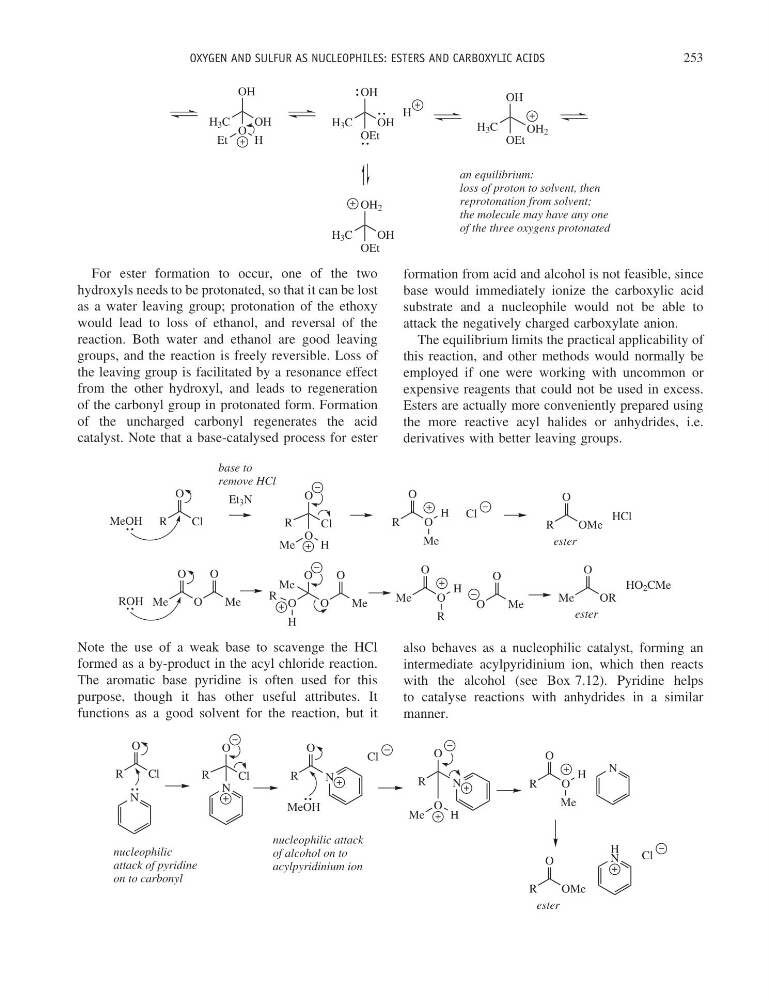
For ester formation to occur, one of the two
hydroxyls needs to be protonated, so that it can be lost
as a water leaving group; protonation of the ethoxy
would lead to loss of ethanol, and reversal of the
reaction. Both water and ethanol are good leaving
groups, and the reaction is freely reversible. Loss of
the leaving group is facilitated by a resonance effect
from the other hydroxyl, and leads to regeneration
of the carbonyl group in protonated form. Formation
of the uncharged carbonyl regenerates the acid
catalyst. Note that a base-catalysed process for ester
formation from acid and alcohol is not feasible, since
base would immediately ionize the carboxylic acid
substrate and a nucleophile would not be able to
attack the negatively charged carboxylate anion.
The equilibrium limits the practical applicability of
this reaction, and other methods would normally be
employed if one were working with uncommon or
expensive reagents that could not be used in excess.
Esters are actually more conveniently prepared using
the more reactive acyl halides or anhydrides, i.e.
derivatives with better leaving groups.
O
R
Cl
R
Cl
O
O
R
OMe
O
Me
O
Me
O
O
O
O
Me
O
O
R
H
Me
Me
OR
O
base to
remove HCl
ester
ester
Me
H
Cl
R
O
O
H
Me
Me
O
O
H
R
O
Me
O
Et 3 N
MeOH
ROH
HCl
HO 2 CMe
Note the use of a weak base to scavenge the HCl
formed as a by-product in the acyl chloride reaction.
The aromatic base pyridine is often used for this
purpose, though it has other useful attributes. It
functions as a good solvent for the reaction, but it
also behaves as a nucleophilic catalyst, forming an
intermediate acylpyridinium ion, which then reacts
with the alcohol (see Box 7.12). Pyridine helps
to catalyse reactions with anhydrides in a similar
manner.
O
R
Cl
N
R
Cl
O
N
N
R
O
MeOH
N
R
O
O
Me
H
R
O
O
H
Me
R
OMe
O
ester
Cl
N
H
N
Cl
nucleophilic
attack of pyridine
on to carbonyl
nucleophilic attack
of alcohol on to
acylpyridinium ion
253
O
Et
H
OH
OEt
OH
an equilibrium:
loss of proton to solvent, then
reprotonation from solvent;
the molecule may have any one
of the three oxygens protonated
OH
H 3 C
H 3 C
OH
OEt
OH
H 3 C
OH 2
OEt
OH 2
H 3 C
OH
H
For ester formation to occur, one of the two
hydroxyls needs to be protonated, so that it can be lost
as a water leaving group; protonation of the ethoxy
would lead to loss of ethanol, and reversal of the
reaction. Both water and ethanol are good leaving
groups, and the reaction is freely reversible. Loss of
the leaving group is facilitated by a resonance effect
from the other hydroxyl, and leads to regeneration
of the carbonyl group in protonated form. Formation
of the uncharged carbonyl regenerates the acid
catalyst. Note that a base-catalysed process for ester
formation from acid and alcohol is not feasible, since
base would immediately ionize the carboxylic acid
substrate and a nucleophile would not be able to
attack the negatively charged carboxylate anion.
The equilibrium limits the practical applicability of
this reaction, and other methods would normally be
employed if one were working with uncommon or
expensive reagents that could not be used in excess.
Esters are actually more conveniently prepared using
the more reactive acyl halides or anhydrides, i.e.
derivatives with better leaving groups.
O
R
Cl
R
Cl
O
O
R
OMe
O
Me
O
Me
O
O
O
O
Me
O
O
R
H
Me
Me
OR
O
base to
remove HCl
ester
ester
Me
H
Cl
R
O
O
H
Me
Me
O
O
H
R
O
Me
O
Et 3 N
MeOH
ROH
HCl
HO 2 CMe
Note the use of a weak base to scavenge the HCl
formed as a by-product in the acyl chloride reaction.
The aromatic base pyridine is often used for this
purpose, though it has other useful attributes. It
functions as a good solvent for the reaction, but it
also behaves as a nucleophilic catalyst, forming an
intermediate acylpyridinium ion, which then reacts
with the alcohol (see Box 7.12). Pyridine helps
to catalyse reactions with anhydrides in a similar
manner.
O
R
Cl
N
R
Cl
O
N
N
R
O
MeOH
N
R
O
O
Me
H
R
O
O
H
Me
R
OMe
O
ester
Cl
N
H
N
Cl
nucleophilic
attack of pyridine
on to carbonyl
nucleophilic attack
of alcohol on to
acylpyridinium ion