

SYSTEMATIC NOMENCLATURE
11
S
tert-butyl methyl thioether
tert-butyl methyl sulfide
3,3-dimethyl-2-thiabutane
• this is a thioether, which can be named as a thioether
or as a sulfide
• an alternative invokes a four-carbon chain with one
carbon replaced by sulfur using the extra
syllable -thia-; this chain thus becomes
2-thiabutane
• note how the (trimethyl)methyl group is most
frequently referred to by its long-established
name of tertiary-butyl, abbreviated to tert-butyl,
or t-butyl
2
3
1
O
OH
O
H 2 N
NH 2
2-amino-4-carbamoylbutanoic acid
2,5-diamino-5-oxo-pentanoic acid
glutamic acid
• this contains an amine, an amide, and a carboxylic
• the amide group as a substituent is termed carbamoyl;
• it is rather easier to consider the amide as amino and
• the ketone is indicated by oxo-; do not confuse this
• the common name is glutamic acid; it is an amino acid
acid; the acid takes priority
this includes one carbon, so the chain length remaining
to name is only four carbons – butane
ketone substituents on the five-carbon chain
with -oxa-, which signifies replacement of one carbon
by oxygen
found in proteins
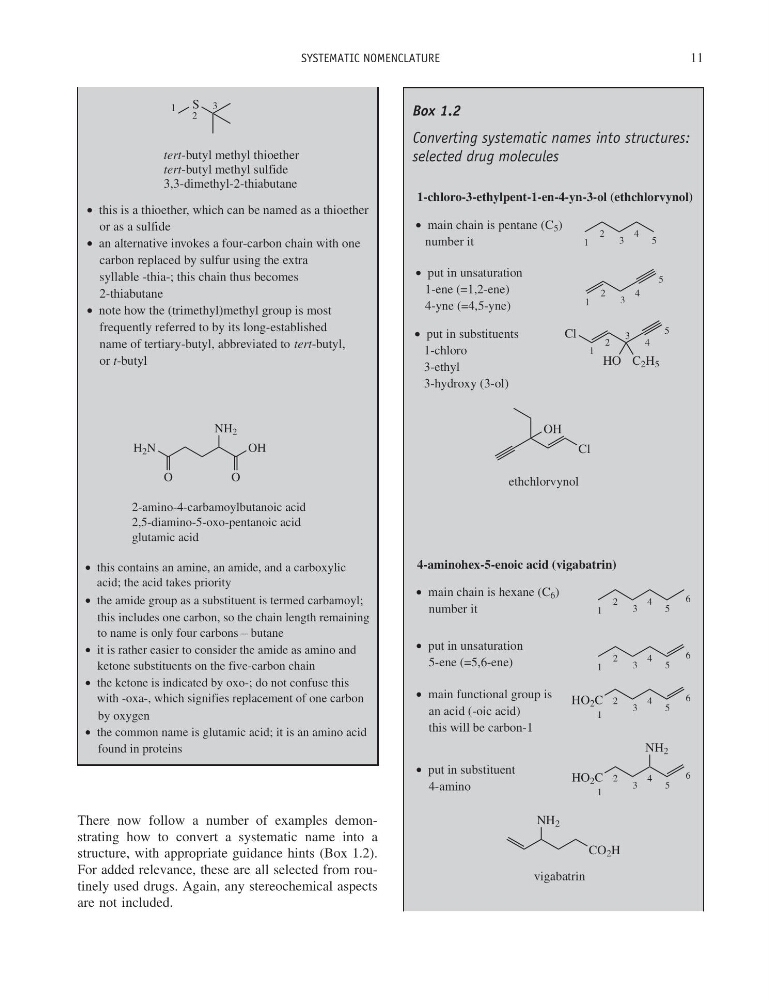
There now follow a number of examples demonstrating how to convert a systematic name into a
structure, with appropriate guidance hints (Box 1.2).
For added relevance, these are all selected from routinely used drugs. Again, any stereochemical aspects
are not included.
Box 1.2
Converting systematic names into structures:
selected drug molecules
Cl
OH
1-chloro-3-ethylpent-1-en-4-yn-3-ol (ethchlorvynol)
• main chain is pentane (C 5 )
number it
1
2
3
4
5
• put in unsaturation
1-ene (=1,2-ene)
4-yne (=4,5-yne)
1
2
3
4
5
• put in substituents
1-chloro
3-ethyl
3-hydroxy (3-ol)
1
2
3
4
5
Cl
C 2 H 5
HO
ethchlorvynol
CO 2 H
NH 2
4-aminohex-5-enoic acid (vigabatrin)
• main chain is hexane (C 6 )
number it
1
2
3
4
5
• put in unsaturation
5-ene (=5,6-ene)
• put in substituent
4-amino
6
1
2
3
4
5
6
• main functional group is
an acid (-oic acid)
this will be carbon-1
HO 2 C
1
2
3
4
5
6
HO 2 C
1
2
3
4
5
6
NH 2
vigabatrin
11
S
tert-butyl methyl thioether
tert-butyl methyl sulfide
3,3-dimethyl-2-thiabutane
• this is a thioether, which can be named as a thioether
or as a sulfide
• an alternative invokes a four-carbon chain with one
carbon replaced by sulfur using the extra
syllable -thia-; this chain thus becomes
2-thiabutane
• note how the (trimethyl)methyl group is most
frequently referred to by its long-established
name of tertiary-butyl, abbreviated to tert-butyl,
or t-butyl
2
3
1
O
OH
O
H 2 N
NH 2
2-amino-4-carbamoylbutanoic acid
2,5-diamino-5-oxo-pentanoic acid
glutamic acid
• this contains an amine, an amide, and a carboxylic
• the amide group as a substituent is termed carbamoyl;
• it is rather easier to consider the amide as amino and
• the ketone is indicated by oxo-; do not confuse this
• the common name is glutamic acid; it is an amino acid
acid; the acid takes priority
this includes one carbon, so the chain length remaining
to name is only four carbons – butane
ketone substituents on the five-carbon chain
with -oxa-, which signifies replacement of one carbon
by oxygen
found in proteins
There now follow a number of examples demonstrating how to convert a systematic name into a
structure, with appropriate guidance hints (Box 1.2).
For added relevance, these are all selected from routinely used drugs. Again, any stereochemical aspects
are not included.
Box 1.2
Converting systematic names into structures:
selected drug molecules
Cl
OH
1-chloro-3-ethylpent-1-en-4-yn-3-ol (ethchlorvynol)
• main chain is pentane (C 5 )
number it
1
2
3
4
5
• put in unsaturation
1-ene (=1,2-ene)
4-yne (=4,5-yne)
1
2
3
4
5
• put in substituents
1-chloro
3-ethyl
3-hydroxy (3-ol)
1
2
3
4
5
Cl
C 2 H 5
HO
ethchlorvynol
CO 2 H
NH 2
4-aminohex-5-enoic acid (vigabatrin)
• main chain is hexane (C 6 )
number it
1
2
3
4
5
• put in unsaturation
5-ene (=5,6-ene)
• put in substituent
4-amino
6
1
2
3
4
5
6
• main functional group is
an acid (-oic acid)
this will be carbon-1
HO 2 C
1
2
3
4
5
6
HO 2 C
1
2
3
4
5
6
NH 2
vigabatrin