

10
MOLECULAR REPRESENTATIONS AND NOMENCLATURE
Box 1.1 (continued)
N
H
CH 3
O
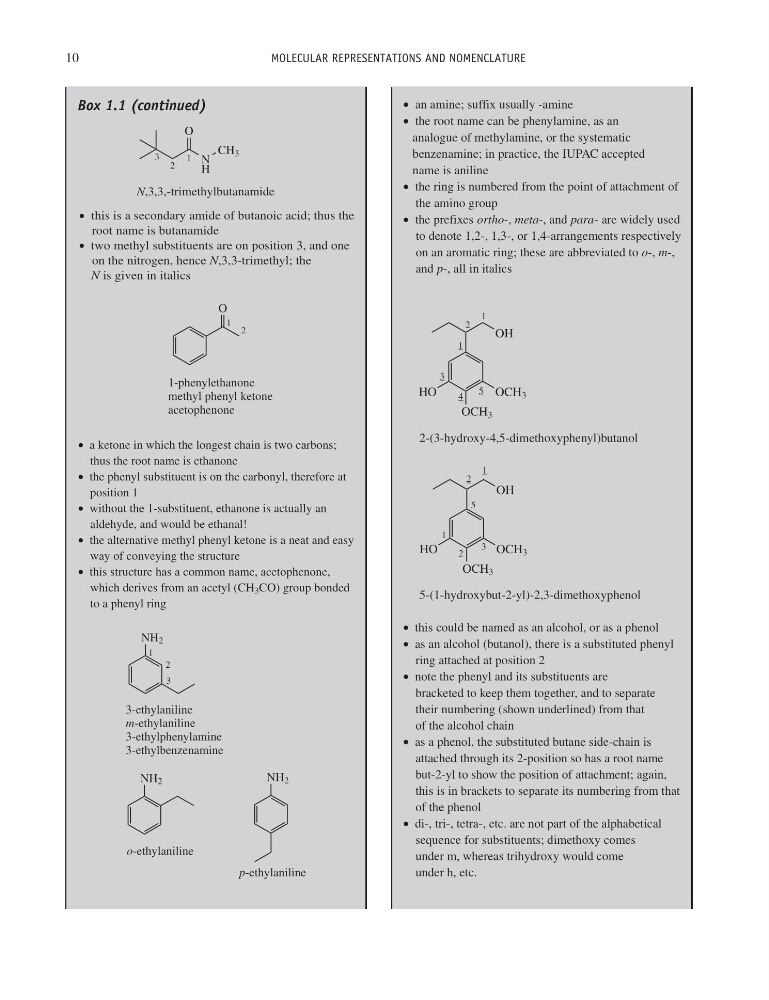
N,3,3,-trimethylbutanamide
1
2
3
• this is a secondary amide of butanoic acid; thus the
root name is butanamide
• two methyl substituents are on position 3, and one
on the nitrogen, hence N,3,3-trimethyl; the
N is given in italics
O
1-phenylethanone
methyl phenyl ketone
acetophenone
• a ketone in which the longest chain is two carbons;
thus the root name is ethanone
• the phenyl substituent is on the carbonyl, therefore at
position 1
• without the 1-substituent, ethanone is actually an
aldehyde, and would be ethanal!
• the alternative methyl phenyl ketone is a neat and easy
way of conveying the structure
• this structure has a common name, acetophenone,
which derives from an acetyl (CH 3 CO) group bonded
to a phenyl ring
1
2
NH 2
3-ethylaniline
m-ethylaniline
3-ethylphenylamine
3-ethylbenzenamine
1
2
3
NH 2
NH 2
o-ethylaniline
p-ethylaniline
• an amine; suffix usually -amine
• the root name can be phenylamine, as an
analogue of methylamine, or the systematic
benzenamine; in practice, the IUPAC accepted
name is aniline
• the ring is numbered from the point of attachment of
the amino group
• the prefixes ortho-, meta-, and para- are widely used
to denote 1,2-, 1,3-, or 1,4-arrangements respectively
on an aromatic ring; these are abbreviated to o-, m-,
and p-, all in italics
HO
OCH 3
OCH 3
2-(3-hydroxy-4,5-dimethoxyphenyl)butanol
OH
HO
OCH 3
OCH 3
OH
1
2
3
4
5
1
2
3
5
1
2
5-(1-hydroxybut-2-yl)-2,3-dimethoxyphenol
• this could be named as an alcohol, or as a phenol
• as an alcohol (butanol), there is a substituted phenyl
ring attached at position 2
• note the phenyl and its substituents are
bracketed to keep them together, and to separate
their numbering (shown underlined) from that
of the alcohol chain
• as a phenol, the substituted butane side-chain is
attached through its 2-position so has a root name
but-2-yl to show the position of attachment; again,
this is in brackets to separate its numbering from that
of the phenol
• di-, tri-, tetra-, etc. are not part of the alphabetical
sequence for substituents; dimethoxy comes
under m, whereas trihydroxy would come
under h, etc.
1
MOLECULAR REPRESENTATIONS AND NOMENCLATURE
Box 1.1 (continued)
N
H
CH 3
O
N,3,3,-trimethylbutanamide
1
2
3
• this is a secondary amide of butanoic acid; thus the
root name is butanamide
• two methyl substituents are on position 3, and one
on the nitrogen, hence N,3,3-trimethyl; the
N is given in italics
O
1-phenylethanone
methyl phenyl ketone
acetophenone
• a ketone in which the longest chain is two carbons;
thus the root name is ethanone
• the phenyl substituent is on the carbonyl, therefore at
position 1
• without the 1-substituent, ethanone is actually an
aldehyde, and would be ethanal!
• the alternative methyl phenyl ketone is a neat and easy
way of conveying the structure
• this structure has a common name, acetophenone,
which derives from an acetyl (CH 3 CO) group bonded
to a phenyl ring
1
2
NH 2
3-ethylaniline
m-ethylaniline
3-ethylphenylamine
3-ethylbenzenamine
1
2
3
NH 2
NH 2
o-ethylaniline
p-ethylaniline
• an amine; suffix usually -amine
• the root name can be phenylamine, as an
analogue of methylamine, or the systematic
benzenamine; in practice, the IUPAC accepted
name is aniline
• the ring is numbered from the point of attachment of
the amino group
• the prefixes ortho-, meta-, and para- are widely used
to denote 1,2-, 1,3-, or 1,4-arrangements respectively
on an aromatic ring; these are abbreviated to o-, m-,
and p-, all in italics
HO
OCH 3
OCH 3
2-(3-hydroxy-4,5-dimethoxyphenyl)butanol
OH
HO
OCH 3
OCH 3
OH
1
2
3
4
5
1
2
3
5
1
2
5-(1-hydroxybut-2-yl)-2,3-dimethoxyphenol
• this could be named as an alcohol, or as a phenol
• as an alcohol (butanol), there is a substituted phenyl
ring attached at position 2
• note the phenyl and its substituents are
bracketed to keep them together, and to separate
their numbering (shown underlined) from that
of the alcohol chain
• as a phenol, the substituted butane side-chain is
attached through its 2-position so has a root name
but-2-yl to show the position of attachment; again,
this is in brackets to separate its numbering from that
of the phenol
• di-, tri-, tetra-, etc. are not part of the alphabetical
sequence for substituents; dimethoxy comes
under m, whereas trihydroxy would come
under h, etc.
1