

SYSTEMATIC NOMENCLATURE
9
O
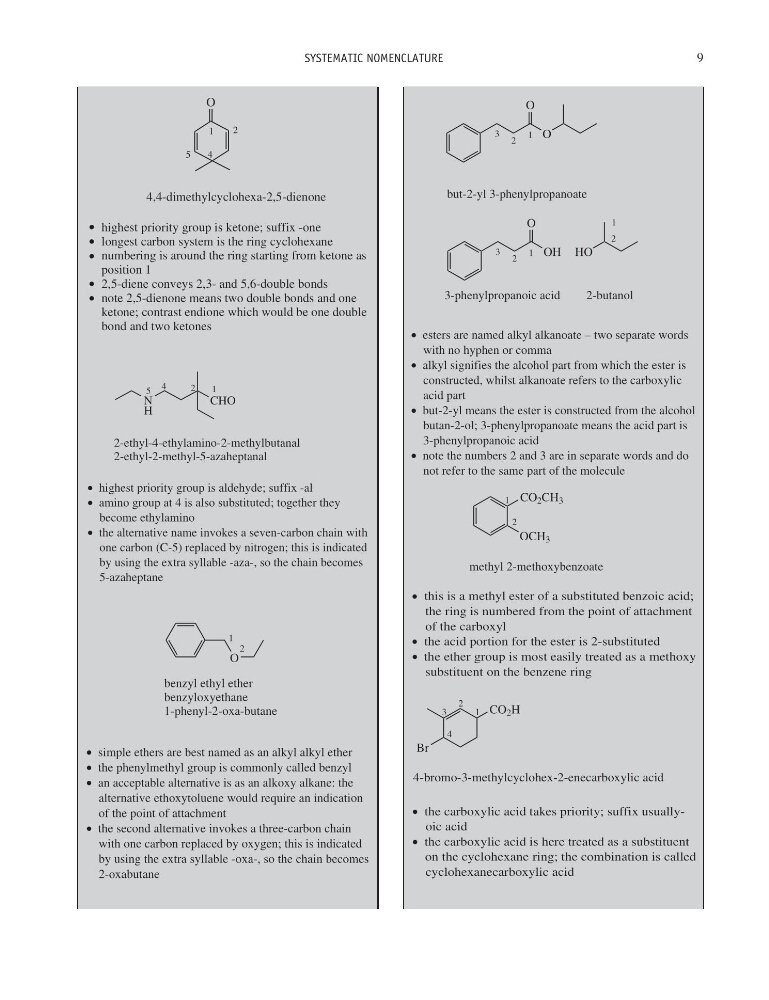
4,4-dimethylcyclohexa-2,5-dienone
highest priority group is ketone; suffix -one
longest carbon system is the ring cyclohexane
numbering is around the ring starting from ketone as
position 1
2,5-diene conveys 2,3- and 5,6-double bonds
note 2,5-dienone means two double bonds and one
ketone; contrast endione which would be one double
bond and two ketones
1
2
4
5
•
•
•
•
•
N
H
CHO
2-ethyl-4-ethylamino-2-methylbutanal
2-ethyl-2-methyl-5-azaheptanal
1
2
5 4
• highest priority group is aldehyde; suffix -al
• amino group at 4 is also substituted; together they
become ethylamino
• the alternative name invokes a seven-carbon chain with
one carbon (C-5) replaced by nitrogen; this is indicated
by using the extra syllable -aza-, so the chain becomes
5-azaheptane
O
benzyl ethyl ether
benzyloxyethane
1-phenyl-2-oxa-butane
• simple ethers are best named as an alkyl alkyl ether
• the phenylmethyl group is commonly called benzyl
• an acceptable alternative is as an alkoxy alkane: the
alternative ethoxytoluene would require an indication
of the point of attachment
• the second alternative invokes a three-carbon chain
with one carbon replaced by oxygen; this is indicated
by using the extra syllable -oxa-, so the chain becomes
2-oxabutane
1
2
O
O
1
2
3
• esters are named alkyl alkanoate – two separate words
with no hyphen or comma
• alkyl signifies the alcohol part from which the ester is
constructed, whilst alkanoate refers to the carboxylic
acid part
• but-2-yl means the ester is constructed from the alcohol
butan-2-ol; 3-phenylpropanoate means the acid part is
3-phenylpropanoic acid
• note the numbers 2 and 3 are in separate words and do
not refer to the same part of the molecule
but-2-yl 3-phenylpropanoate
OH
O
1
2
3
1
2
HO
3-phenylpropanoic acid
2-butanol
CO 2 CH 3
OCH 3
methyl 2-methoxybenzoate
• this is a methyl ester of a substituted benzoic acid;
the ring is numbered from the point of attachment
of the carboxyl
• the acid portion for the ester is 2-substituted
• the ether group is most easily treated as a methoxy
substituent on the benzene ring
1
2
CO 2 H
Br
4-bromo-3-methylcyclohex-2-enecarboxylic acid
1
2
3
4
• the carboxylic acid takes priority; suffix usuallyoic acid
• the carboxylic acid is here treated as a substituent
on the cyclohexane ring; the combination is called
cyclohexanecarboxylic acid
9
O
4,4-dimethylcyclohexa-2,5-dienone
highest priority group is ketone; suffix -one
longest carbon system is the ring cyclohexane
numbering is around the ring starting from ketone as
position 1
2,5-diene conveys 2,3- and 5,6-double bonds
note 2,5-dienone means two double bonds and one
ketone; contrast endione which would be one double
bond and two ketones
1
2
4
5
•
•
•
•
•
N
H
CHO
2-ethyl-4-ethylamino-2-methylbutanal
2-ethyl-2-methyl-5-azaheptanal
1
2
5 4
• highest priority group is aldehyde; suffix -al
• amino group at 4 is also substituted; together they
become ethylamino
• the alternative name invokes a seven-carbon chain with
one carbon (C-5) replaced by nitrogen; this is indicated
by using the extra syllable -aza-, so the chain becomes
5-azaheptane
O
benzyl ethyl ether
benzyloxyethane
1-phenyl-2-oxa-butane
• simple ethers are best named as an alkyl alkyl ether
• the phenylmethyl group is commonly called benzyl
• an acceptable alternative is as an alkoxy alkane: the
alternative ethoxytoluene would require an indication
of the point of attachment
• the second alternative invokes a three-carbon chain
with one carbon replaced by oxygen; this is indicated
by using the extra syllable -oxa-, so the chain becomes
2-oxabutane
1
2
O
O
1
2
3
• esters are named alkyl alkanoate – two separate words
with no hyphen or comma
• alkyl signifies the alcohol part from which the ester is
constructed, whilst alkanoate refers to the carboxylic
acid part
• but-2-yl means the ester is constructed from the alcohol
butan-2-ol; 3-phenylpropanoate means the acid part is
3-phenylpropanoic acid
• note the numbers 2 and 3 are in separate words and do
not refer to the same part of the molecule
but-2-yl 3-phenylpropanoate
OH
O
1
2
3
1
2
HO
3-phenylpropanoic acid
2-butanol
CO 2 CH 3
OCH 3
methyl 2-methoxybenzoate
• this is a methyl ester of a substituted benzoic acid;
the ring is numbered from the point of attachment
of the carboxyl
• the acid portion for the ester is 2-substituted
• the ether group is most easily treated as a methoxy
substituent on the benzene ring
1
2
CO 2 H
Br
4-bromo-3-methylcyclohex-2-enecarboxylic acid
1
2
3
4
• the carboxylic acid takes priority; suffix usuallyoic acid
• the carboxylic acid is here treated as a substituent
on the cyclohexane ring; the combination is called
cyclohexanecarboxylic acid