

8
MOLECULAR REPRESENTATIONS AND NOMENCLATURE
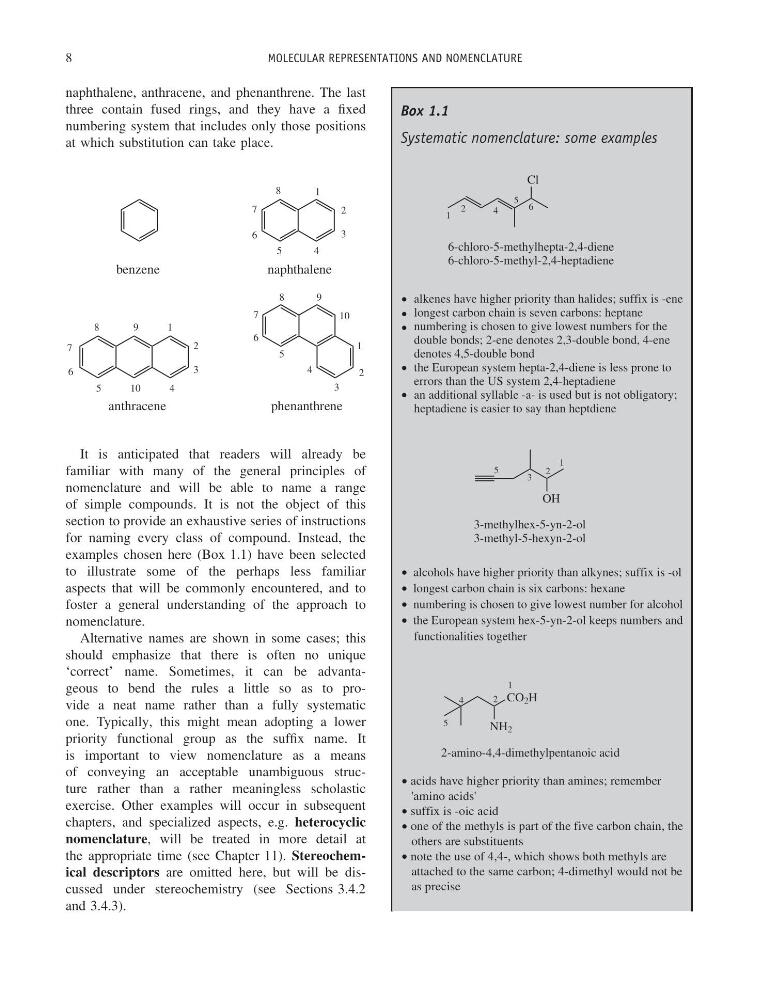
naphthalene, anthracene, and phenanthrene. The last
three contain fused rings, and they have a fixed
numbering system that includes only those positions
at which substitution can take place.
benzene
naphthalene
anthracene
phenanthrene
1
2
3
4
5
6
7
8
9
10
1
2
3
4
5
6
7
8
1
2
3
4
5
6
7
8
9
10
It is anticipated that readers will already be
familiar with many of the general principles of
nomenclature and will be able to name a range
of simple compounds. It is not the object of this
section to provide an exhaustive series of instructions
for naming every class of compound. Instead, the
examples chosen here (Box 1.1) have been selected
to illustrate some of the perhaps less familiar
aspects that will be commonly encountered, and to
foster a general understanding of the approach to
nomenclature.
Alternative names are shown in some cases; this
should emphasize that there is often no unique
‘correct’ name. Sometimes, it can be advantageous to bend the rules a little so as to provide a neat name rather than a fully systematic
one. Typically, this might mean adopting a lower
priority functional group as the suffix name. It
is important to view nomenclature as a means
of conveying an acceptable unambiguous structure rather than a rather meaningless scholastic
exercise. Other examples will occur in subsequent
chapters, and specialized aspects, e.g. heterocyclic
nomenclature, will be treated in more detail at
the appropriate time (see Chapter 11). Stereochemical descriptors are omitted here, but will be discussed under stereochemistry (see Sections 3.4.2
and 3.4.3).
Box 1.1
Systematic nomenclature: some examples
Cl
6-chloro-5-methylhepta-2,4-diene
6-chloro-5-methyl-2,4-heptadiene
1
2
4
5
6
alkenes have higher priority than halides; suffix is -ene
longest carbon chain is seven carbons: heptane
numbering is chosen to give lowest numbers for the
double bonds; 2-ene denotes 2,3-double bond, 4-ene
denotes 4,5-double bond
the European system hepta-2,4-diene is less prone to
errors than the US system 2,4-heptadiene
an additional syllable -a- is used but is not obligatory;
heptadiene is easier to say than heptdiene
•
•
•
•
•
OH
3-methylhex-5-yn-2-ol
3-methyl-5-hexyn-2-ol
• alcohols have higher priority than alkynes; suffix is -ol
• longest carbon chain is six carbons: hexane
• numbering is chosen to give lowest number for alcohol
• the European system hex-5-yn-2-ol keeps numbers and
functionalities together
1
2
3
5
NH 2
CO 2 H
2-amino-4,4-dimethylpentanoic acid
• acids have higher priority than amines; remember
'amino acids'
• suffix is -oic acid
• one of the methyls is part of the five carbon chain, the
others are substituents
• note the use of 4,4-, which shows both methyls are
attached to the same carbon; 4-dimethyl would not be
as precise
1
2
4
5
MOLECULAR REPRESENTATIONS AND NOMENCLATURE
naphthalene, anthracene, and phenanthrene. The last
three contain fused rings, and they have a fixed
numbering system that includes only those positions
at which substitution can take place.
benzene
naphthalene
anthracene
phenanthrene
1
2
3
4
5
6
7
8
9
10
1
2
3
4
5
6
7
8
1
2
3
4
5
6
7
8
9
10
It is anticipated that readers will already be
familiar with many of the general principles of
nomenclature and will be able to name a range
of simple compounds. It is not the object of this
section to provide an exhaustive series of instructions
for naming every class of compound. Instead, the
examples chosen here (Box 1.1) have been selected
to illustrate some of the perhaps less familiar
aspects that will be commonly encountered, and to
foster a general understanding of the approach to
nomenclature.
Alternative names are shown in some cases; this
should emphasize that there is often no unique
‘correct’ name. Sometimes, it can be advantageous to bend the rules a little so as to provide a neat name rather than a fully systematic
one. Typically, this might mean adopting a lower
priority functional group as the suffix name. It
is important to view nomenclature as a means
of conveying an acceptable unambiguous structure rather than a rather meaningless scholastic
exercise. Other examples will occur in subsequent
chapters, and specialized aspects, e.g. heterocyclic
nomenclature, will be treated in more detail at
the appropriate time (see Chapter 11). Stereochemical descriptors are omitted here, but will be discussed under stereochemistry (see Sections 3.4.2
and 3.4.3).
Box 1.1
Systematic nomenclature: some examples
Cl
6-chloro-5-methylhepta-2,4-diene
6-chloro-5-methyl-2,4-heptadiene
1
2
4
5
6
alkenes have higher priority than halides; suffix is -ene
longest carbon chain is seven carbons: heptane
numbering is chosen to give lowest numbers for the
double bonds; 2-ene denotes 2,3-double bond, 4-ene
denotes 4,5-double bond
the European system hepta-2,4-diene is less prone to
errors than the US system 2,4-heptadiene
an additional syllable -a- is used but is not obligatory;
heptadiene is easier to say than heptdiene
•
•
•
•
•
OH
3-methylhex-5-yn-2-ol
3-methyl-5-hexyn-2-ol
• alcohols have higher priority than alkynes; suffix is -ol
• longest carbon chain is six carbons: hexane
• numbering is chosen to give lowest number for alcohol
• the European system hex-5-yn-2-ol keeps numbers and
functionalities together
1
2
3
5
NH 2
CO 2 H
2-amino-4,4-dimethylpentanoic acid
• acids have higher priority than amines; remember
'amino acids'
• suffix is -oic acid
• one of the methyls is part of the five carbon chain, the
others are substituents
• note the use of 4,4-, which shows both methyls are
attached to the same carbon; 4-dimethyl would not be
as precise
1
2
4
5