

NITROGEN AS A NUCLEOPHILE: IMINES AND ENAMINES
243
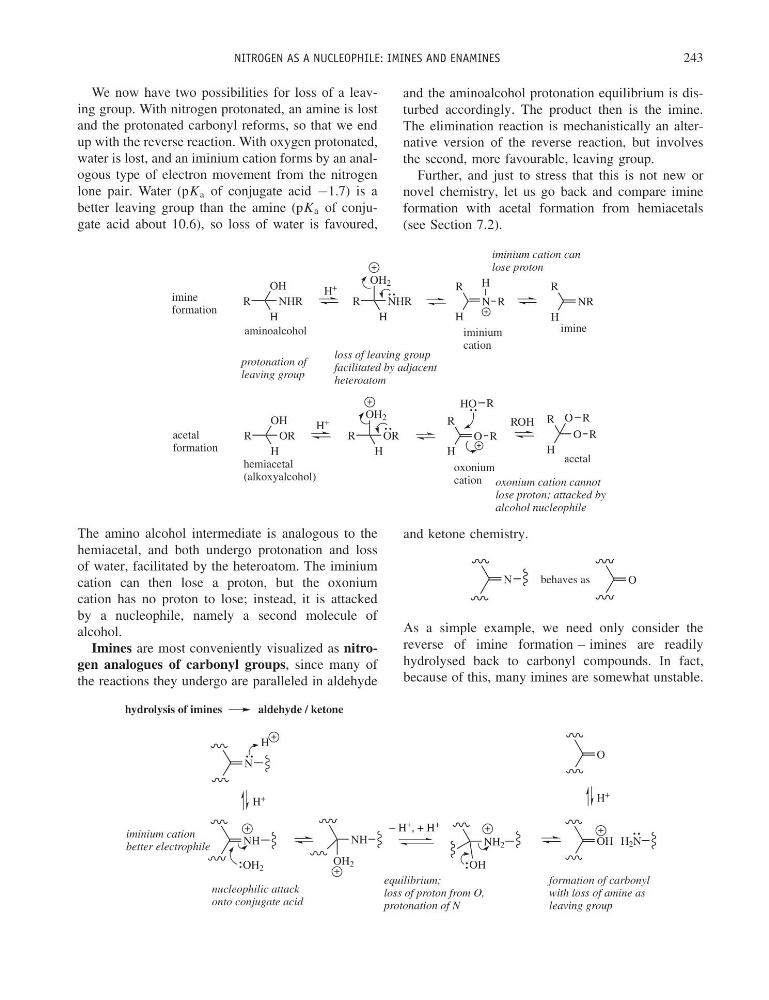
We now have two possibilities for loss of a leaving group. With nitrogen protonated, an amine is lost
and the protonated carbonyl reforms, so that we end
up with the reverse reaction. With oxygen protonated,
water is lost, and an iminium cation forms by an analogous type of electron movement from the nitrogen
lone pair. Water (pK a of conjugate acid −1.7) is a
better leaving group than the amine (pK a of conjugate acid about 10.6), so loss of water is favoured,
and the aminoalcohol protonation equilibrium is disturbed accordingly. The product then is the imine.
The elimination reaction is mechanistically an alternative version of the reverse reaction, but involves
the second, more favourable, leaving group.
Further, and just to stress that this is not new or
novel chemistry, let us go back and compare imine
formation with acetal formation from hemiacetals
(see Section 7.2).
iminium cation can
lose proton
protonation of
leaving group
HO R
loss of leaving group
facilitated by adjacent
heteroatom
R
H
OH
NHR
R
H
OH 2
NHR
H
+
N
H
R
R
H
R
H
OH
OR
R
H
OH 2
OR
H
+
O
H
R
R
oxonium
cation
iminium
cation
O
H
R
R
O R
acetal
ROH
aminoalcohol
hemiacetal
(alkoxyalcohol)
NR
H
R
imine
oxonium cation cannot
lose proton; attacked by
alcohol nucleophile
imine
formation
acetal
formation
The amino alcohol intermediate is analogous to the
hemiacetal, and both undergo protonation and loss
of water, facilitated by the heteroatom. The iminium
cation can then lose a proton, but the oxonium
cation has no proton to lose; instead, it is attacked
by a nucleophile, namely a second molecule of
alcohol.
Imines are most conveniently visualized as nitrogen analogues of carbonyl groups, since many of
the reactions they undergo are paralleled in aldehyde
and ketone chemistry.
N
O
behaves as
As a simple example, we need only consider the
reverse of imine formation – imines are readily
hydrolysed back to carbonyl compounds. In fact,
because of this, many imines are somewhat unstable.
iminium cation
better electrophile
NH
NH 2
OH
NH
OH 2
OH H 2 N
N
O
hydrolysis of imines
aldehyde / ketone
nucleophilic attack
onto conjugate acid
equilibrium;
loss of proton from O,
protonation of N
formation of carbonyl
with loss of amine as
leaving group
H +
H
+
− H
+ , + H
+
OH 2
H
243
We now have two possibilities for loss of a leaving group. With nitrogen protonated, an amine is lost
and the protonated carbonyl reforms, so that we end
up with the reverse reaction. With oxygen protonated,
water is lost, and an iminium cation forms by an analogous type of electron movement from the nitrogen
lone pair. Water (pK a of conjugate acid −1.7) is a
better leaving group than the amine (pK a of conjugate acid about 10.6), so loss of water is favoured,
and the aminoalcohol protonation equilibrium is disturbed accordingly. The product then is the imine.
The elimination reaction is mechanistically an alternative version of the reverse reaction, but involves
the second, more favourable, leaving group.
Further, and just to stress that this is not new or
novel chemistry, let us go back and compare imine
formation with acetal formation from hemiacetals
(see Section 7.2).
iminium cation can
lose proton
protonation of
leaving group
HO R
loss of leaving group
facilitated by adjacent
heteroatom
R
H
OH
NHR
R
H
OH 2
NHR
H
+
N
H
R
R
H
R
H
OH
OR
R
H
OH 2
OR
H
+
O
H
R
R
oxonium
cation
iminium
cation
O
H
R
R
O R
acetal
ROH
aminoalcohol
hemiacetal
(alkoxyalcohol)
NR
H
R
imine
oxonium cation cannot
lose proton; attacked by
alcohol nucleophile
imine
formation
acetal
formation
The amino alcohol intermediate is analogous to the
hemiacetal, and both undergo protonation and loss
of water, facilitated by the heteroatom. The iminium
cation can then lose a proton, but the oxonium
cation has no proton to lose; instead, it is attacked
by a nucleophile, namely a second molecule of
alcohol.
Imines are most conveniently visualized as nitrogen analogues of carbonyl groups, since many of
the reactions they undergo are paralleled in aldehyde
and ketone chemistry.
N
O
behaves as
As a simple example, we need only consider the
reverse of imine formation – imines are readily
hydrolysed back to carbonyl compounds. In fact,
because of this, many imines are somewhat unstable.
iminium cation
better electrophile
NH
NH 2
OH
NH
OH 2
OH H 2 N
N
O
hydrolysis of imines
aldehyde / ketone
nucleophilic attack
onto conjugate acid
equilibrium;
loss of proton from O,
protonation of N
formation of carbonyl
with loss of amine as
leaving group
H +
H
+
− H
+ , + H
+
OH 2
H