

244
NUCLEOPHILIC REACTIONS OF CARBONYL GROUPS
Protonation to the conjugate acid (iminium cation)
increases the potential of the imine to act as an
electrophile (compare carbonyl; see Section 7.1), and
this is followed by nucleophilic attack of water.
The protonated product is in equilibrium with the
other mono-protonated species in which the nitrogen
carries the charge. We shall meet this mechanistic
feature from time to time, and it is usually represented
in a mechanism simply by putting ‘−H
+ , +H
+ ’ over
the equilibrium arrows. Do not interpret this as an
internal transfer of a proton; such transfer would not
be possible, and it is necessary to have solvent to
supply and remove protons.
Protonation of nitrogen allows loss of the amine
leaving group and formation of the conjugate acid of
the carbonyl compound. Despite the comments made
above regarding alternative leaving groups, imine
formation and hydrolysis are reversible, though it
will usually be necessary to disturb the equilibrium,
as required, by using an excess of the appropriate
reagent.
In Section 10.6 we shall meet the Mannich reaction, where an imine or iminium ion acts as an
electrophile for nucleophiles of the enolate anion
type.
Box 7.9
Hydrolysis of nitriles to carboxylic acids
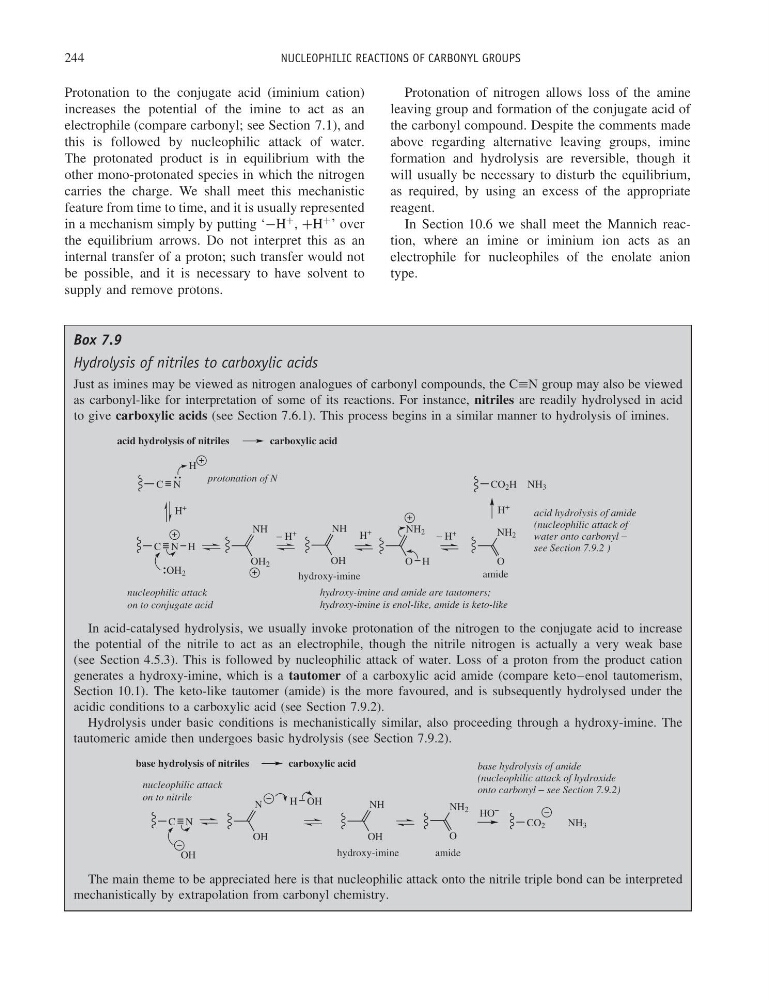
Just as imines may be viewed as nitrogen analogues of carbonyl compounds, the C≡N group may also be viewed
as carbonyl-like for interpretation of some of its reactions. For instance, nitriles are readily hydrolysed in acid
to give carboxylic acids (see Section 7.6.1). This process begins in a similar manner to hydrolysis of imines.
C N H
C N
NH
OH 2
NH
OH
carboxylic acid
acid hydrolysis of nitriles
NH 2
O
CO 2 H
hydroxy-imine
amide
hydroxy-imine and amide are tautomers;
hydroxy-imine is enol-like, amide is keto-like
nucleophilic attack
on to conjugate acid
acid hydrolysis of amide
(nucleophilic attack of
water onto carbonyl −
see Section 7.9.2 )
H +
H +
protonation of N
− H
+
NH 2
O H
H
+
− H +
NH 3
H
OH 2
In acid-catalysed hydrolysis, we usually invoke protonation of the nitrogen to the conjugate acid to increase
the potential of the nitrile to act as an electrophile, though the nitrile nitrogen is actually a very weak base
(see Section 4.5.3). This is followed by nucleophilic attack of water. Loss of a proton from the product cation
generates a hydroxy-imine, which is a tautomer of a carboxylic acid amide (compare keto–enol tautomerism,
Section 10.1). The keto-like tautomer (amide) is the more favoured, and is subsequently hydrolysed under the
acidic conditions to a carboxylic acid (see Section 7.9.2).
Hydrolysis under basic conditions is mechanistically similar, also proceeding through a hydroxy-imine. The
tautomeric amide then undergoes basic hydrolysis (see Section 7.9.2).
carboxylic acid
base hydrolysis of nitriles
C N
OH
N
OH
H OH
NH
OH
NH 2
O
CO 2
amide
HO
−
base hydrolysis of amide
(nucleophilic attack of hydroxide
onto carbonyl − see Section 7.9.2)
hydroxy-imine
nucleophilic attack
on to nitrile
NH 3
The main theme to be appreciated here is that nucleophilic attack onto the nitrile triple bond can be interpreted
mechanistically by extrapolation from carbonyl chemistry.
NUCLEOPHILIC REACTIONS OF CARBONYL GROUPS
Protonation to the conjugate acid (iminium cation)
increases the potential of the imine to act as an
electrophile (compare carbonyl; see Section 7.1), and
this is followed by nucleophilic attack of water.
The protonated product is in equilibrium with the
other mono-protonated species in which the nitrogen
carries the charge. We shall meet this mechanistic
feature from time to time, and it is usually represented
in a mechanism simply by putting ‘−H
+ , +H
+ ’ over
the equilibrium arrows. Do not interpret this as an
internal transfer of a proton; such transfer would not
be possible, and it is necessary to have solvent to
supply and remove protons.
Protonation of nitrogen allows loss of the amine
leaving group and formation of the conjugate acid of
the carbonyl compound. Despite the comments made
above regarding alternative leaving groups, imine
formation and hydrolysis are reversible, though it
will usually be necessary to disturb the equilibrium,
as required, by using an excess of the appropriate
reagent.
In Section 10.6 we shall meet the Mannich reaction, where an imine or iminium ion acts as an
electrophile for nucleophiles of the enolate anion
type.
Box 7.9
Hydrolysis of nitriles to carboxylic acids
Just as imines may be viewed as nitrogen analogues of carbonyl compounds, the C≡N group may also be viewed
as carbonyl-like for interpretation of some of its reactions. For instance, nitriles are readily hydrolysed in acid
to give carboxylic acids (see Section 7.6.1). This process begins in a similar manner to hydrolysis of imines.
C N H
C N
NH
OH 2
NH
OH
carboxylic acid
acid hydrolysis of nitriles
NH 2
O
CO 2 H
hydroxy-imine
amide
hydroxy-imine and amide are tautomers;
hydroxy-imine is enol-like, amide is keto-like
nucleophilic attack
on to conjugate acid
acid hydrolysis of amide
(nucleophilic attack of
water onto carbonyl −
see Section 7.9.2 )
H +
H +
protonation of N
− H
+
NH 2
O H
H
+
− H +
NH 3
H
OH 2
In acid-catalysed hydrolysis, we usually invoke protonation of the nitrogen to the conjugate acid to increase
the potential of the nitrile to act as an electrophile, though the nitrile nitrogen is actually a very weak base
(see Section 4.5.3). This is followed by nucleophilic attack of water. Loss of a proton from the product cation
generates a hydroxy-imine, which is a tautomer of a carboxylic acid amide (compare keto–enol tautomerism,
Section 10.1). The keto-like tautomer (amide) is the more favoured, and is subsequently hydrolysed under the
acidic conditions to a carboxylic acid (see Section 7.9.2).
Hydrolysis under basic conditions is mechanistically similar, also proceeding through a hydroxy-imine. The
tautomeric amide then undergoes basic hydrolysis (see Section 7.9.2).
carboxylic acid
base hydrolysis of nitriles
C N
OH
N
OH
H OH
NH
OH
NH 2
O
CO 2
amide
HO
−
base hydrolysis of amide
(nucleophilic attack of hydroxide
onto carbonyl − see Section 7.9.2)
hydroxy-imine
nucleophilic attack
on to nitrile
NH 3
The main theme to be appreciated here is that nucleophilic attack onto the nitrile triple bond can be interpreted
mechanistically by extrapolation from carbonyl chemistry.