

242
NUCLEOPHILIC REACTIONS OF CARBONYL GROUPS
no other chiral carbons in the starting material. Estrone contains the complex steroidal ring system with four fused
rings (see Box 3.19), and the product ethinylestradiol is formed as just one of the two possible epimers at C-17.
By considering the three-dimensional shape of estrone (see Box 3.19), we can appreciate that nucleophilic
attack from the upper face is hindered by the methyl group adjacent to the ketone. Therefore, the nucleophile can
only approach from the lower face, and the product is formed stereospecifically.
7.7 Nitrogen as a nucleophile: imines
and enamines
7.7.1 Imines
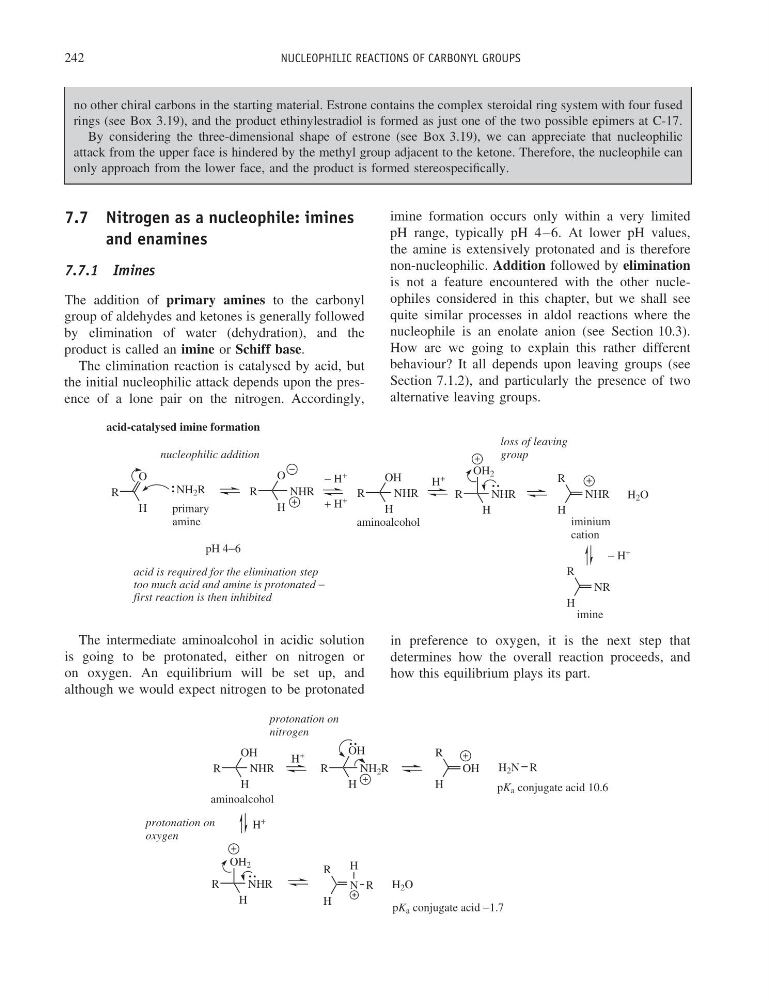
The addition of primary amines to the carbonyl
group of aldehydes and ketones is generally followed
by elimination of water (dehydration), and the
product is called an imine or Schiff base.
The elimination reaction is catalysed by acid, but
the initial nucleophilic attack depends upon the presence of a lone pair on the nitrogen. Accordingly,
imine formation occurs only within a very limited
pH range, typically pH 4–6. At lower pH values,
the amine is extensively protonated and is therefore
non-nucleophilic. Addition followed by elimination
is not a feature encountered with the other nucleophiles considered in this chapter, but we shall see
quite similar processes in aldol reactions where the
nucleophile is an enolate anion (see Section 10.3).
How are we going to explain this rather different
behaviour? It all depends upon leaving groups (see
Section 7.1.2), and particularly the presence of two
alternative leaving groups.
R
H
O
NH 2 R
R
H
OH
NHR
R
H
OH 2
NHR
NHR
H
R
iminium
cation
pH 4−6
acid is required for the elimination step
too much acid and amine is protonated −
first reaction is then inhibited
acid-catalysed imine formation
aminoalcohol
R
H
O
NHR
− H +
+ H
+
H +
NR
H
R
imine
− H +
nucleophilic addition
loss of leaving
group
primary
amine
H 2 O
The intermediate aminoalcohol in acidic solution
is going to be protonated, either on nitrogen or
on oxygen. An equilibrium will be set up, and
although we would expect nitrogen to be protonated
in preference to oxygen, it is the next step that
determines how the overall reaction proceeds, and
how this equilibrium plays its part.
OH
H
R
H 2 N R
N
H
R
R
H
pK a conjugate acid −1.7
pK a conjugate acid 10.6
R
H
OH
NHR
R
H
OH 2
NHR
H +
H
+
R
H
OH
NH 2 R
protonation on
nitrogen
protonation on
oxygen
aminoalcohol
H 2 O
NUCLEOPHILIC REACTIONS OF CARBONYL GROUPS
no other chiral carbons in the starting material. Estrone contains the complex steroidal ring system with four fused
rings (see Box 3.19), and the product ethinylestradiol is formed as just one of the two possible epimers at C-17.
By considering the three-dimensional shape of estrone (see Box 3.19), we can appreciate that nucleophilic
attack from the upper face is hindered by the methyl group adjacent to the ketone. Therefore, the nucleophile can
only approach from the lower face, and the product is formed stereospecifically.
7.7 Nitrogen as a nucleophile: imines
and enamines
7.7.1 Imines
The addition of primary amines to the carbonyl
group of aldehydes and ketones is generally followed
by elimination of water (dehydration), and the
product is called an imine or Schiff base.
The elimination reaction is catalysed by acid, but
the initial nucleophilic attack depends upon the presence of a lone pair on the nitrogen. Accordingly,
imine formation occurs only within a very limited
pH range, typically pH 4–6. At lower pH values,
the amine is extensively protonated and is therefore
non-nucleophilic. Addition followed by elimination
is not a feature encountered with the other nucleophiles considered in this chapter, but we shall see
quite similar processes in aldol reactions where the
nucleophile is an enolate anion (see Section 10.3).
How are we going to explain this rather different
behaviour? It all depends upon leaving groups (see
Section 7.1.2), and particularly the presence of two
alternative leaving groups.
R
H
O
NH 2 R
R
H
OH
NHR
R
H
OH 2
NHR
NHR
H
R
iminium
cation
pH 4−6
acid is required for the elimination step
too much acid and amine is protonated −
first reaction is then inhibited
acid-catalysed imine formation
aminoalcohol
R
H
O
NHR
− H +
+ H
+
H +
NR
H
R
imine
− H +
nucleophilic addition
loss of leaving
group
primary
amine
H 2 O
The intermediate aminoalcohol in acidic solution
is going to be protonated, either on nitrogen or
on oxygen. An equilibrium will be set up, and
although we would expect nitrogen to be protonated
in preference to oxygen, it is the next step that
determines how the overall reaction proceeds, and
how this equilibrium plays its part.
OH
H
R
H 2 N R
N
H
R
R
H
pK a conjugate acid −1.7
pK a conjugate acid 10.6
R
H
OH
NHR
R
H
OH 2
NHR
H +
H
+
R
H
OH
NH 2 R
protonation on
nitrogen
protonation on
oxygen
aminoalcohol
H 2 O