

HYDRIDE AS A NUCLEOPHILE: REDUCTION OF ALDEHYDES AND KETONES, LAH AND SODIUM BOROHYDRIDE
237
sequentially less reactive than the original reagent,
and this has led to the development of other
complex metal hydride reducing agents that are less
reactive and, consequently, more selective than LAH.
They are produced by treating LAH with various
amounts of an alcohol ROH, giving compounds
with the general formulae (RO)MH 3
− , (RO) 2 MH 2
− ,
and (RO) 3 MH
− as their anionic component. These
provide a range of reducing agents with different
activities. LAH itself is a powerful reducing agent and
will react with a number of other functional groups
(see Sections 7.7.1 and 7.11).
Note that LAH does not reduce carbon–carbon
double bonds; these double bonds lack the charge
separation that distinguishes the carbonyl group,
and there is no electrophilic character to allow
nucleophilic attack. An effective way of reducing
C=C is catalytic hydrogenation (see Section 9.4.3).
Box 7.6
Nicotinamide adenine dinucleotide as reducing agent
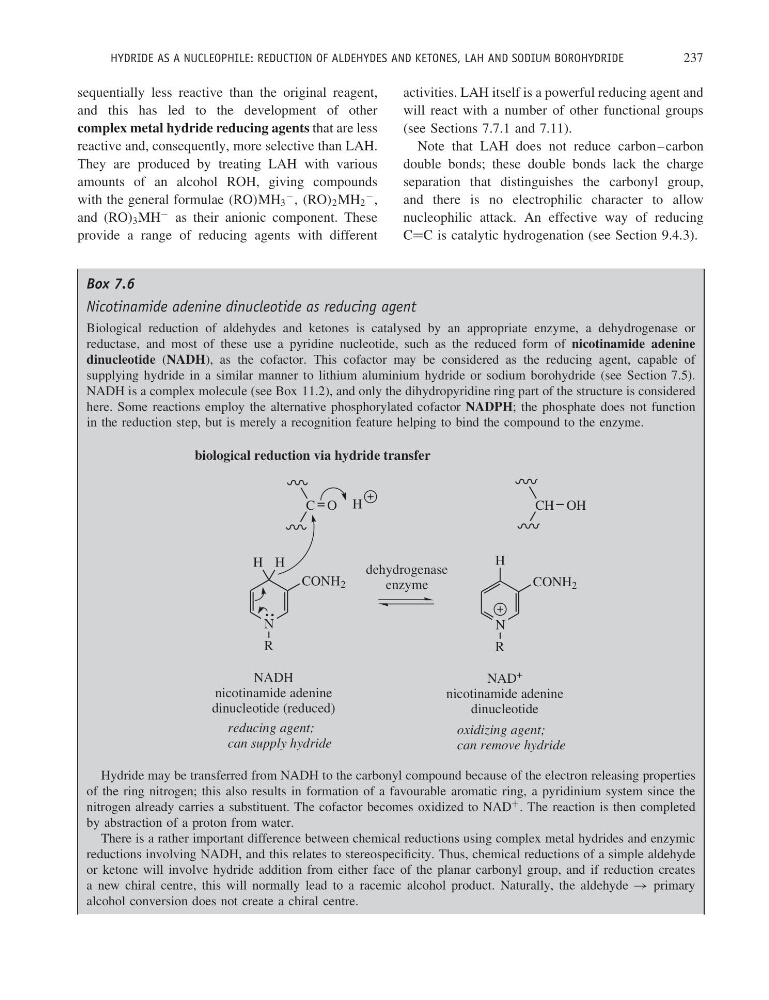
Biological reduction of aldehydes and ketones is catalysed by an appropriate enzyme, a dehydrogenase or
reductase, and most of these use a pyridine nucleotide, such as the reduced form of nicotinamide adenine
dinucleotide (NADH), as the cofactor. This cofactor may be considered as the reducing agent, capable of
supplying hydride in a similar manner to lithium aluminium hydride or sodium borohydride (see Section 7.5).
NADH is a complex molecule (see Box 11.2), and only the dihydropyridine ring part of the structure is considered
here. Some reactions employ the alternative phosphorylated cofactor NADPH; the phosphate does not function
in the reduction step, but is merely a recognition feature helping to bind the compound to the enzyme.
N
R
CONH 2
H
H
C O
N
R
CONH 2
CH OH
H
NADH
nicotinamide adenine
dinucleotide (reduced)
dehydrogenase
enzyme
biological reduction via hydride transfer
NAD +
nicotinamide adenine
dinucleotide
reducing agent;
can supply hydride
oxidizing agent;
can remove hydride
H
Hydride may be transferred from NADH to the carbonyl compound because of the electron releasing properties
of the ring nitrogen; this also results in formation of a favourable aromatic ring, a pyridinium system since the
nitrogen already carries a substituent. The cofactor becomes oxidized to NAD
+ . The reaction is then completed
by abstraction of a proton from water.
There is a rather important difference between chemical reductions using complex metal hydrides and enzymic
reductions involving NADH, and this relates to stereospecificity. Thus, chemical reductions of a simple aldehyde
or ketone will involve hydride addition from either face of the planar carbonyl group, and if reduction creates
a new chiral centre, this will normally lead to a racemic alcohol product. Naturally, the aldehyde → primary
alcohol conversion does not create a chiral centre.
237
sequentially less reactive than the original reagent,
and this has led to the development of other
complex metal hydride reducing agents that are less
reactive and, consequently, more selective than LAH.
They are produced by treating LAH with various
amounts of an alcohol ROH, giving compounds
with the general formulae (RO)MH 3
− , (RO) 2 MH 2
− ,
and (RO) 3 MH
− as their anionic component. These
provide a range of reducing agents with different
activities. LAH itself is a powerful reducing agent and
will react with a number of other functional groups
(see Sections 7.7.1 and 7.11).
Note that LAH does not reduce carbon–carbon
double bonds; these double bonds lack the charge
separation that distinguishes the carbonyl group,
and there is no electrophilic character to allow
nucleophilic attack. An effective way of reducing
C=C is catalytic hydrogenation (see Section 9.4.3).
Box 7.6
Nicotinamide adenine dinucleotide as reducing agent
Biological reduction of aldehydes and ketones is catalysed by an appropriate enzyme, a dehydrogenase or
reductase, and most of these use a pyridine nucleotide, such as the reduced form of nicotinamide adenine
dinucleotide (NADH), as the cofactor. This cofactor may be considered as the reducing agent, capable of
supplying hydride in a similar manner to lithium aluminium hydride or sodium borohydride (see Section 7.5).
NADH is a complex molecule (see Box 11.2), and only the dihydropyridine ring part of the structure is considered
here. Some reactions employ the alternative phosphorylated cofactor NADPH; the phosphate does not function
in the reduction step, but is merely a recognition feature helping to bind the compound to the enzyme.
N
R
CONH 2
H
H
C O
N
R
CONH 2
CH OH
H
NADH
nicotinamide adenine
dinucleotide (reduced)
dehydrogenase
enzyme
biological reduction via hydride transfer
NAD +
nicotinamide adenine
dinucleotide
reducing agent;
can supply hydride
oxidizing agent;
can remove hydride
H
Hydride may be transferred from NADH to the carbonyl compound because of the electron releasing properties
of the ring nitrogen; this also results in formation of a favourable aromatic ring, a pyridinium system since the
nitrogen already carries a substituent. The cofactor becomes oxidized to NAD
+ . The reaction is then completed
by abstraction of a proton from water.
There is a rather important difference between chemical reductions using complex metal hydrides and enzymic
reductions involving NADH, and this relates to stereospecificity. Thus, chemical reductions of a simple aldehyde
or ketone will involve hydride addition from either face of the planar carbonyl group, and if reduction creates
a new chiral centre, this will normally lead to a racemic alcohol product. Naturally, the aldehyde → primary
alcohol conversion does not create a chiral centre.