

236
NUCLEOPHILIC REACTIONS OF CARBONYL GROUPS
O
H AlH 3
O
OAlH 3
O
OH
O
O
O
O
O
carbonyl oxygen combines
with Lewis acid AlH 3
4
all four hydrides are capable of
being used; 1 mol LiAlH 4
reduces 4 mol aldehyde/ketone
3
2
Danger! H 2 O reacts
violently with any
unreacted LiAlH 4
second molecule of
carbonyl compound
third molecule of
carbonyl compound
fourth molecule of
carbonyl compound
H
H
H
H
H
H
AlH 3
Al
H 2 O
AlH Li
AlH 2
Li
Li
Li
Li
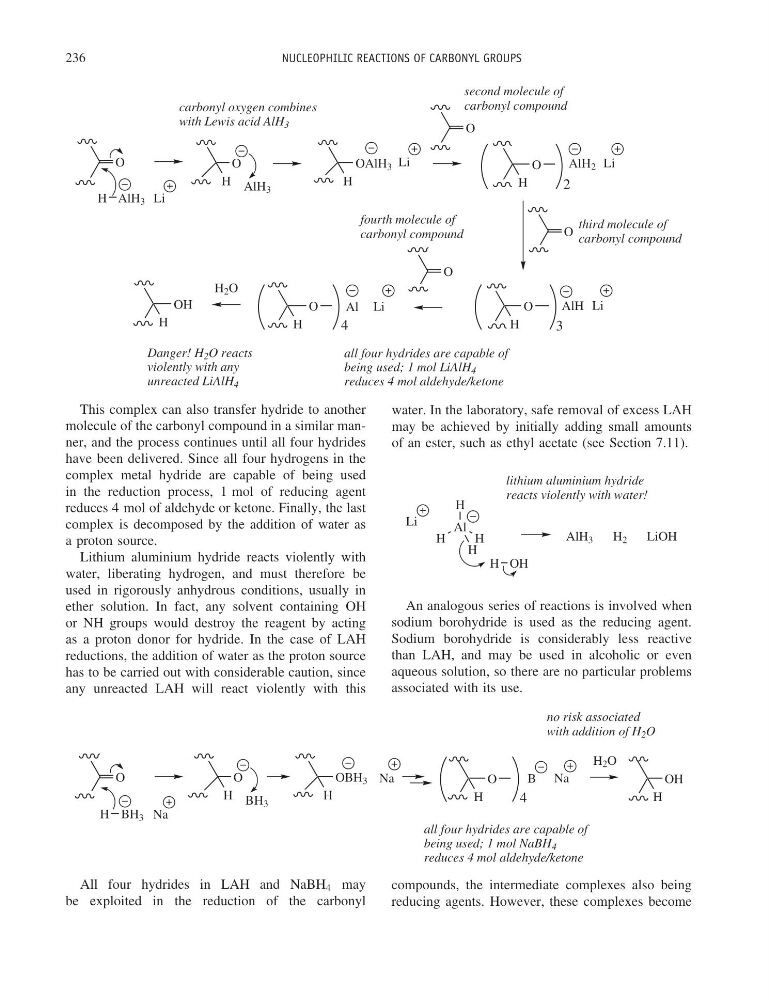
This complex can also transfer hydride to another
molecule of the carbonyl compound in a similar manner, and the process continues until all four hydrides
have been delivered. Since all four hydrogens in the
complex metal hydride are capable of being used
in the reduction process, 1 mol of reducing agent
reduces 4 mol of aldehyde or ketone. Finally, the last
complex is decomposed by the addition of water as
a proton source.
Lithium aluminium hydride reacts violently with
water, liberating hydrogen, and must therefore be
used in rigorously anhydrous conditions, usually in
ether solution. In fact, any solvent containing OH
or NH groups would destroy the reagent by acting
as a proton donor for hydride. In the case of LAH
reductions, the addition of water as the proton source
has to be carried out with considerable caution, since
any unreacted LAH will react violently with this
water. In the laboratory, safe removal of excess LAH
may be achieved by initially adding small amounts
of an ester, such as ethyl acetate (see Section 7.11).
H
Al
H
H
H
H OH
AlH 3
Li
LiOH
H 2
lithium aluminium hydride
reacts violently with water!
An analogous series of reactions is involved when
sodium borohydride is used as the reducing agent.
Sodium borohydride is considerably less reactive
than LAH, and may be used in alcoholic or even
aqueous solution, so there are no particular problems
associated with its use.
O
H BH 3
O
OBH 3
O
OH
no risk associated
with addition of H 2 O
all four hydrides are capable of
being used; 1 mol NaBH 4
reduces 4 mol aldehyde/ketone
H
H
H
H
4
BH 3
B
H 2 O
Na
Na
Na
All four hydrides in LAH and NaBH 4 may
be exploited in the reduction of the carbonyl
compounds, the intermediate complexes also being
reducing agents. However, these complexes become
NUCLEOPHILIC REACTIONS OF CARBONYL GROUPS
O
H AlH 3
O
OAlH 3
O
OH
O
O
O
O
O
carbonyl oxygen combines
with Lewis acid AlH 3
4
all four hydrides are capable of
being used; 1 mol LiAlH 4
reduces 4 mol aldehyde/ketone
3
2
Danger! H 2 O reacts
violently with any
unreacted LiAlH 4
second molecule of
carbonyl compound
third molecule of
carbonyl compound
fourth molecule of
carbonyl compound
H
H
H
H
H
H
AlH 3
Al
H 2 O
AlH Li
AlH 2
Li
Li
Li
Li
This complex can also transfer hydride to another
molecule of the carbonyl compound in a similar manner, and the process continues until all four hydrides
have been delivered. Since all four hydrogens in the
complex metal hydride are capable of being used
in the reduction process, 1 mol of reducing agent
reduces 4 mol of aldehyde or ketone. Finally, the last
complex is decomposed by the addition of water as
a proton source.
Lithium aluminium hydride reacts violently with
water, liberating hydrogen, and must therefore be
used in rigorously anhydrous conditions, usually in
ether solution. In fact, any solvent containing OH
or NH groups would destroy the reagent by acting
as a proton donor for hydride. In the case of LAH
reductions, the addition of water as the proton source
has to be carried out with considerable caution, since
any unreacted LAH will react violently with this
water. In the laboratory, safe removal of excess LAH
may be achieved by initially adding small amounts
of an ester, such as ethyl acetate (see Section 7.11).
H
Al
H
H
H
H OH
AlH 3
Li
LiOH
H 2
lithium aluminium hydride
reacts violently with water!
An analogous series of reactions is involved when
sodium borohydride is used as the reducing agent.
Sodium borohydride is considerably less reactive
than LAH, and may be used in alcoholic or even
aqueous solution, so there are no particular problems
associated with its use.
O
H BH 3
O
OBH 3
O
OH
no risk associated
with addition of H 2 O
all four hydrides are capable of
being used; 1 mol NaBH 4
reduces 4 mol aldehyde/ketone
H
H
H
H
4
BH 3
B
H 2 O
Na
Na
Na
All four hydrides in LAH and NaBH 4 may
be exploited in the reduction of the carbonyl
compounds, the intermediate complexes also being
reducing agents. However, these complexes become