

238
NUCLEOPHILIC REACTIONS OF CARBONYL GROUPS
Box 7.6 (continued)
O
R
R´
NaBH 4
OH
R´
R
H
OH
R´
H
R
+
addition from either face of
planar carbonyl group
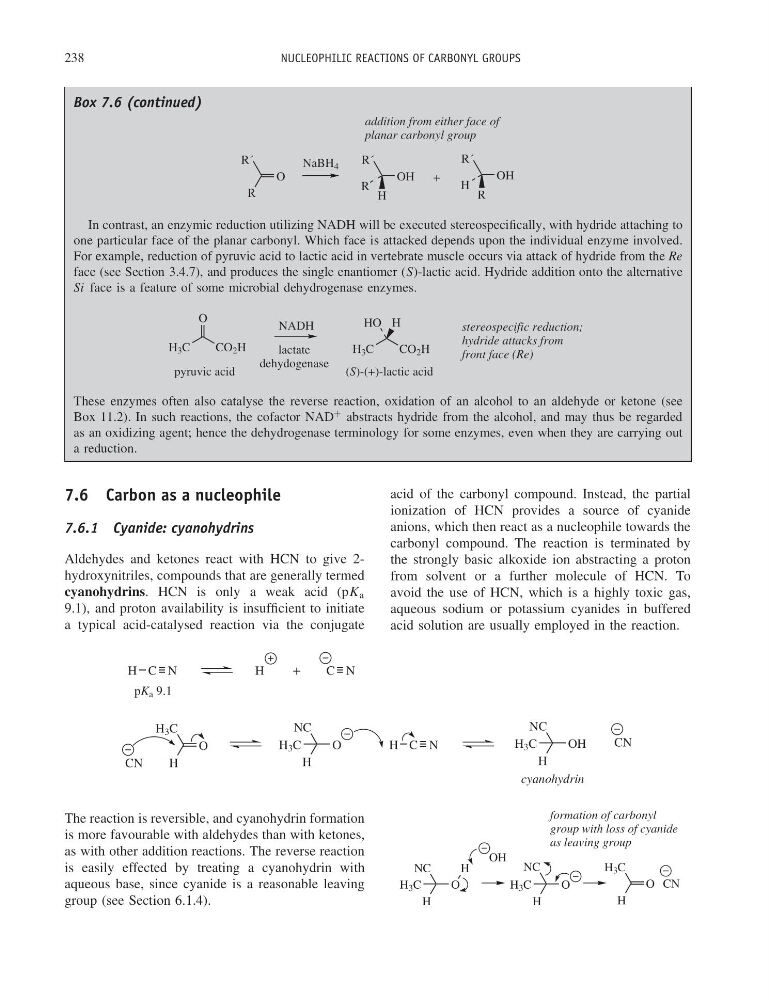
In contrast, an enzymic reduction utilizing NADH will be executed stereospecifically, with hydride attaching to
one particular face of the planar carbonyl. Which face is attacked depends upon the individual enzyme involved.
For example, reduction of pyruvic acid to lactic acid in vertebrate muscle occurs via attack of hydride from the Re
face (see Section 3.4.7), and produces the single enantiomer (S)-lactic acid. Hydride addition onto the alternative
Si face is a feature of some microbial dehydrogenase enzymes.
O
H 3 C
CO 2 H
pyruvic acid
NADH
lactate
dehydogenase
H 3 C
CO 2 H
(S)-(+)-lactic acid
H
HO
stereospecific reduction;
hydride attacks from
front face (Re)
These enzymes often also catalyse the reverse reaction, oxidation of an alcohol to an aldehyde or ketone (see
Box 11.2). In such reactions, the cofactor NAD
+ abstracts hydride from the alcohol, and may thus be regarded
as an oxidizing agent; hence the dehydrogenase terminology for some enzymes, even when they are carrying out
a reduction.
7.6 Carbon as a nucleophile
7.6.1 Cyanide: cyanohydrins
Aldehydes and ketones react with HCN to give 2hydroxynitriles, compounds that are generally termed
cyanohydrins. HCN is only a weak acid (pK a
9.1), and proton availability is insufficient to initiate
a typical acid-catalysed reaction via the conjugate
acid of the carbonyl compound. Instead, the partial
ionization of HCN provides a source of cyanide
anions, which then react as a nucleophile towards the
carbonyl compound. The reaction is terminated by
the strongly basic alkoxide ion abstracting a proton
from solvent or a further molecule of HCN. To
avoid the use of HCN, which is a highly toxic gas,
aqueous sodium or potassium cyanides in buffered
acid solution are usually employed in the reaction.
O
H
H 3 C
H C N
C N
H C N
+
cyanohydrin
pK a 9.1
OH
H
NC
H 3 C
O
H
NC
H 3 C
CN
H
CN
The reaction is reversible, and cyanohydrin formation
is more favourable with aldehydes than with ketones,
as with other addition reactions. The reverse reaction
is easily effected by treating a cyanohydrin with
aqueous base, since cyanide is a reasonable leaving
group (see Section 6.1.4).
O
H
H 3 C
formation of carbonyl
group with loss of cyanide
as leaving group
O
H
NC
H 3 C
H
O
H
NC
H 3 C
OH
CN
NUCLEOPHILIC REACTIONS OF CARBONYL GROUPS
Box 7.6 (continued)
O
R
R´
NaBH 4
OH
R´
R
H
OH
R´
H
R
+
addition from either face of
planar carbonyl group
In contrast, an enzymic reduction utilizing NADH will be executed stereospecifically, with hydride attaching to
one particular face of the planar carbonyl. Which face is attacked depends upon the individual enzyme involved.
For example, reduction of pyruvic acid to lactic acid in vertebrate muscle occurs via attack of hydride from the Re
face (see Section 3.4.7), and produces the single enantiomer (S)-lactic acid. Hydride addition onto the alternative
Si face is a feature of some microbial dehydrogenase enzymes.
O
H 3 C
CO 2 H
pyruvic acid
NADH
lactate
dehydogenase
H 3 C
CO 2 H
(S)-(+)-lactic acid
H
HO
stereospecific reduction;
hydride attacks from
front face (Re)
These enzymes often also catalyse the reverse reaction, oxidation of an alcohol to an aldehyde or ketone (see
Box 11.2). In such reactions, the cofactor NAD
+ abstracts hydride from the alcohol, and may thus be regarded
as an oxidizing agent; hence the dehydrogenase terminology for some enzymes, even when they are carrying out
a reduction.
7.6 Carbon as a nucleophile
7.6.1 Cyanide: cyanohydrins
Aldehydes and ketones react with HCN to give 2hydroxynitriles, compounds that are generally termed
cyanohydrins. HCN is only a weak acid (pK a
9.1), and proton availability is insufficient to initiate
a typical acid-catalysed reaction via the conjugate
acid of the carbonyl compound. Instead, the partial
ionization of HCN provides a source of cyanide
anions, which then react as a nucleophile towards the
carbonyl compound. The reaction is terminated by
the strongly basic alkoxide ion abstracting a proton
from solvent or a further molecule of HCN. To
avoid the use of HCN, which is a highly toxic gas,
aqueous sodium or potassium cyanides in buffered
acid solution are usually employed in the reaction.
O
H
H 3 C
H C N
C N
H C N
+
cyanohydrin
pK a 9.1
OH
H
NC
H 3 C
O
H
NC
H 3 C
CN
H
CN
The reaction is reversible, and cyanohydrin formation
is more favourable with aldehydes than with ketones,
as with other addition reactions. The reverse reaction
is easily effected by treating a cyanohydrin with
aqueous base, since cyanide is a reasonable leaving
group (see Section 6.1.4).
O
H
H 3 C
formation of carbonyl
group with loss of cyanide
as leaving group
O
H
NC
H 3 C
H
O
H
NC
H 3 C
OH
CN