

OXYGEN AS A NUCLEOPHILE: HEMIACETALS, HEMIKETALS, ACETALS AND KETALS
233
Cellulose is reputedly the most abundant organic material on Earth, being the main constituent in plant cell
walls. It is composed of glucopyranose units linked β1 → 4 in a linear chain, i.e. this time the configuration at
the anomeric centre is β. Alternate residues are found to be ‘rotated’ in the structure, allowing hydrogen bonding
between adjacent molecules, and construction of the strong fibres characteristic of cellulose, as for example in
cotton.
There is further discussion of polysaccharides in Chapter 12.
Box 7.5
Acetal linkages in etoposide
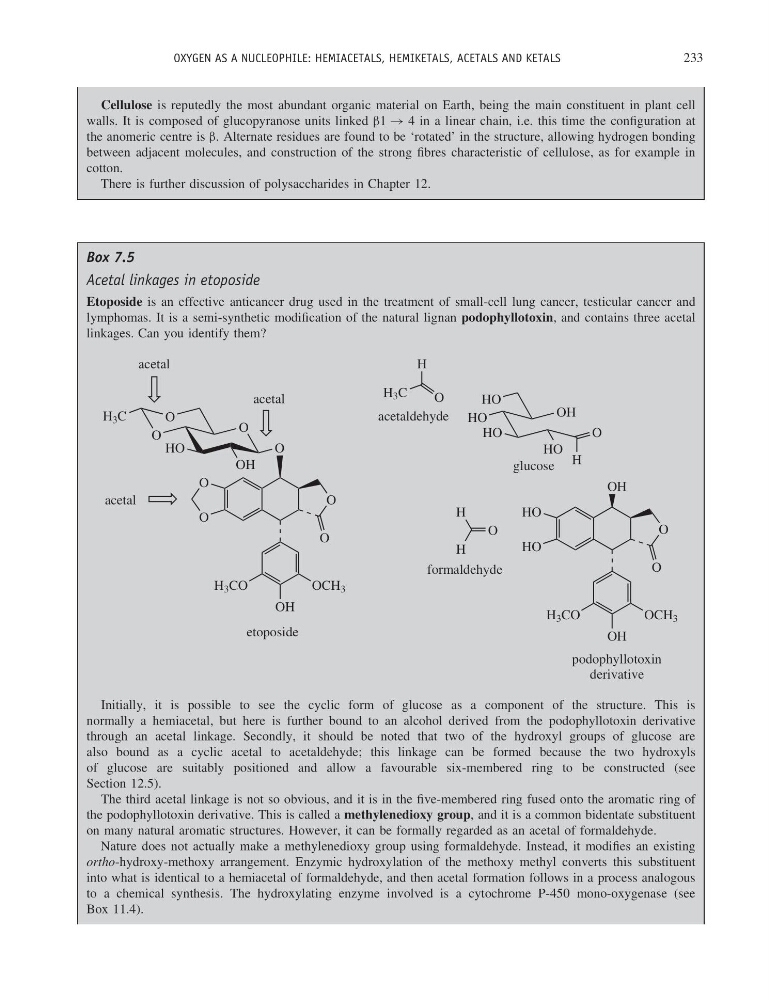
Etoposide is an effective anticancer drug used in the treatment of small-cell lung cancer, testicular cancer and
lymphomas. It is a semi-synthetic modification of the natural lignan podophyllotoxin, and contains three acetal
linkages. Can you identify them?
OH
H 3 CO
O
O
OCH 3
O
O
O
O
O
O
OH
HO
H 3 C
OH
O
HO
HO
HO
HO
H 3 C
H
O
OH
H 3 CO
O
O
OCH 3
HO
HO
O
H
H
H
OH
etoposide
acetal
acetal
acetal
glucose
acetaldehyde
formaldehyde
podophyllotoxin
derivative
Initially, it is possible to see the cyclic form of glucose as a component of the structure. This is
normally a hemiacetal, but here is further bound to an alcohol derived from the podophyllotoxin derivative
through an acetal linkage. Secondly, it should be noted that two of the hydroxyl groups of glucose are
also bound as a cyclic acetal to acetaldehyde; this linkage can be formed because the two hydroxyls
of glucose are suitably positioned and allow a favourable six-membered ring to be constructed (see
Section 12.5).
The third acetal linkage is not so obvious, and it is in the five-membered ring fused onto the aromatic ring of
the podophyllotoxin derivative. This is called a methylenedioxy group, and it is a common bidentate substituent
on many natural aromatic structures. However, it can be formally regarded as an acetal of formaldehyde.
Nature does not actually make a methylenedioxy group using formaldehyde. Instead, it modifies an existing
ortho-hydroxy-methoxy arrangement. Enzymic hydroxylation of the methoxy methyl converts this substituent
into what is identical to a hemiacetal of formaldehyde, and then acetal formation follows in a process analogous
to a chemical synthesis. The hydroxylating enzyme involved is a cytochrome P-450 mono-oxygenase (see
Box 11.4).
233
Cellulose is reputedly the most abundant organic material on Earth, being the main constituent in plant cell
walls. It is composed of glucopyranose units linked β1 → 4 in a linear chain, i.e. this time the configuration at
the anomeric centre is β. Alternate residues are found to be ‘rotated’ in the structure, allowing hydrogen bonding
between adjacent molecules, and construction of the strong fibres characteristic of cellulose, as for example in
cotton.
There is further discussion of polysaccharides in Chapter 12.
Box 7.5
Acetal linkages in etoposide
Etoposide is an effective anticancer drug used in the treatment of small-cell lung cancer, testicular cancer and
lymphomas. It is a semi-synthetic modification of the natural lignan podophyllotoxin, and contains three acetal
linkages. Can you identify them?
OH
H 3 CO
O
O
OCH 3
O
O
O
O
O
O
OH
HO
H 3 C
OH
O
HO
HO
HO
HO
H 3 C
H
O
OH
H 3 CO
O
O
OCH 3
HO
HO
O
H
H
H
OH
etoposide
acetal
acetal
acetal
glucose
acetaldehyde
formaldehyde
podophyllotoxin
derivative
Initially, it is possible to see the cyclic form of glucose as a component of the structure. This is
normally a hemiacetal, but here is further bound to an alcohol derived from the podophyllotoxin derivative
through an acetal linkage. Secondly, it should be noted that two of the hydroxyl groups of glucose are
also bound as a cyclic acetal to acetaldehyde; this linkage can be formed because the two hydroxyls
of glucose are suitably positioned and allow a favourable six-membered ring to be constructed (see
Section 12.5).
The third acetal linkage is not so obvious, and it is in the five-membered ring fused onto the aromatic ring of
the podophyllotoxin derivative. This is called a methylenedioxy group, and it is a common bidentate substituent
on many natural aromatic structures. However, it can be formally regarded as an acetal of formaldehyde.
Nature does not actually make a methylenedioxy group using formaldehyde. Instead, it modifies an existing
ortho-hydroxy-methoxy arrangement. Enzymic hydroxylation of the methoxy methyl converts this substituent
into what is identical to a hemiacetal of formaldehyde, and then acetal formation follows in a process analogous
to a chemical synthesis. The hydroxylating enzyme involved is a cytochrome P-450 mono-oxygenase (see
Box 11.4).