

234
NUCLEOPHILIC REACTIONS OF CARBONYL GROUPS
Box 7.5 (continued)
O
CH 3
OH
O
CH 2
OH
O
CH 2
O
O
O
OH
H
hemiacetal of
formaldehyde
nucleophilic attack onto
carbonyl equivalent
methylenedioxy
derivative
ortho-hydroxymethoxy derivative
enzymic
oxidation
H
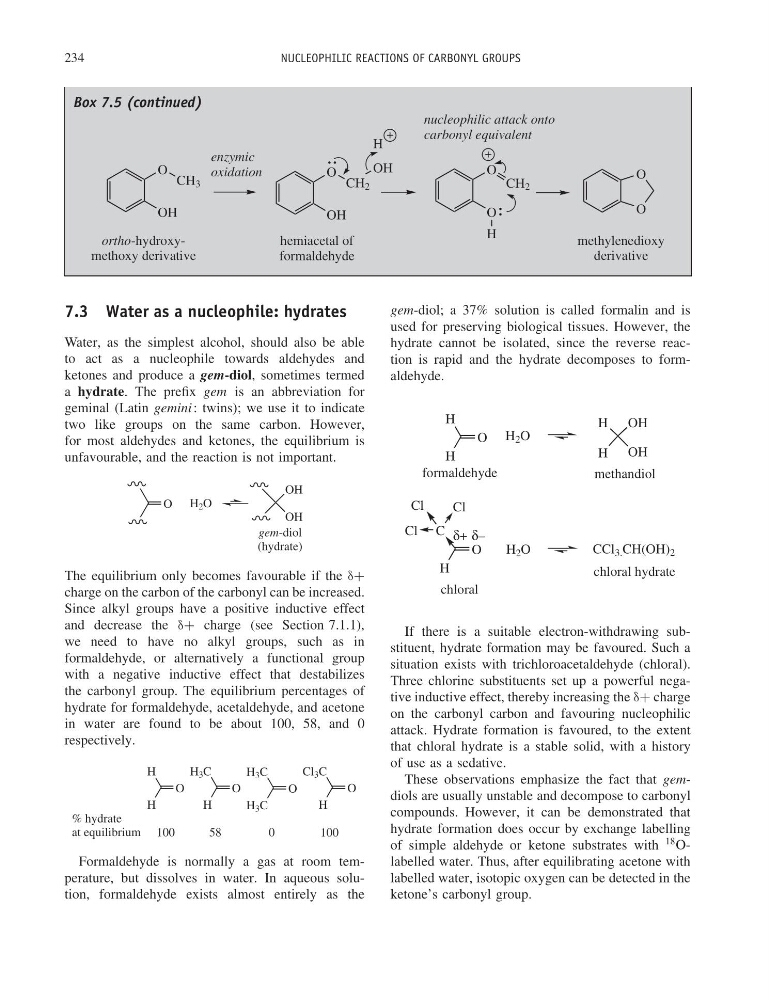
7.3 Water as a nucleophile: hydrates
Water, as the simplest alcohol, should also be able
to act as a nucleophile towards aldehydes and
ketones and produce a gem-diol, sometimes termed
a hydrate. The prefix gem is an abbreviation for
geminal (Latin gemini : twins); we use it to indicate
two like groups on the same carbon. However,
for most aldehydes and ketones, the equilibrium is
unfavourable, and the reaction is not important.
O
OH
OH
gem-diol
(hydrate)
H 2 O
The equilibrium only becomes favourable if the δ+
charge on the carbon of the carbonyl can be increased.
Since alkyl groups have a positive inductive effect
and decrease the δ+ charge (see Section 7.1.1),
we need to have no alkyl groups, such as in
formaldehyde, or alternatively a functional group
with a negative inductive effect that destabilizes
the carbonyl group. The equilibrium percentages of
hydrate for formaldehyde, acetaldehyde, and acetone
in water are found to be about 100, 58, and 0
respectively.
O
H
H
O
H
H 3 C
O
H 3 C
H 3 C
% hydrate
at equilibrium 100
58
0
O
H
Cl 3 C
100
Formaldehyde is normally a gas at room temperature, but dissolves in water. In aqueous solution, formaldehyde exists almost entirely as the
gem-diol; a 37% solution is called formalin and is
used for preserving biological tissues. However, the
hydrate cannot be isolated, since the reverse reaction is rapid and the hydrate decomposes to formaldehyde.
O
H
H
H
H OH
OH
methandiol
formaldehyde
O
H
C
Cl
Cl
Cl
δ+ δ–
chloral hydrate
chloral
H 2 O
H 2 O
CCl 3. CH(OH) 2
If there is a suitable electron-withdrawing substituent, hydrate formation may be favoured. Such a
situation exists with trichloroacetaldehyde (chloral).
Three chlorine substituents set up a powerful negative inductive effect, thereby increasing the δ+ charge
on the carbonyl carbon and favouring nucleophilic
attack. Hydrate formation is favoured, to the extent
that chloral hydrate is a stable solid, with a history
of use as a sedative.
These observations emphasize the fact that gemdiols are usually unstable and decompose to carbonyl
compounds. However, it can be demonstrated that
hydrate formation does occur by exchange labelling
of simple aldehyde or ketone substrates with
18 Olabelled water. Thus, after equilibrating acetone with
labelled water, isotopic oxygen can be detected in the
ketone’s carbonyl group.
NUCLEOPHILIC REACTIONS OF CARBONYL GROUPS
Box 7.5 (continued)
O
CH 3
OH
O
CH 2
OH
O
CH 2
O
O
O
OH
H
hemiacetal of
formaldehyde
nucleophilic attack onto
carbonyl equivalent
methylenedioxy
derivative
ortho-hydroxymethoxy derivative
enzymic
oxidation
H
7.3 Water as a nucleophile: hydrates
Water, as the simplest alcohol, should also be able
to act as a nucleophile towards aldehydes and
ketones and produce a gem-diol, sometimes termed
a hydrate. The prefix gem is an abbreviation for
geminal (Latin gemini : twins); we use it to indicate
two like groups on the same carbon. However,
for most aldehydes and ketones, the equilibrium is
unfavourable, and the reaction is not important.
O
OH
OH
gem-diol
(hydrate)
H 2 O
The equilibrium only becomes favourable if the δ+
charge on the carbon of the carbonyl can be increased.
Since alkyl groups have a positive inductive effect
and decrease the δ+ charge (see Section 7.1.1),
we need to have no alkyl groups, such as in
formaldehyde, or alternatively a functional group
with a negative inductive effect that destabilizes
the carbonyl group. The equilibrium percentages of
hydrate for formaldehyde, acetaldehyde, and acetone
in water are found to be about 100, 58, and 0
respectively.
O
H
H
O
H
H 3 C
O
H 3 C
H 3 C
% hydrate
at equilibrium 100
58
0
O
H
Cl 3 C
100
Formaldehyde is normally a gas at room temperature, but dissolves in water. In aqueous solution, formaldehyde exists almost entirely as the
gem-diol; a 37% solution is called formalin and is
used for preserving biological tissues. However, the
hydrate cannot be isolated, since the reverse reaction is rapid and the hydrate decomposes to formaldehyde.
O
H
H
H
H OH
OH
methandiol
formaldehyde
O
H
C
Cl
Cl
Cl
δ+ δ–
chloral hydrate
chloral
H 2 O
H 2 O
CCl 3. CH(OH) 2
If there is a suitable electron-withdrawing substituent, hydrate formation may be favoured. Such a
situation exists with trichloroacetaldehyde (chloral).
Three chlorine substituents set up a powerful negative inductive effect, thereby increasing the δ+ charge
on the carbonyl carbon and favouring nucleophilic
attack. Hydrate formation is favoured, to the extent
that chloral hydrate is a stable solid, with a history
of use as a sedative.
These observations emphasize the fact that gemdiols are usually unstable and decompose to carbonyl
compounds. However, it can be demonstrated that
hydrate formation does occur by exchange labelling
of simple aldehyde or ketone substrates with
18 Olabelled water. Thus, after equilibrating acetone with
labelled water, isotopic oxygen can be detected in the
ketone’s carbonyl group.