

232
NUCLEOPHILIC REACTIONS OF CARBONYL GROUPS
The equilibrium mixture of α and β isomers of glucose has [α] D + 52.7
◦ (see Box 7.1), and that of fructose
is strongly laevorotatory with [α] D − 92.4
◦ . Since glucose and fructose are structural isomers and have the same
molecular weight, it can be calculated that the resultant optical activity will be [α] D − 19.85
◦ . This derives from
(−92.4) × 0.5 + (+52.7) × 0.5, the 0.5 factor being necessary because 1 g of the disaccharide sucrose gives 0.5 g
of each monosaccharide. This change in optical activity from plus to minus is the reason for the terminology
‘invert’.
The high sweetness of fructose combined with that of glucose means invert sugar is sweeter than sucrose, so
it provides a cheaper, less calorific sweetener than sucrose. The relative sweetness figures for sucrose, glucose
and fructose are 1.0, 0.7 and 1.7 respectively. Honey is also composed mainly of invert sugar.
Box 7.4
Polysaccharides: starch, glycogen and cellulose are polyacetals of glucose
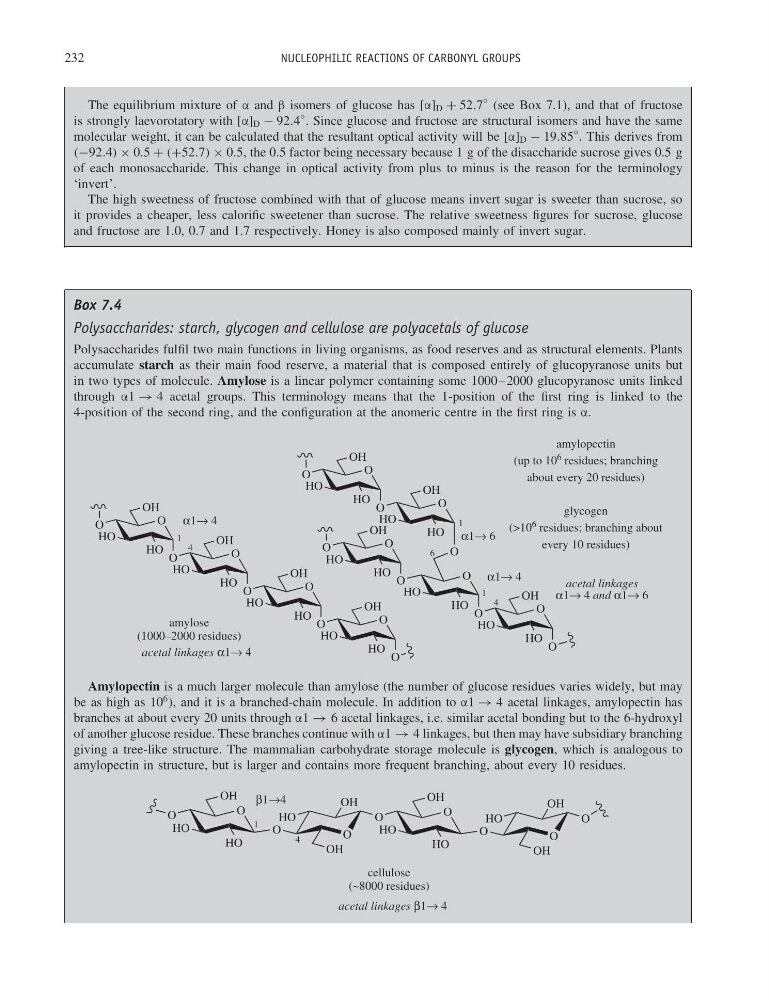
Polysaccharides fulfil two main functions in living organisms, as food reserves and as structural elements. Plants
accumulate starch as their main food reserve, a material that is composed entirely of glucopyranose units but
in two types of molecule. Amylose is a linear polymer containing some 1000–2000 glucopyranose units linked
through α1 → 4 acetal groups. This terminology means that the 1-position of the first ring is linked to the
4-position of the second ring, and the configuration at the anomeric centre in the first ring is α.
acetal linkages α1→ 4
O
O
HO
OH
HO
O
O
HO
OH
HO
O
HO
HO
O
O
HO
OH
HO O
O
HO
OH
HO
O
1
4
1
amylose
(1000–2000 residues)
6
1
4
amylopectin
(up to 10 6 residues; branching
about every 20 residues)
glycogen
(>10 6 residues; branching about
every 10 residues)
α1→ 4
α1→ 4
α1→ 6
O
O
HO
OH
HO
O
O
HO
OH
HO O
O
O
HO
OH
HO
O
O
O
HO
OH
HO O
acetal linkages
α1→ 4 and α1→ 6
Amylopectin is a much larger molecule than amylose (the number of glucose residues varies widely, but may
be as high as 10
6 ), and it is a branched-chain molecule. In addition to α1 → 4 acetal linkages, amylopectin has
branches at about every 20 units through α1 → 6 acetal linkages, i.e. similar acetal bonding but to the 6-hydroxyl
of another glucose residue. These branches continue with α1 → 4 linkages, but then may have subsidiary branching
giving a tree-like structure. The mammalian carbohydrate storage molecule is glycogen, which is analogous to
amylopectin in structure, but is larger and contains more frequent branching, about every 10 residues.
acetal linkages β1→ 4
O
HO
OH
HO
O
O
HO
OH
OH
O
1
4
cellulose
(~8000 residues)
β1→4
O
HO
OH
HO
O
O
HO
OH
OH
O
O
NUCLEOPHILIC REACTIONS OF CARBONYL GROUPS
The equilibrium mixture of α and β isomers of glucose has [α] D + 52.7
◦ (see Box 7.1), and that of fructose
is strongly laevorotatory with [α] D − 92.4
◦ . Since glucose and fructose are structural isomers and have the same
molecular weight, it can be calculated that the resultant optical activity will be [α] D − 19.85
◦ . This derives from
(−92.4) × 0.5 + (+52.7) × 0.5, the 0.5 factor being necessary because 1 g of the disaccharide sucrose gives 0.5 g
of each monosaccharide. This change in optical activity from plus to minus is the reason for the terminology
‘invert’.
The high sweetness of fructose combined with that of glucose means invert sugar is sweeter than sucrose, so
it provides a cheaper, less calorific sweetener than sucrose. The relative sweetness figures for sucrose, glucose
and fructose are 1.0, 0.7 and 1.7 respectively. Honey is also composed mainly of invert sugar.
Box 7.4
Polysaccharides: starch, glycogen and cellulose are polyacetals of glucose
Polysaccharides fulfil two main functions in living organisms, as food reserves and as structural elements. Plants
accumulate starch as their main food reserve, a material that is composed entirely of glucopyranose units but
in two types of molecule. Amylose is a linear polymer containing some 1000–2000 glucopyranose units linked
through α1 → 4 acetal groups. This terminology means that the 1-position of the first ring is linked to the
4-position of the second ring, and the configuration at the anomeric centre in the first ring is α.
acetal linkages α1→ 4
O
O
HO
OH
HO
O
O
HO
OH
HO
O
HO
HO
O
O
HO
OH
HO O
O
HO
OH
HO
O
1
4
1
amylose
(1000–2000 residues)
6
1
4
amylopectin
(up to 10 6 residues; branching
about every 20 residues)
glycogen
(>10 6 residues; branching about
every 10 residues)
α1→ 4
α1→ 4
α1→ 6
O
O
HO
OH
HO
O
O
HO
OH
HO O
O
O
HO
OH
HO
O
O
O
HO
OH
HO O
acetal linkages
α1→ 4 and α1→ 6
Amylopectin is a much larger molecule than amylose (the number of glucose residues varies widely, but may
be as high as 10
6 ), and it is a branched-chain molecule. In addition to α1 → 4 acetal linkages, amylopectin has
branches at about every 20 units through α1 → 6 acetal linkages, i.e. similar acetal bonding but to the 6-hydroxyl
of another glucose residue. These branches continue with α1 → 4 linkages, but then may have subsidiary branching
giving a tree-like structure. The mammalian carbohydrate storage molecule is glycogen, which is analogous to
amylopectin in structure, but is larger and contains more frequent branching, about every 10 residues.
acetal linkages β1→ 4
O
HO
OH
HO
O
O
HO
OH
OH
O
1
4
cellulose
(~8000 residues)
β1→4
O
HO
OH
HO
O
O
HO
OH
OH
O
O