

OXYGEN AS A NUCLEOPHILE: HEMIACETALS, HEMIKETALS, ACETALS AND KETALS
231
Of course, we can use the same strategy to protect
a diol. We would convert this into an acetal or ketal
using a suitable aldehyde or ketone.
OH
OH
O
CH 3
CH 3
+
H +
O
O
CH 3
CH 3 +
glycerol
acetone
cyclic ketal
(acetonide)
HO
HO
H 2 O
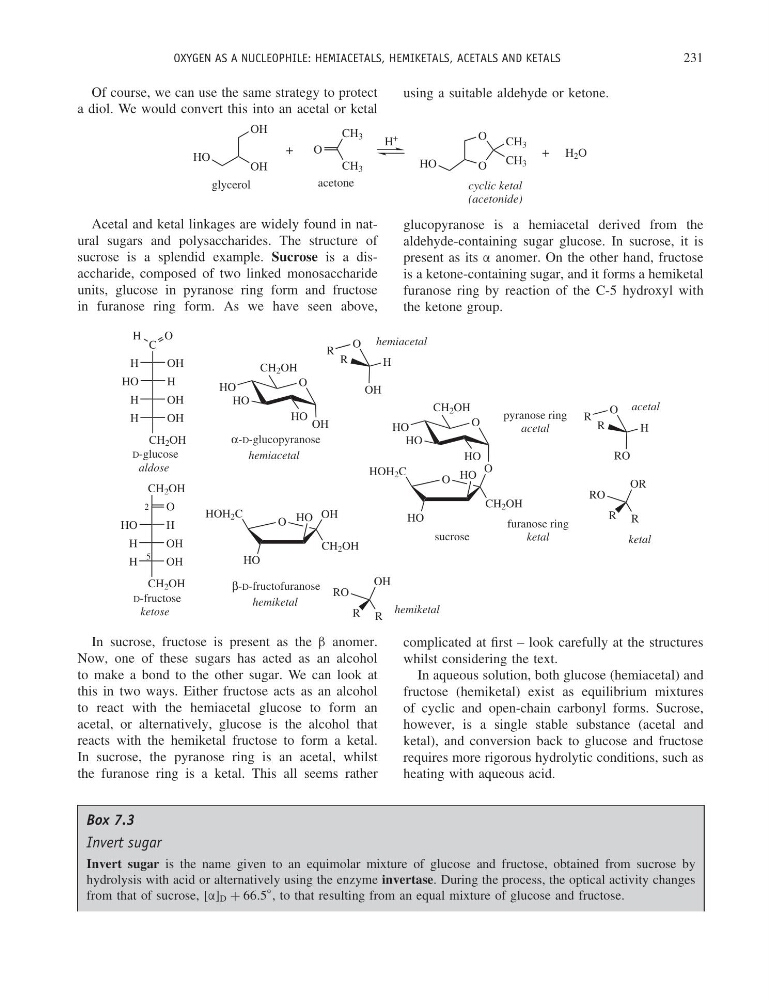
Acetal and ketal linkages are widely found in natural sugars and polysaccharides. The structure of
sucrose is a splendid example. Sucrose is a disaccharide, composed of two linked monosaccharide
units, glucose in pyranose ring form and fructose
in furanose ring form. As we have seen above,
glucopyranose is a hemiacetal derived from the
aldehyde-containing sugar glucose. In sucrose, it is
present as its α anomer. On the other hand, fructose
is a ketone-containing sugar, and it forms a hemiketal
furanose ring by reaction of the C-5 hydroxyl with
the ketone group.
HO
O
HO
HO
CH 2 OH
OH
O
HOH 2 C
HO
OH
C
OH
H
H
HO
OH
H
H
OH
CH 2 OH
H
O
CH 2 OH
O
H
HO
OH
H
H
OH
CH 2 OH
CH 2 OH
HO
HO
O
HO
HO
CH 2 OH
O
HOH 2 C
HO
O
CH 2 OH
HO
D-glucose
D-fructose
α-D-glucopyranose
β-D-fructofuranose
hemiacetal
hemiketal
aldose
ketose
sucrose
pyranose ring
acetal
furanose ring
ketal
2
5
RO
OR
R
R
O
R
R
RO
H
O
R
R
OH
H
hemiacetal
RO
OH
R
R
hemiketal
acetal
ketal
In sucrose, fructose is present as the β anomer.
Now, one of these sugars has acted as an alcohol
to make a bond to the other sugar. We can look at
this in two ways. Either fructose acts as an alcohol
to react with the hemiacetal glucose to form an
acetal, or alternatively, glucose is the alcohol that
reacts with the hemiketal fructose to form a ketal.
In sucrose, the pyranose ring is an acetal, whilst
the furanose ring is a ketal. This all seems rather
complicated at first – look carefully at the structures
whilst considering the text.
In aqueous solution, both glucose (hemiacetal) and
fructose (hemiketal) exist as equilibrium mixtures
of cyclic and open-chain carbonyl forms. Sucrose,
however, is a single stable substance (acetal and
ketal), and conversion back to glucose and fructose
requires more rigorous hydrolytic conditions, such as
heating with aqueous acid.
Box 7.3
Invert sugar
Invert sugar is the name given to an equimolar mixture of glucose and fructose, obtained from sucrose by
hydrolysis with acid or alternatively using the enzyme invertase. During the process, the optical activity changes
from that of sucrose, [α] D + 66.5
◦ , to that resulting from an equal mixture of glucose and fructose.
231
Of course, we can use the same strategy to protect
a diol. We would convert this into an acetal or ketal
using a suitable aldehyde or ketone.
OH
OH
O
CH 3
CH 3
+
H +
O
O
CH 3
CH 3 +
glycerol
acetone
cyclic ketal
(acetonide)
HO
HO
H 2 O
Acetal and ketal linkages are widely found in natural sugars and polysaccharides. The structure of
sucrose is a splendid example. Sucrose is a disaccharide, composed of two linked monosaccharide
units, glucose in pyranose ring form and fructose
in furanose ring form. As we have seen above,
glucopyranose is a hemiacetal derived from the
aldehyde-containing sugar glucose. In sucrose, it is
present as its α anomer. On the other hand, fructose
is a ketone-containing sugar, and it forms a hemiketal
furanose ring by reaction of the C-5 hydroxyl with
the ketone group.
HO
O
HO
HO
CH 2 OH
OH
O
HOH 2 C
HO
OH
C
OH
H
H
HO
OH
H
H
OH
CH 2 OH
H
O
CH 2 OH
O
H
HO
OH
H
H
OH
CH 2 OH
CH 2 OH
HO
HO
O
HO
HO
CH 2 OH
O
HOH 2 C
HO
O
CH 2 OH
HO
D-glucose
D-fructose
α-D-glucopyranose
β-D-fructofuranose
hemiacetal
hemiketal
aldose
ketose
sucrose
pyranose ring
acetal
furanose ring
ketal
2
5
RO
OR
R
R
O
R
R
RO
H
O
R
R
OH
H
hemiacetal
RO
OH
R
R
hemiketal
acetal
ketal
In sucrose, fructose is present as the β anomer.
Now, one of these sugars has acted as an alcohol
to make a bond to the other sugar. We can look at
this in two ways. Either fructose acts as an alcohol
to react with the hemiacetal glucose to form an
acetal, or alternatively, glucose is the alcohol that
reacts with the hemiketal fructose to form a ketal.
In sucrose, the pyranose ring is an acetal, whilst
the furanose ring is a ketal. This all seems rather
complicated at first – look carefully at the structures
whilst considering the text.
In aqueous solution, both glucose (hemiacetal) and
fructose (hemiketal) exist as equilibrium mixtures
of cyclic and open-chain carbonyl forms. Sucrose,
however, is a single stable substance (acetal and
ketal), and conversion back to glucose and fructose
requires more rigorous hydrolytic conditions, such as
heating with aqueous acid.
Box 7.3
Invert sugar
Invert sugar is the name given to an equimolar mixture of glucose and fructose, obtained from sucrose by
hydrolysis with acid or alternatively using the enzyme invertase. During the process, the optical activity changes
from that of sucrose, [α] D + 66.5
◦ , to that resulting from an equal mixture of glucose and fructose.