

230
NUCLEOPHILIC REACTIONS OF CARBONYL GROUPS
R
OR′
OR′
R
OR′
OR′
H
R′OH
acetal
R
OR′
OH
protonation
of oxygen
loss of leaving group with
formation of protonated carbonyl
acid catalyst
regenerated
nucleophilic attack of
alcohol onto
carbonyl equivalent
R
OR′
OR′
R″
R
O
R″
ketone
ketal
resonance forms
of cation
this is merely a
further example of
R
OR′
OH 2
R
O
H
R′
R
O
H
R′
R′OH
O
H
R
E
H
H
H
H
H 2 O
H
H
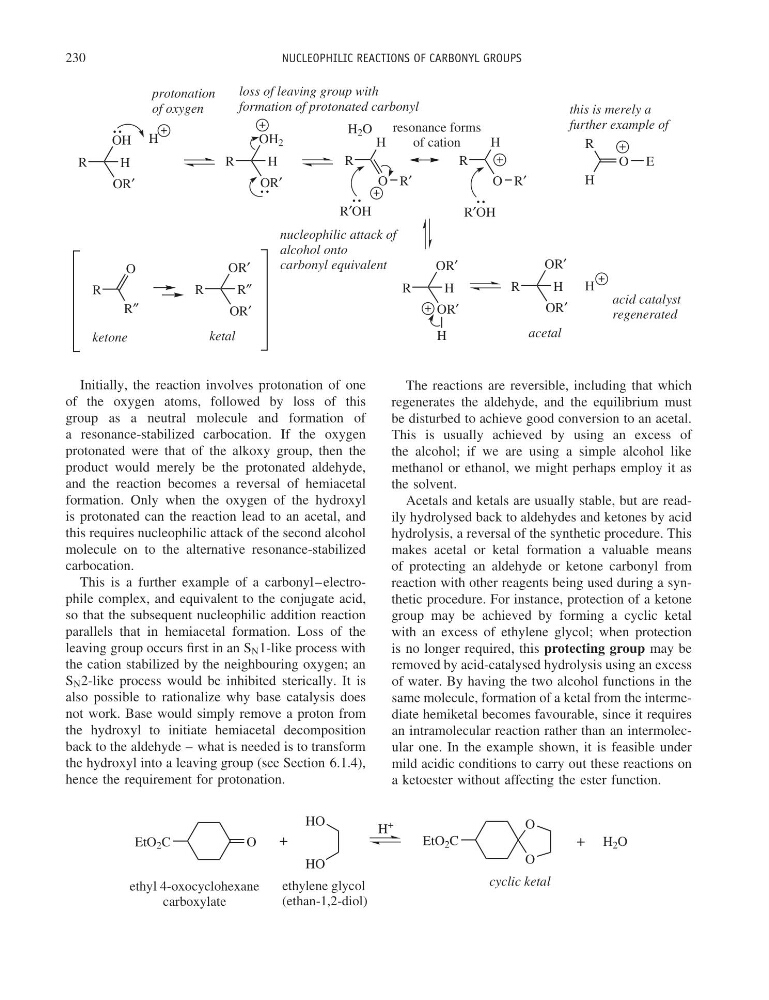
Initially, the reaction involves protonation of one
of the oxygen atoms, followed by loss of this
group as a neutral molecule and formation of
a resonance-stabilized carbocation. If the oxygen
protonated were that of the alkoxy group, then the
product would merely be the protonated aldehyde,
and the reaction becomes a reversal of hemiacetal
formation. Only when the oxygen of the hydroxyl
is protonated can the reaction lead to an acetal, and
this requires nucleophilic attack of the second alcohol
molecule on to the alternative resonance-stabilized
carbocation.
This is a further example of a carbonyl–electrophile complex, and equivalent to the conjugate acid,
so that the subsequent nucleophilic addition reaction
parallels that in hemiacetal formation. Loss of the
leaving group occurs first in an S N 1-like process with
the cation stabilized by the neighbouring oxygen; an
S N 2-like process would be inhibited sterically. It is
also possible to rationalize why base catalysis does
not work. Base would simply remove a proton from
the hydroxyl to initiate hemiacetal decomposition
back to the aldehyde – what is needed is to transform
the hydroxyl into a leaving group (see Section 6.1.4),
hence the requirement for protonation.
The reactions are reversible, including that which
regenerates the aldehyde, and the equilibrium must
be disturbed to achieve good conversion to an acetal.
This is usually achieved by using an excess of
the alcohol; if we are using a simple alcohol like
methanol or ethanol, we might perhaps employ it as
the solvent.
Acetals and ketals are usually stable, but are readily hydrolysed back to aldehydes and ketones by acid
hydrolysis, a reversal of the synthetic procedure. This
makes acetal or ketal formation a valuable means
of protecting an aldehyde or ketone carbonyl from
reaction with other reagents being used during a synthetic procedure. For instance, protection of a ketone
group may be achieved by forming a cyclic ketal
with an excess of ethylene glycol; when protection
is no longer required, this protecting group may be
removed by acid-catalysed hydrolysis using an excess
of water. By having the two alcohol functions in the
same molecule, formation of a ketal from the intermediate hemiketal becomes favourable, since it requires
an intramolecular reaction rather than an intermolecular one. In the example shown, it is feasible under
mild acidic conditions to carry out these reactions on
a ketoester without affecting the ester function.
O
HO
HO
O
O
cyclic ketal
+
ethylene glycol
(ethan-1,2-diol)
+
H
+
EtO 2 C
EtO 2 C
ethyl 4-oxocyclohexane
carboxylate
H 2 O
NUCLEOPHILIC REACTIONS OF CARBONYL GROUPS
R
OR′
OR′
R
OR′
OR′
H
R′OH
acetal
R
OR′
OH
protonation
of oxygen
loss of leaving group with
formation of protonated carbonyl
acid catalyst
regenerated
nucleophilic attack of
alcohol onto
carbonyl equivalent
R
OR′
OR′
R″
R
O
R″
ketone
ketal
resonance forms
of cation
this is merely a
further example of
R
OR′
OH 2
R
O
H
R′
R
O
H
R′
R′OH
O
H
R
E
H
H
H
H
H 2 O
H
H
Initially, the reaction involves protonation of one
of the oxygen atoms, followed by loss of this
group as a neutral molecule and formation of
a resonance-stabilized carbocation. If the oxygen
protonated were that of the alkoxy group, then the
product would merely be the protonated aldehyde,
and the reaction becomes a reversal of hemiacetal
formation. Only when the oxygen of the hydroxyl
is protonated can the reaction lead to an acetal, and
this requires nucleophilic attack of the second alcohol
molecule on to the alternative resonance-stabilized
carbocation.
This is a further example of a carbonyl–electrophile complex, and equivalent to the conjugate acid,
so that the subsequent nucleophilic addition reaction
parallels that in hemiacetal formation. Loss of the
leaving group occurs first in an S N 1-like process with
the cation stabilized by the neighbouring oxygen; an
S N 2-like process would be inhibited sterically. It is
also possible to rationalize why base catalysis does
not work. Base would simply remove a proton from
the hydroxyl to initiate hemiacetal decomposition
back to the aldehyde – what is needed is to transform
the hydroxyl into a leaving group (see Section 6.1.4),
hence the requirement for protonation.
The reactions are reversible, including that which
regenerates the aldehyde, and the equilibrium must
be disturbed to achieve good conversion to an acetal.
This is usually achieved by using an excess of
the alcohol; if we are using a simple alcohol like
methanol or ethanol, we might perhaps employ it as
the solvent.
Acetals and ketals are usually stable, but are readily hydrolysed back to aldehydes and ketones by acid
hydrolysis, a reversal of the synthetic procedure. This
makes acetal or ketal formation a valuable means
of protecting an aldehyde or ketone carbonyl from
reaction with other reagents being used during a synthetic procedure. For instance, protection of a ketone
group may be achieved by forming a cyclic ketal
with an excess of ethylene glycol; when protection
is no longer required, this protecting group may be
removed by acid-catalysed hydrolysis using an excess
of water. By having the two alcohol functions in the
same molecule, formation of a ketal from the intermediate hemiketal becomes favourable, since it requires
an intramolecular reaction rather than an intermolecular one. In the example shown, it is feasible under
mild acidic conditions to carry out these reactions on
a ketoester without affecting the ester function.
O
HO
HO
O
O
cyclic ketal
+
ethylene glycol
(ethan-1,2-diol)
+
H
+
EtO 2 C
EtO 2 C
ethyl 4-oxocyclohexane
carboxylate
H 2 O