

OXYGEN AS A NUCLEOPHILE: HEMIACETALS, HEMIKETALS, ACETALS AND KETALS
229
and similar derivatives of 2-deoxy-β-D-ribofuranose, the deoxynucleosides deoxyadenosine, deoxyguanosine,
deoxycytidine, and deoxythymidine, are the building blocks of deoxyribonucleic acids (DNA; see Section 14.1).
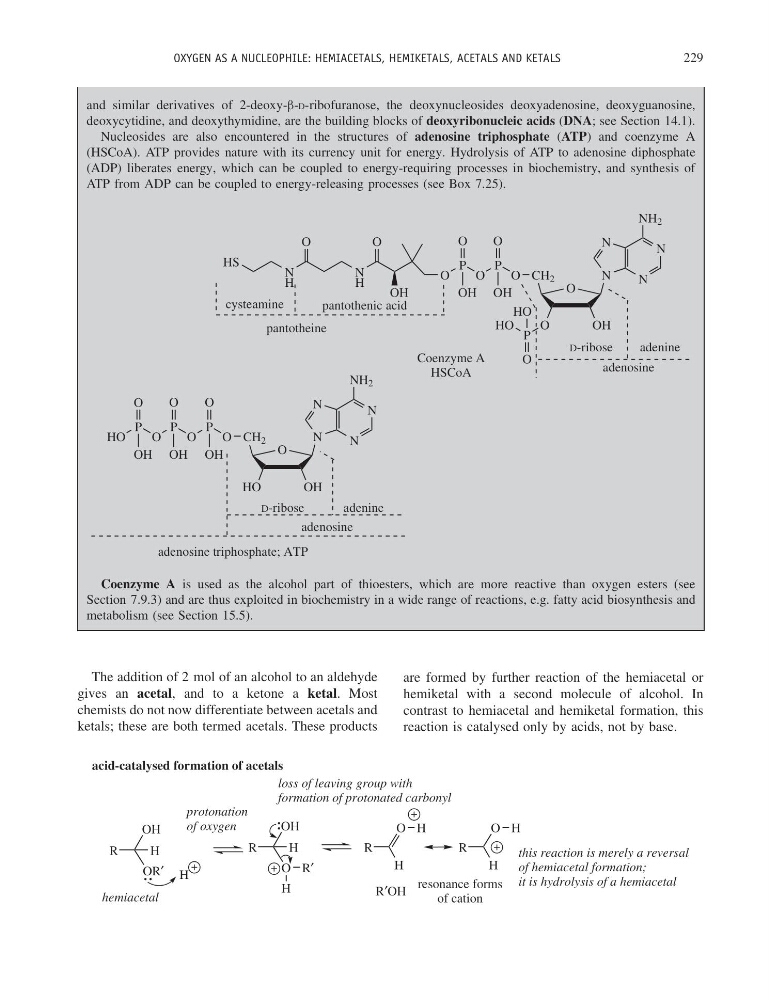
Nucleosides are also encountered in the structures of adenosine triphosphate (ATP) and coenzyme A
(HSCoA). ATP provides nature with its currency unit for energy. Hydrolysis of ATP to adenosine diphosphate
(ADP) liberates energy, which can be coupled to energy-requiring processes in biochemistry, and synthesis of
ATP from ADP can be coupled to energy-releasing processes (see Box 7.25).
N
N
N
NH 2
O
OH
N
CH 2
N
H
N
H
OH
O
O
HS
Coenzyme A
HSCoA
cysteamine
pantothenic acid
pantotheine
adenosine
adenine
D-ribose
N
N
N
NH 2
O
HO
OH
N
CH 2
adenosine triphosphate; ATP
adenosine
adenine
D-ribose
O
P
HO
O
P
O
O
OH OH
P
O
O
OH
O
P
O
O
OH
P
O
O
OH
O
P
HO
O
HO
Coenzyme A is used as the alcohol part of thioesters, which are more reactive than oxygen esters (see
Section 7.9.3) and are thus exploited in biochemistry in a wide range of reactions, e.g. fatty acid biosynthesis and
metabolism (see Section 15.5).
The addition of 2 mol of an alcohol to an aldehyde
gives an acetal, and to a ketone a ketal. Most
chemists do not now differentiate between acetals and
ketals; these are both termed acetals. These products
are formed by further reaction of the hemiacetal or
hemiketal with a second molecule of alcohol. In
contrast to hemiacetal and hemiketal formation, this
reaction is catalysed only by acids, not by base.
R
OR′
OH
R
O
H
H
resonance forms
of cation
hemiacetal
R′OH
acid-catalysed formation of acetals
protonation
of oxygen
loss of leaving group with
formation of protonated carbonyl
this reaction is merely a reversal
of hemiacetal formation;
it is hydrolysis of a hemiacetal
R
O
H
H
R
O
OH
H
R′
H
H
H
229
and similar derivatives of 2-deoxy-β-D-ribofuranose, the deoxynucleosides deoxyadenosine, deoxyguanosine,
deoxycytidine, and deoxythymidine, are the building blocks of deoxyribonucleic acids (DNA; see Section 14.1).
Nucleosides are also encountered in the structures of adenosine triphosphate (ATP) and coenzyme A
(HSCoA). ATP provides nature with its currency unit for energy. Hydrolysis of ATP to adenosine diphosphate
(ADP) liberates energy, which can be coupled to energy-requiring processes in biochemistry, and synthesis of
ATP from ADP can be coupled to energy-releasing processes (see Box 7.25).
N
N
N
NH 2
O
OH
N
CH 2
N
H
N
H
OH
O
O
HS
Coenzyme A
HSCoA
cysteamine
pantothenic acid
pantotheine
adenosine
adenine
D-ribose
N
N
N
NH 2
O
HO
OH
N
CH 2
adenosine triphosphate; ATP
adenosine
adenine
D-ribose
O
P
HO
O
P
O
O
OH OH
P
O
O
OH
O
P
O
O
OH
P
O
O
OH
O
P
HO
O
HO
Coenzyme A is used as the alcohol part of thioesters, which are more reactive than oxygen esters (see
Section 7.9.3) and are thus exploited in biochemistry in a wide range of reactions, e.g. fatty acid biosynthesis and
metabolism (see Section 15.5).
The addition of 2 mol of an alcohol to an aldehyde
gives an acetal, and to a ketone a ketal. Most
chemists do not now differentiate between acetals and
ketals; these are both termed acetals. These products
are formed by further reaction of the hemiacetal or
hemiketal with a second molecule of alcohol. In
contrast to hemiacetal and hemiketal formation, this
reaction is catalysed only by acids, not by base.
R
OR′
OH
R
O
H
H
resonance forms
of cation
hemiacetal
R′OH
acid-catalysed formation of acetals
protonation
of oxygen
loss of leaving group with
formation of protonated carbonyl
this reaction is merely a reversal
of hemiacetal formation;
it is hydrolysis of a hemiacetal
R
O
H
H
R
O
OH
H
R′
H
H
H