

228
NUCLEOPHILIC REACTIONS OF CARBONYL GROUPS
C
OH
H
OH
H
OH
H
CH 2 OH
H
OH
HO
O
OH
HO
O
OH
OH
HO
O
HO OH
Fischer projection
D-(+)-ribose
β-D-ribopyranose
α-D-ribopyranose
pyranose form
wavy bond indicates
either stereochemistry
OH
C
OH
H
OH
H
OH
H
CH 2 OH
H
O
5
1
conjugate acid
OH
OH
OH
O
pyran
H
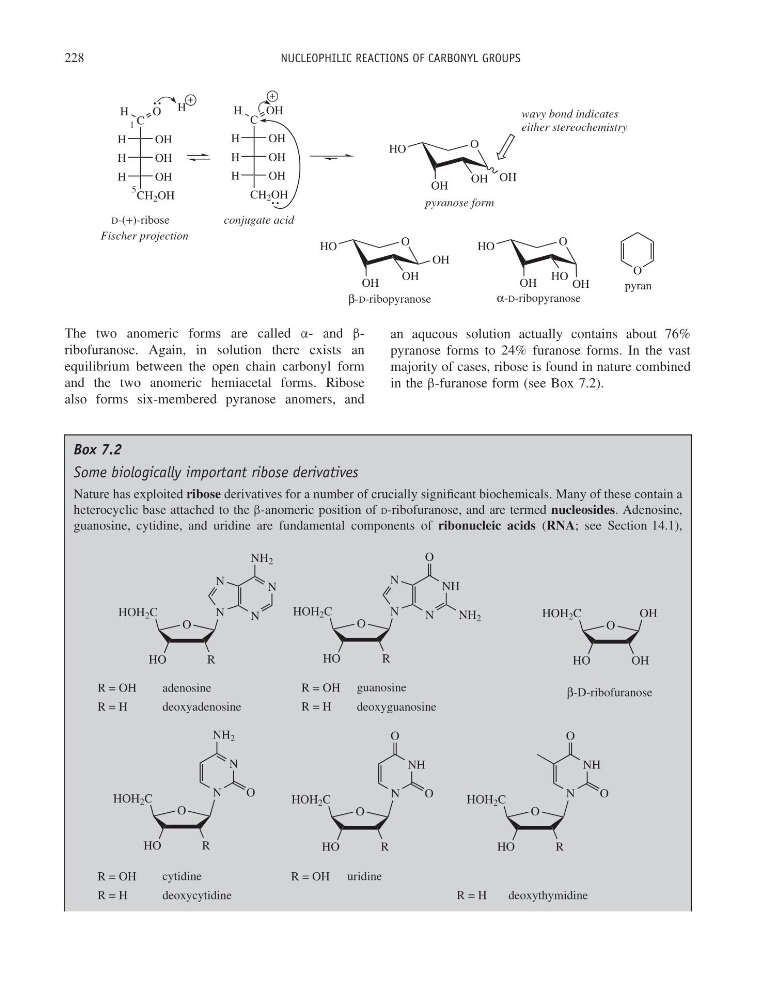
The two anomeric forms are called α- and βribofuranose. Again, in solution there exists an
equilibrium between the open chain carbonyl form
and the two anomeric hemiacetal forms. Ribose
also forms six-membered pyranose anomers, and
an aqueous solution actually contains about 76%
pyranose forms to 24% furanose forms. In the vast
majority of cases, ribose is found in nature combined
in the β-furanose form (see Box 7.2).
Box 7.2
Some biologically important ribose derivatives
Nature has exploited ribose derivatives for a number of crucially significant biochemicals. Many of these contain a
heterocyclic base attached to the β-anomeric position of D-ribofuranose, and are termed nucleosides. Adenosine,
guanosine, cytidine, and uridine are fundamental components of ribonucleic acids (RNA; see Section 14.1),
N
N
N
NH 2
O
HO
R
N
HOH 2 C
R = OH
R = H
N
NH
N
O
O
HO
R
N
HOH 2 C
NH 2
adenosine
deoxyadenosine
guanosine
deoxyguanosine
O
HO
R
HOH 2 C
N
NH
O
O
uridine
O
HO
R
HOH 2 C
N
NH
O
O
deoxythymidine
O
HO
R
HOH 2 C
N
N
NH 2
O
cytidine
deoxycytidine
R = OH
R = H
R = OH
R = H
R = OH
R = H
β-D-ribofuranose
O
HO
OH
OH
HOH 2 C
NUCLEOPHILIC REACTIONS OF CARBONYL GROUPS
C
OH
H
OH
H
OH
H
CH 2 OH
H
OH
HO
O
OH
HO
O
OH
OH
HO
O
HO OH
Fischer projection
D-(+)-ribose
β-D-ribopyranose
α-D-ribopyranose
pyranose form
wavy bond indicates
either stereochemistry
OH
C
OH
H
OH
H
OH
H
CH 2 OH
H
O
5
1
conjugate acid
OH
OH
OH
O
pyran
H
The two anomeric forms are called α- and βribofuranose. Again, in solution there exists an
equilibrium between the open chain carbonyl form
and the two anomeric hemiacetal forms. Ribose
also forms six-membered pyranose anomers, and
an aqueous solution actually contains about 76%
pyranose forms to 24% furanose forms. In the vast
majority of cases, ribose is found in nature combined
in the β-furanose form (see Box 7.2).
Box 7.2
Some biologically important ribose derivatives
Nature has exploited ribose derivatives for a number of crucially significant biochemicals. Many of these contain a
heterocyclic base attached to the β-anomeric position of D-ribofuranose, and are termed nucleosides. Adenosine,
guanosine, cytidine, and uridine are fundamental components of ribonucleic acids (RNA; see Section 14.1),
N
N
N
NH 2
O
HO
R
N
HOH 2 C
R = OH
R = H
N
NH
N
O
O
HO
R
N
HOH 2 C
NH 2
adenosine
deoxyadenosine
guanosine
deoxyguanosine
O
HO
R
HOH 2 C
N
NH
O
O
uridine
O
HO
R
HOH 2 C
N
NH
O
O
deoxythymidine
O
HO
R
HOH 2 C
N
N
NH 2
O
cytidine
deoxycytidine
R = OH
R = H
R = OH
R = H
R = OH
R = H
β-D-ribofuranose
O
HO
OH
OH
HOH 2 C