

OXYGEN AS A NUCLEOPHILE: HEMIACETALS, HEMIKETALS, ACETALS AND KETALS
227
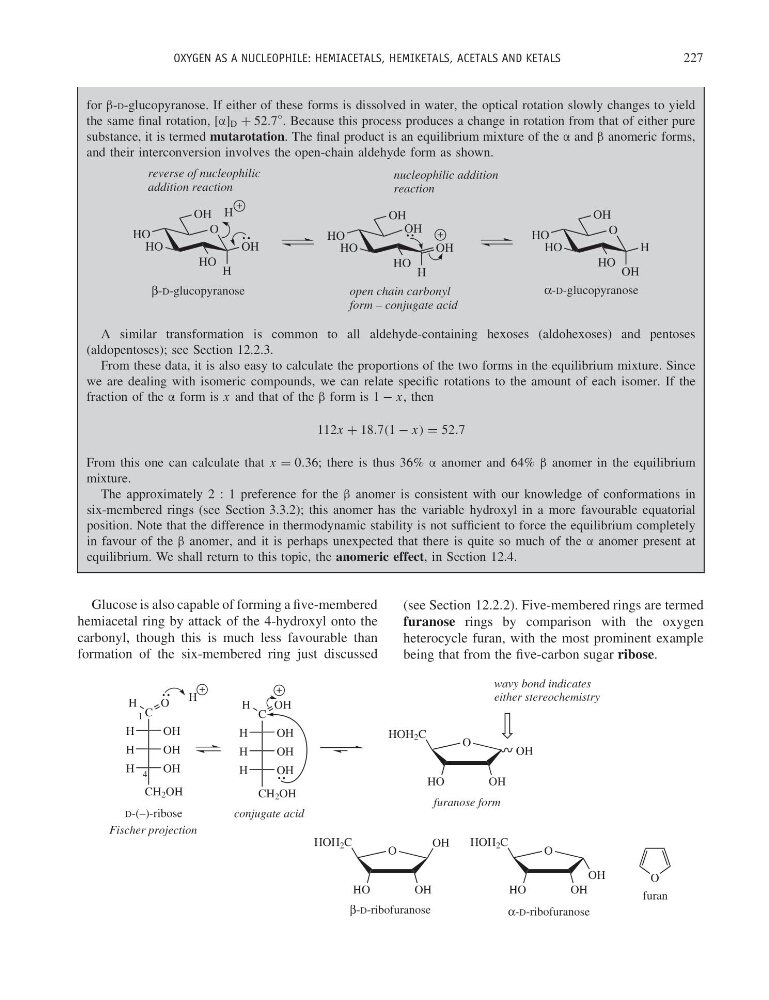
for β-D-glucopyranose. If either of these forms is dissolved in water, the optical rotation slowly changes to yield
the same final rotation, [α] D + 52.7
◦ . Because this process produces a change in rotation from that of either pure
substance, it is termed mutarotation. The final product is an equilibrium mixture of the α and β anomeric forms,
and their interconversion involves the open-chain aldehyde form as shown.
O
HO
HO
HO
OH
OH
OH
HO
HO
HO
OH
OH
O
HO
HO
HO
H
OH
H
H
OH
α-D-glucopyranose
β-D-glucopyranose
reverse of nucleophilic
addition reaction
nucleophilic addition
reaction
open chain carbonyl
form – conjugate acid
H
A similar transformation is common to all aldehyde-containing hexoses (aldohexoses) and pentoses
(aldopentoses); see Section 12.2.3.
From these data, it is also easy to calculate the proportions of the two forms in the equilibrium mixture. Since
we are dealing with isomeric compounds, we can relate specific rotations to the amount of each isomer. If the
fraction of the α form is x and that of the β form is 1 − x, then
112x + 18.7(1 − x) = 52.7
From this one can calculate that x = 0.36; there is thus 36% α anomer and 64% β anomer in the equilibrium
mixture.
The approximately 2 : 1 preference for the β anomer is consistent with our knowledge of conformations in
six-membered rings (see Section 3.3.2); this anomer has the variable hydroxyl in a more favourable equatorial
position. Note that the difference in thermodynamic stability is not sufficient to force the equilibrium completely
in favour of the β anomer, and it is perhaps unexpected that there is quite so much of the α anomer present at
equilibrium. We shall return to this topic, the anomeric effect, in Section 12.4.
Glucose is also capable of forming a five-membered
hemiacetal ring by attack of the 4-hydroxyl onto the
carbonyl, though this is much less favourable than
formation of the six-membered ring just discussed
(see Section 12.2.2). Five-membered rings are termed
furanose rings by comparison with the oxygen
heterocycle furan, with the most prominent example
being that from the five-carbon sugar ribose.
C
OH
H
OH
H
OH
H
CH 2 OH
H
OH
O
HOH 2 C
HO
OH
OH
O
O
HOH 2 C
HO
OH
O
HOH 2 C
HO
OH
OH
OH
D-(–)-ribose
Fischer projection
furanose form
β-D-ribofuranose
α-D-ribofuranose
furan
wavy bond indicates
either stereochemistry
C
OH
H
OH
H
OH
H
CH 2 OH
H
O
conjugate acid
4
1
H
227
for β-D-glucopyranose. If either of these forms is dissolved in water, the optical rotation slowly changes to yield
the same final rotation, [α] D + 52.7
◦ . Because this process produces a change in rotation from that of either pure
substance, it is termed mutarotation. The final product is an equilibrium mixture of the α and β anomeric forms,
and their interconversion involves the open-chain aldehyde form as shown.
O
HO
HO
HO
OH
OH
OH
HO
HO
HO
OH
OH
O
HO
HO
HO
H
OH
H
H
OH
α-D-glucopyranose
β-D-glucopyranose
reverse of nucleophilic
addition reaction
nucleophilic addition
reaction
open chain carbonyl
form – conjugate acid
H
A similar transformation is common to all aldehyde-containing hexoses (aldohexoses) and pentoses
(aldopentoses); see Section 12.2.3.
From these data, it is also easy to calculate the proportions of the two forms in the equilibrium mixture. Since
we are dealing with isomeric compounds, we can relate specific rotations to the amount of each isomer. If the
fraction of the α form is x and that of the β form is 1 − x, then
112x + 18.7(1 − x) = 52.7
From this one can calculate that x = 0.36; there is thus 36% α anomer and 64% β anomer in the equilibrium
mixture.
The approximately 2 : 1 preference for the β anomer is consistent with our knowledge of conformations in
six-membered rings (see Section 3.3.2); this anomer has the variable hydroxyl in a more favourable equatorial
position. Note that the difference in thermodynamic stability is not sufficient to force the equilibrium completely
in favour of the β anomer, and it is perhaps unexpected that there is quite so much of the α anomer present at
equilibrium. We shall return to this topic, the anomeric effect, in Section 12.4.
Glucose is also capable of forming a five-membered
hemiacetal ring by attack of the 4-hydroxyl onto the
carbonyl, though this is much less favourable than
formation of the six-membered ring just discussed
(see Section 12.2.2). Five-membered rings are termed
furanose rings by comparison with the oxygen
heterocycle furan, with the most prominent example
being that from the five-carbon sugar ribose.
C
OH
H
OH
H
OH
H
CH 2 OH
H
OH
O
HOH 2 C
HO
OH
OH
O
O
HOH 2 C
HO
OH
O
HOH 2 C
HO
OH
OH
OH
D-(–)-ribose
Fischer projection
furanose form
β-D-ribofuranose
α-D-ribofuranose
furan
wavy bond indicates
either stereochemistry
C
OH
H
OH
H
OH
H
CH 2 OH
H
O
conjugate acid
4
1
H