

226
NUCLEOPHILIC REACTIONS OF CARBONYL GROUPS
Table 7.1 Hydroxyaldehyde–cyclic hemiacetal equilibria
Hydroxyaldehyde Hemiacetal Ring
size
% Hemiacetal
at equilibrium
HO CHO
O
H
OH
4
0
CHO
OH
O
H
OH
5
8 9
CHO
OH
O OH
H
6
9 4
CHO
OH
O
OH
H
7
1 5
However, as seen in Table 7.1, rings other than fiveand six-membered are either not formed or are not
particularly favoured.
A vast range of natural sugars exemplify these
cyclic addition products. A typical sugar exists
predominantly in the form of a hemiacetal or
hemiketal in solution, although this is an equilibrium
reaction, and the open chain carbonyl form is always
present to a small extent (<1%). The formation of
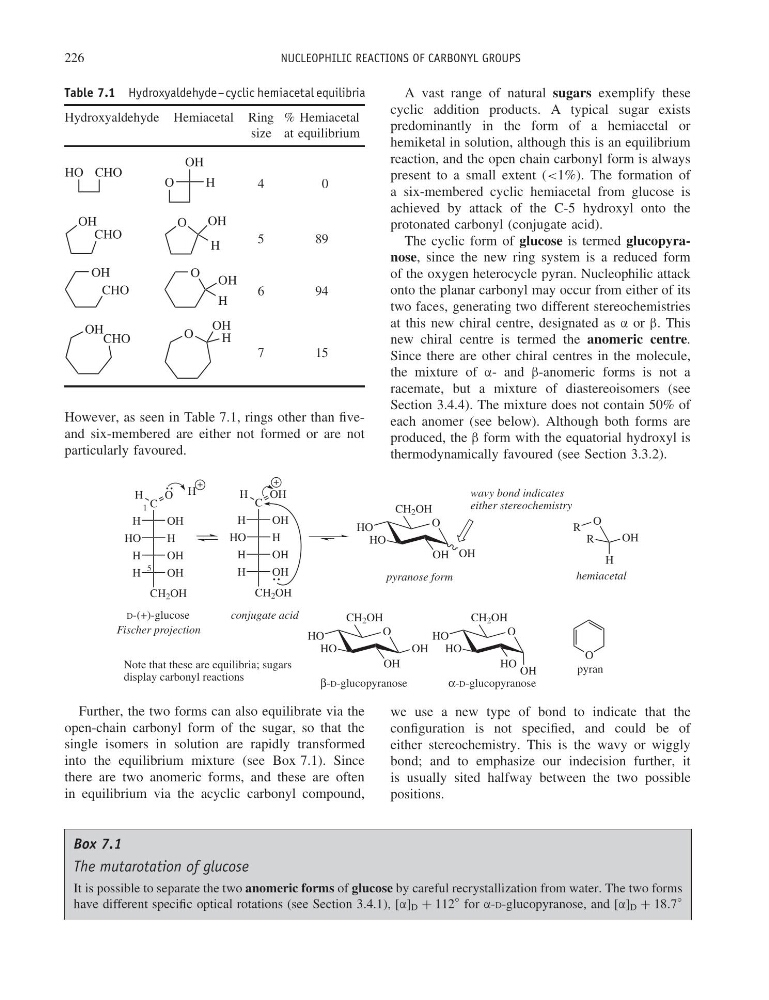
a six-membered cyclic hemiacetal from glucose is
achieved by attack of the C-5 hydroxyl onto the
protonated carbonyl (conjugate acid).
The cyclic form of glucose is termed glucopyranose, since the new ring system is a reduced form
of the oxygen heterocycle pyran. Nucleophilic attack
onto the planar carbonyl may occur from either of its
two faces, generating two different stereochemistries
at this new chiral centre, designated as α or β. This
new chiral centre is termed the anomeric centre.
Since there are other chiral centres in the molecule,
the mixture of α- and β-anomeric forms is not a
racemate, but a mixture of diastereoisomers (see
Section 3.4.4). The mixture does not contain 50% of
each anomer (see below). Although both forms are
produced, the β form with the equatorial hydroxyl is
thermodynamically favoured (see Section 3.3.2).
C
OH
H
H
HO
OH
H
H
OH
CH 2 OH
H
OH
HO
O
HO
OH
CH 2 OH
HO
O
HO
OH
CH 2 OH
OH
HO
O
HO
HO
CH 2 OH
OH
O
Fischer projection
D-(+)-glucose
pyran
β-D-glucopyranose
α-D-glucopyranose
pyranose form
wavy bond indicates
either stereochemistry
OH
C
OH
H
H
HO
OH
H
H
OH
CH 2 OH
H
O
5
1
conjugate acid
Note that these are equilibria; sugars
display carbonyl reactions
O
R
OH
R
hemiacetal
H
H
Further, the two forms can also equilibrate via the
open-chain carbonyl form of the sugar, so that the
single isomers in solution are rapidly transformed
into the equilibrium mixture (see Box 7.1). Since
there are two anomeric forms, and these are often
in equilibrium via the acyclic carbonyl compound,
we use a new type of bond to indicate that the
configuration is not specified, and could be of
either stereochemistry. This is the wavy or wiggly
bond; and to emphasize our indecision further, it
is usually sited halfway between the two possible
positions.
Box 7.1
The mutarotation of glucose
It is possible to separate the two anomeric forms of glucose by careful recrystallization from water. The two forms
have different specific optical rotations (see Section 3.4.1), [α] D + 112
◦ for α-D-glucopyranose, and [α] D + 18.7
◦
NUCLEOPHILIC REACTIONS OF CARBONYL GROUPS
Table 7.1 Hydroxyaldehyde–cyclic hemiacetal equilibria
Hydroxyaldehyde Hemiacetal Ring
size
% Hemiacetal
at equilibrium
HO CHO
O
H
OH
4
0
CHO
OH
O
H
OH
5
8 9
CHO
OH
O OH
H
6
9 4
CHO
OH
O
OH
H
7
1 5
However, as seen in Table 7.1, rings other than fiveand six-membered are either not formed or are not
particularly favoured.
A vast range of natural sugars exemplify these
cyclic addition products. A typical sugar exists
predominantly in the form of a hemiacetal or
hemiketal in solution, although this is an equilibrium
reaction, and the open chain carbonyl form is always
present to a small extent (<1%). The formation of
a six-membered cyclic hemiacetal from glucose is
achieved by attack of the C-5 hydroxyl onto the
protonated carbonyl (conjugate acid).
The cyclic form of glucose is termed glucopyranose, since the new ring system is a reduced form
of the oxygen heterocycle pyran. Nucleophilic attack
onto the planar carbonyl may occur from either of its
two faces, generating two different stereochemistries
at this new chiral centre, designated as α or β. This
new chiral centre is termed the anomeric centre.
Since there are other chiral centres in the molecule,
the mixture of α- and β-anomeric forms is not a
racemate, but a mixture of diastereoisomers (see
Section 3.4.4). The mixture does not contain 50% of
each anomer (see below). Although both forms are
produced, the β form with the equatorial hydroxyl is
thermodynamically favoured (see Section 3.3.2).
C
OH
H
H
HO
OH
H
H
OH
CH 2 OH
H
OH
HO
O
HO
OH
CH 2 OH
HO
O
HO
OH
CH 2 OH
OH
HO
O
HO
HO
CH 2 OH
OH
O
Fischer projection
D-(+)-glucose
pyran
β-D-glucopyranose
α-D-glucopyranose
pyranose form
wavy bond indicates
either stereochemistry
OH
C
OH
H
H
HO
OH
H
H
OH
CH 2 OH
H
O
5
1
conjugate acid
Note that these are equilibria; sugars
display carbonyl reactions
O
R
OH
R
hemiacetal
H
H
Further, the two forms can also equilibrate via the
open-chain carbonyl form of the sugar, so that the
single isomers in solution are rapidly transformed
into the equilibrium mixture (see Box 7.1). Since
there are two anomeric forms, and these are often
in equilibrium via the acyclic carbonyl compound,
we use a new type of bond to indicate that the
configuration is not specified, and could be of
either stereochemistry. This is the wavy or wiggly
bond; and to emphasize our indecision further, it
is usually sited halfway between the two possible
positions.
Box 7.1
The mutarotation of glucose
It is possible to separate the two anomeric forms of glucose by careful recrystallization from water. The two forms
have different specific optical rotations (see Section 3.4.1), [α] D + 112
◦ for α-D-glucopyranose, and [α] D + 18.7
◦